150 Free Spins No Deposit UK: What the Promotion Actually Delivers
 Available in GB
A “150 free spins no deposit” headline lands in a UK inbox like a free drink token. It looks weightless, but it carries a price tag — and the price tag is the wagering requirement, the win cap, the eligibility checks and the licence behind it. This page is built around what that tag costs the person paying it, and around the only legal route through which it can reach a UK player in the first place. It compares ten Gambling Commission licensees on the matters that change the experience of claiming such a promotion, then walks through the conditions that sit on top of any offer of this shape.

Currency, dates and licence data current as of 23 September 2026, verified against the Gambling Commission’s public register of gambling businesses.
Table of Contents
- The Legal Gate: Why a UK Offer Has to Be Commission-Licensed
- Responsible Gambling: GAMSTOP and the Surrounding Safeguards
- Payments and Payout Speed
- What a 150 Free Spins Offer Is — and What the Fine Print Does to It
- Ten UK-Licensed Operators Compared
- Brand-by-Brand Read
- Reading the Bonus Terms Before Claiming
- Tax and What the Operator Pays
- Offshore Sites and the Gap They Leave
- Frequently Asked Questions
The Legal Gate: Why a UK Offer Has to Be Commission-Licensed
A casino offering 150 free spins with no deposit to a player in Great Britain is offering a remote casino game. The Gambling Act 2005, extended to offshore operators by the Gambling (Licensing and Advertising) Act 2014, requires anyone taking customers in England, Scotland or Wales to hold a Gambling Commission licence — wherever the operator is based. A Curaçao, Maltese or Gibraltar credential does not substitute. Section 33 of the Act makes providing gambling to people in Great Britain without such a licence a criminal offence, and the Commission’s own response is to disrupt illegal sites through cease-and-desist notices, search-engine delisting, and payment and hosting referrals; it does not have ISP-blocking power, and it does not penalise the player. What the player loses on an unlicensed site, in practice, is the protection a licence brings: no GAMSTOP, no Commission complaints route, no approved alternative dispute resolution.

The register is the test. The Commission’s public register of gambling businesses lists every active account, the licence it holds and the domains it operates. On 18 September 2026, that register recorded 139 businesses holding an active remote casino operating licence, and the same register’s domain list held 1065 active and 361 white-label domain entries — a white-label site trades under another company’s licence and is therefore not a separate licensee in its own right. A remote casino licence number has the shape account-R-number-suffix, where the first six digits repeat the licence holder’s account number and the R marks a remote (online) licence. Every brand featured later on this page carries a number in that format, and every one of those numbers was on the register on the date this page was written.
Beyond the licence itself, a UK player faces a stack of identity and affordability checks before the first spin. The minimum age is 18; name, address and date of birth must be verified before the first deposit or any play, a rule that has stood since 7 May 2019. Credit cards have been banned for gambling since 14 April 2020 — including credit-card balances routed through e-wallets — which is why every payment method discussed below is a debit, a transfer or a wallet, never a credit line.
Responsible Gambling: GAMSTOP and the Surrounding Safeguards
A 150-spin no-deposit promotion is still a bet, and the safer-gambling architecture that wraps around any other bet wraps around this one too. GAMSTOP, the national online self-exclusion scheme, is a mandatory condition of every online operating licence. Registration blocks the player from opening new accounts with any UK-licensed operator for the chosen period — six months, one year or five years — and cannot be cancelled early. A 150 no-deposit free spins offer carries no exception to that block, which is the answer to anyone asking whether they can take a “free” trial while self-excluded: the registration covers the offer, the operator enforces the block on the register at the point of signup, and the spin simply does not credit.

Below the self-exclusion ceiling sit the day-to-day tools: deposit limits, time-outs and reality checks are all operator-implemented. The Commission does not set a state-wide deposit or loss ceiling, but since 31 October 2025 operators have had to prompt a customer to set a financial limit before the first deposit. Financial vulnerability checks run automatically once a player has deposited £150 net in a rolling 30-day window, a rule in force from 28 February 2025 using public data only; the wider financial risk assessments are announced but not yet live. Auto-play is banned, slot spins may not be faster than 2.5 seconds, and losses disguised as wins are banned. The first time a 150-spin offer is claimed, these are the rails the play runs on.
Help is reachable through GamCare (the National Gambling Helpline) and GambleAware. The Commission’s role is regulatory; the support organisations run the practical end. A reader considering any promotion on this page, including a no-stake trial, who notices the offer pulling them past a planned spend, has somewhere to go before the spend becomes a habit.
Payments and Payout Speed
A no-deposit promotion looks like a free entry into a slot, but the winnings are not free money: they sit behind a wagering requirement, and once cleared they have to be withdrawn. The withdrawal rails matter because they decide how fast the cleared funds reach the player’s account, and which payment methods the operator actually pays out to.
Bank transfers within the UK typically move through the Faster Payments Service, launched in 2008 and operated by Pay.UK. The scheme runs around the clock, most payments arrive instantly or within a couple of minutes, and a transfer can occasionally take up to two hours. The per-transaction limit set by the scheme itself is £1,000,000, though individual banks impose lower customer-level limits. The Bank of England oversees the system’s safety and final settlement without being a direct participant. For casino withdrawals, Faster Payments is the rail that drives most “same-day” claims.
Apple Pay sits in a different place. It was developed and operated by Apple Inc. and launched on 20 October 2014, initially supporting only US-issued payment cards; UK card support followed on 14 July 2015. Card data is protected through tokenization — the actual card number is replaced with a device-specific Device Primary Account Number, and a dynamic security code is generated for each transaction. In-store payments use near-field communication; a supported card from a participating issuer is required, and Apple Pay is not available in every market. For online casino use, the practical reality is that Apple Pay is a deposit front-end, not a withdrawal destination at most operators — payouts go back to a bank account, often via Faster Payments, rather than back to the Apple Pay wallet.
AstroPay is the third rail worth knowing. The company was founded in 2009 and is headquartered in Uruguay, and operates as a global digital wallet offering online payments, virtual and physical debit cards, and peer-to-peer transfers. Its UK entity, Larstal Limited, is an electronic money institution authorised by the Financial Conduct Authority under the Electronic Money Regulations 2011; its Isle of Man entity, AstroPay Global (IOM) Limited, is licensed by the Isle of Man Financial Services Authority for money transmission; its Brazilian arm is authorised by the Brazilian Central Bank as an electronic currency issuer; and its Danish entity holds the equivalent Danish authorisation. The point for a UK reader is that AstroPay deposits work where the operator supports them, but the same credit-card ban of 14 April 2020 still governs which cards can fund the wallet in the first place.
The withdrawal picture, then, comes down to Faster Payments for most UK bank accounts, with e-wallets and cards available where the operator allows them, and with no shortcut past the operator’s own pending-time window before the rail takes over. Anonymous play is not possible at a licensed site, which is the reason a bank account in the player’s own name usually has to be in place before the first withdrawal, no-deposit or otherwise.
What a 150 Free Spins Offer Is — and What the Fine Print Does to It
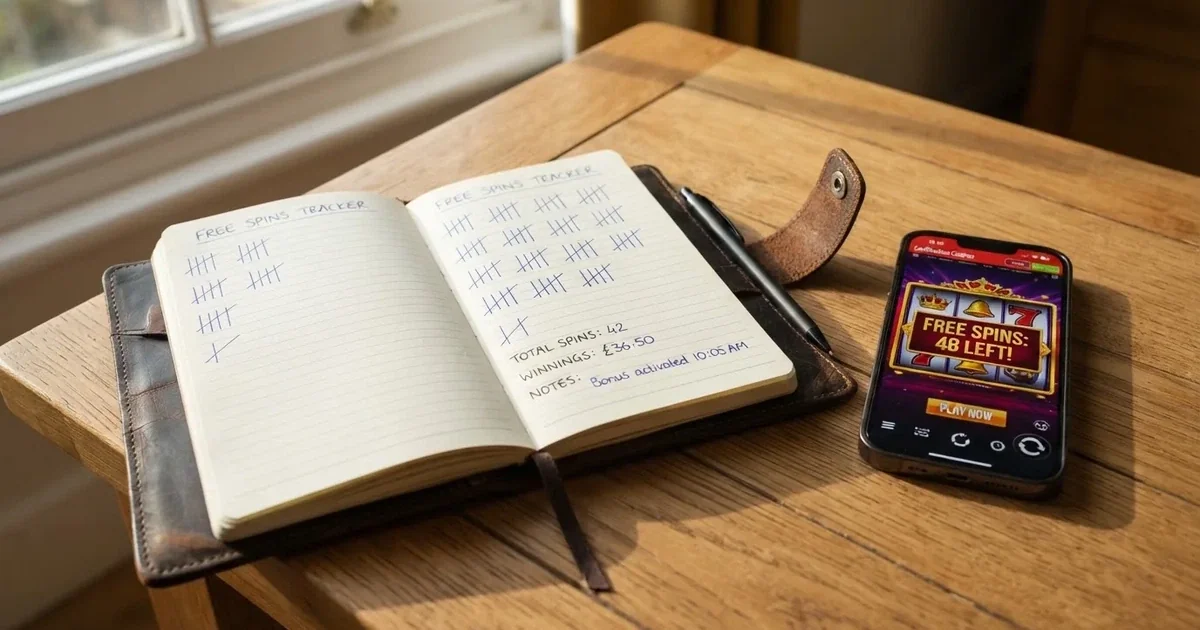
A “no deposit” offer means exactly that: the player is not asked to deposit before the spins credit. What the player often does not realise on first reading is the size of the wagering requirement and the cap on winnings that sit on top of the win. These two terms convert “150 free spins” from a free trial into a calculated exercise in clearing conditions.
Wagering is the multiplier applied to winnings before they can be withdrawn. A 35x requirement on £10 of spin winnings means £350 of qualifying bets before cash-out. The Commission capped wagering requirements at 10x and banned mixed-product bonuses (bet on sport, get casino spins, and so on) from 19 December 2025. That ceiling is the single most important number on a UK offer of this shape: anything above 10x is not lawful, and the cap applies uniformly across every GB-licensed operator. The practical implication is that the worst-case requirement is now modest by international standards, though it is still a real barrier between spin winnings and a withdrawal.
A win cap is the second lever. Many no-deposit promotions limit the amount that can be converted from bonus funds to withdrawable cash — sometimes to a fixed sum, sometimes to a multiple of the bonus value. Once the cap is reached, additional spin winnings either drop off or contribute to the bonus balance without paying out. The cap’s size and the wagering multiplier together decide how much of the headline number a player will ever see.
Game weightings are the third lever, and the one operators vary most. Not every slot contributes 100% of each £1 wagered to clearing the requirement; some contribute 50%, some 10%, some 0%. The 150-spin allocation may also be split across several games rather than concentrated on a single title. Reading the contribution table is the single highest-yield piece of pre-claim reading on this kind of offer.
Expiry is the silent one. Spins credited on registration typically have a short window in which they must be used — 24 hours, 48 hours, seven days — and the wagering requirement that sits on top of any winnings has its own clock. Letting either run out forfeits the lot. A 150-spin offer that looks generous on day one can be worth nothing on day eight if the wagering has not been cleared.
Game-cycle stake limits apply across the offer, not just on the deposited balance. From 9 April 2025, players aged 25 and over face a maximum stake of £5 per game cycle on online slots; the 18–24 cohort faces £2 from 21 May 2025. These caps apply to the bonus balance too, which is one of the reasons a wagering requirement can take longer to clear than the headline spin count suggests — every wager counts toward the requirement, but each one is capped in size.
The 10x Turnover Band
The wagering-turnover-band calculation the Commission put in force from 19 December 2025 anchors every lawful UK bonus to the same ceiling. Take a hypothetical £10 in spin winnings subject to the 10x cap: the player must place £100 of qualifying wagers before that £10 becomes withdrawable. Where the spin winnings run higher, the band widens proportionally; £20 in winnings means £200 of qualifying wagers, and so on.
That is the most useful single number on the page, because it puts every offer in front of the same ruler. A 65x requirement that was common in the offshore market is now simply not lawful in Great Britain, and the 10x ceiling is the only lawful UK rate above zero. The number does not say how much the offer pays out, and it does not say how long the playthrough takes. What it says is that the gap between the marketing headline and the cleared cash is, at most, a tenfold turnover — a number a reader can hold against any specific term they see on a specific promotion.
The time that gap takes to walk through depends on game cycle length and stake size. A £2 stake per spin at the lower age-tier cap, with spins running at the 2.5-second floor, clears £100 of wagering in 50 spins, which is just over two minutes of pure spin time. In practice, the clearing time is dominated by the win rate, not the spin rate, and a player who hits few winning combinations will see the requirement cleared slowly or not at all.
Ten UK-Licensed Operators Compared
The table below compares ten Gambling Commission licensees that are the obvious places a reader will look first when shopping a 150-spin offer. It is not a ranking, and it is not a recommendation — it is a side-by-side of the data the Commission’s own register carries for each, plus a column for whether the operator has any documented link to no-deposit free-spin promotions in this market. Where that link is not on the public register, the cell stays empty: the operator appears on its other fields, and the absence speaks for itself.
| Brand | Licence holder and GB remote casino licence | Domain status on the register | Subject support |
|---|---|---|---|
| PokerStars | Stars Interactive Limited · 039108-R-319334-026 | Active (Pokerstars.uk) | — |
| Betfred | Petfre (Gibraltar) Limited · 039544-R-319290-010 | Active (Betfred.com) | — |
| Betfair | PPB Games Limited · 039411-R-319335-010 | Active (Betfair.com) | — |
| bet365 | Hillside (UK Gaming) ENC · 055149-R-331499-004 | Active (Bet365.com) | — |
| Unibet | Platinum Gaming Limited · 045322-R-324275-019 | Active (unibet.co.uk) | — |
| Coral | LC International Limited · 054743-R-330863-014 | Active (coral.co.uk) | — |
| Casumo | Recro Limited · 061549-R-336718-002 | Active (Casumo.com) | — |
| 888casino | 888 UK Limited · 039028-R-319297-014 | Active (888casino) | — |
| kwiff | Eaton Gate Gaming Limited · 044448-R-323408-017 | Active (Kwiff.com) | — |
| Midnite | Dribble Media Limited · 042647-R-321653-022 | Active (Midnite.com) | — |
The subject-support column is empty across the board, and that is the point of the table. The Commission’s public register tells a reader who is licensed and on what domain; it does not tell a reader who is running a 150-spin no-deposit promotion in 2026. The only honest move is to leave the column blank and let the rest of the table — names, account numbers, licence suffixes and domain statuses — carry the comparison on its own terms.
Several of the listed brands sit under the same parent. Coral is one of three brands on the list that share LC International Limited as their licence holder, alongside Ladbrokes and Gala Bingo off-list. None of that changes what an individual player sees at signup, but it does mean the licensee-level discipline the Commission applies runs across all the brands under that licence, which is a quiet form of consumer protection worth knowing about.
Brand-by-Brand Read
The notes below are drawn from the Commission’s register and the licensing framework above. They describe each brand on what is verifiable from those sources, and stop where that data stops.
PokerStars
Stars Interactive Limited runs Pokerstars.uk as an active domain under account 39108, holding the remote casino operating licence 039108-R-319334-026. The Stars brand is best known for poker, but the casino vertical sits on the same licence and the same age and verification regime. A 150-spin no-deposit offer at this brand, if one runs in 2026, is wrapped in the same 10x wagering ceiling as every other GB-licensed promotion and the same Faster Payments withdrawal rail once clearing is done. The brand’s own strength is volume of play across poker and casino; the offer’s strength, such as it is, comes from the licence ceiling rather than the brand name.
Betfred
Betfred.com is listed as an active domain of Petfre (Gibraltar) Limited (account 39544), holding remote casino licence 039544-R-319290-010. The Gibraltar incorporation is the only non-UK element here: the licence is still a Gambling Commission licence, and Gibraltar-based operators have been on the same footing as UK-incorporated ones since the Gambling (Licensing and Advertising) Act 2014. The bookmaking heritage is the brand’s distinguishing feature, and the casino vertical grew into it rather than out of it. A 150-spin trial here would clear through the same conditions as any other licensed offer.
Betfair
PPB Games Limited (account 39411) holds remote casino licence 039411-R-319335-010, with Betfair.com as an active domain. The exchange heritage is what marks the brand apart: Betfair built its name on peer-to-peer betting, and the casino vertical sits alongside rather than at the centre. For a reader who already uses the exchange, the casino tab is one click away; for a reader who does not, the casino’s terms carry no advantage from the exchange history.
bet365
Hillside (UK Gaming) ENC (account 55149) holds remote casino licence 055149-R-331499-004, with Bet365.com as an active domain. The brand sits at the upper end of the market on volume and reach, and the licence is held by a UK-incorporated entity. A 150-spin offer at this brand would inherit the same wagering ceiling and same identity-verification flow as any other UK-licensed promotion, but would also benefit from the in-house speed of the operator’s own withdrawal processing.
Unibet
Platinum Gaming Limited (account 45322) holds remote casino licence 045322-R-324275-019, with unibet.co.uk as an active domain. The Kindred Group parent is the brand’s distinguishing fact, with a multi-jurisdiction footprint behind the UK front. The UK-registered domain and the Commission licence are what govern a 150-spin offer here; the parent’s other markets are irrelevant to the wagering ceiling that sits on top of any UK promotion.
Coral
LC International Limited (account 54743) holds remote casino licence 054743-R-330863-014, with coral.co.uk as an active domain. Coral is one of three high-street names under the same licence holder, alongside Ladbrokes and Gala Bingo, which means the compliance regime the Commission applies runs across all three brands at once. For a reader choosing between them on a 150-spin offer, the only honest distinction is the look of the site and the games available; the licence conditions, the safer-gambling tools and the withdrawal rails are identical.
Casumo
Recro Limited (account 61549) holds remote casino licence 061549-R-336718-002, with Casumo.com as an active domain. The brand was built around the casino vertical from the start, which is the relevant distinction in this list: most of the others are bookmakers with a casino tab; Casumo is a casino brand. A 150-spin no-deposit offer at Casumo, if one runs, would sit alongside a games catalogue that is the brand’s reason to exist.
888casino
888 UK Limited (account 39028) holds remote casino licence 039028-R-319297-014, with 888casino as an active domain. The 888 group has been on the UK register for long enough that the licence suffix has grown to a high two-digit number; the suffix is just a count of variations on the licence over time and is not itself a quality signal. The brand’s position in the market is as one of the longer-standing pure-play casino names.
kwiff
Eaton Gate Gaming Limited (account 44448) holds remote casino licence 044448-R-323408-017, with Kwiff.com as an active domain. The brand markets itself around “surprise” odds boosts and a quirkier product, which is the distinguishing fact; the licence conditions are exactly the same as every other row in this table. A 150-spin offer here, if one runs, would clear through the same wagering ceiling as everyone else’s.
Midnite
Dribble Media Limited (account 42647) holds remote casino licence 042647-R-321653-022, with Midnite.com as an active domain. Midnite is one of the newer entrants on this list, and the smaller account number tells a reader nothing more than when the licence was first granted. The Commission treats new and long-standing licensees on the same terms, and a 150-spin trial at a newer brand carries no extra or lesser protection than the same offer at an older one.
Reading the Bonus Terms Before Claiming
The single most useful habit a reader can build around a 150 free spins no deposit offer is to read four numbers in order: the wagering requirement, the win cap, the game weighting and the expiry. The wagering requirement tells the player how much they must turn over before winnings become cash; the win cap tells them how much of those winnings they will ever see; the game weighting tells them how much of each wager actually counts; the expiry tells them how long they have to do it.
Under the 19 December 2025 cap, the wagering requirement on any UK-licensed offer is 10x at the top end, and the bonus ceiling is uniform across the board. A reader who sees a higher number is looking at an offer that is not lawful for UK players. That alone trims a long list of marketing headlines down to a short one, and the short list is the only list worth reading further.
The win cap is where offers diverge. Some promotions allow the full spin winnings to convert to withdrawable cash subject only to wagering; others cap the conversion at a fixed sum that bears no relation to the actual win. The lower the cap, the more a player is paid to claim an offer that mathematically cannot pay out its full headline — a useful fact for anyone trying to understand why an offer is being marketed as aggressively as it is.
Game weighting is the silent variable. A 150-spin offer concentrated on a single slot at 100% contribution clears in a predictable way; a 150-spin offer split across games with mixed contributions clears slower, or not at all if some games are excluded from clearing altogether. The terms page tells a reader which case they are in.
Expiry is the deadline. Spins credited on signup typically expire in 24 to 72 hours at most GB-licensed operators; wagering requirements run for longer, but still on a fixed clock. The combination of expiry and the age-tier stake cap (£5 at 25+, £2 at 18–24) is what fixes the maximum rate at which the wagering can be cleared, and from there a reader can derive a lower bound on how long the offer actually takes.
Tax and What the Operator Pays
A player in the UK pays no tax on gambling winnings, full stop. The tax that matters sits on the operator side: Remote Gaming Duty, raised from 21% to 40% from 1 April 2026, applies to the gross gaming yield of remote operators. The operator pays it; the player does not see it on a withdrawal; the only consequence for the player is that the operator’s margin has narrowed, which tends to push offers harder rather than softer as the operator tries to recover the higher duty through volume.
A reader considering the 150-spin offer at any of the ten brands above should not expect a higher headline as a result of the duty change — the 10x wagering ceiling is the binding constraint on the bonus side, and Remote Gaming Duty does not relax it. Where it matters is in the operator’s underlying economics, which a reader does not need to model in order to make the right choice between two offers; the right choice is the one with the better terms, and the duty is the same for every licensee.
Offshore Sites and the Gap They Leave
A site not on the Commission’s register is, by definition, not licensed to take UK players. Some still do, marketed from outside the UK, accepting deposits in crypto or via e-wallets, and offering wagering requirements well above the 10x UK ceiling. The reason a reader should care is not the bonus size — it is what the unlicensed site does not provide.
There is no GAMSTOP coverage: a player who has self-excluded can still register and play, because the site is not plugged into the UK self-exclusion register. There is no Commission complaints route, and no approved alternative dispute resolution body to escalate to if a withdrawal stalls. There is no identity verification at the level the Commission requires, which sounds like a feature until the same absence is what lets a problem gambler register with a different email. And if the operator decides not to pay, the player has very limited recourse.
The Commission’s enforcement tools are cease-and-desist notices, search-engine delisting, and payment and hosting referrals. It does not have ISP-blocking power, which is why unlicensed sites are still reachable. The choice to play on one is the reader’s, and it is a choice to step outside every protection the rest of this page describes.
Frequently Asked Questions
What does 150 free spins with no deposit actually mean?
It means 150 spins on a named slot or set of slots, credited without the player having to deposit first. The spins are usually on a single game at a fixed stake and have a short window in which to use them. Any winnings from the spins are bonus funds, not real cash, until the wagering requirement attached to them has been cleared. The “no deposit” describes the entry condition, not the payout condition.
Are there wagering requirements on winnings from 150 free spins?
Yes. Every lawful UK offer carries a wagering requirement, and from 19 December 2025 the Commission capped that requirement at 10x of the bonus amount across the board. A reader who sees anything higher is looking at an offer that is not licensed for the UK market. The 10x ceiling is uniform across every GB-licensed operator; what varies is the win cap and the game weighting that sit on top of it.
Is there a maximum win cap on 150 no-deposit free spins?
Often, yes. Many no-deposit promotions cap the amount that converts from bonus funds to withdrawable cash, either at a fixed sum or at a multiple of the bonus value. The cap is set by the operator and disclosed in the offer terms. Where the cap is low relative to the spin value, the offer’s headline is doing more work than the offer itself.
Does GAMSTOP self-exclusion cover a 150 free spins offer?
Yes. GAMSTOP is a mandatory condition of every online operating licence, and the self-exclusion applies to every product on the licence, including a no-deposit free spins promotion. A player who has registered with GAMSTOP will be blocked at signup, the spins will not credit, and the offer is not a way to bypass the self-exclusion.
How long do 150 no-deposit free spins stay valid once credited?
The expiry is set by the operator and disclosed in the offer terms, and is typically between 24 hours and seven days. The wagering requirement that sits on top of any winnings has its own clock, usually longer but still finite. Letting either run out forfeits the promotion. A reader who wants the full value of the offer should plan to claim and clear within the stated windows.
Must a casino be licensed by the Gambling Commission to offer 150 free spins with no deposit to UK players?
Yes. Under the Gambling Act 2005 and the Gambling (Licensing and Advertising) Act 2014, any operator taking customers in Great Britain needs a Commission licence, wherever the operator is based. The Commission’s public register is the test of whether a brand is licensed; offering the promotion to a UK player without that licence is a criminal offence under section 33 of the Act, and the player on such a site forfeits the protections a licensed site provides.
Written by the editors at bankingcasinouk.