
Best bingo casinos UK: the licensed shortlist and what each one really costs
 Available in GB
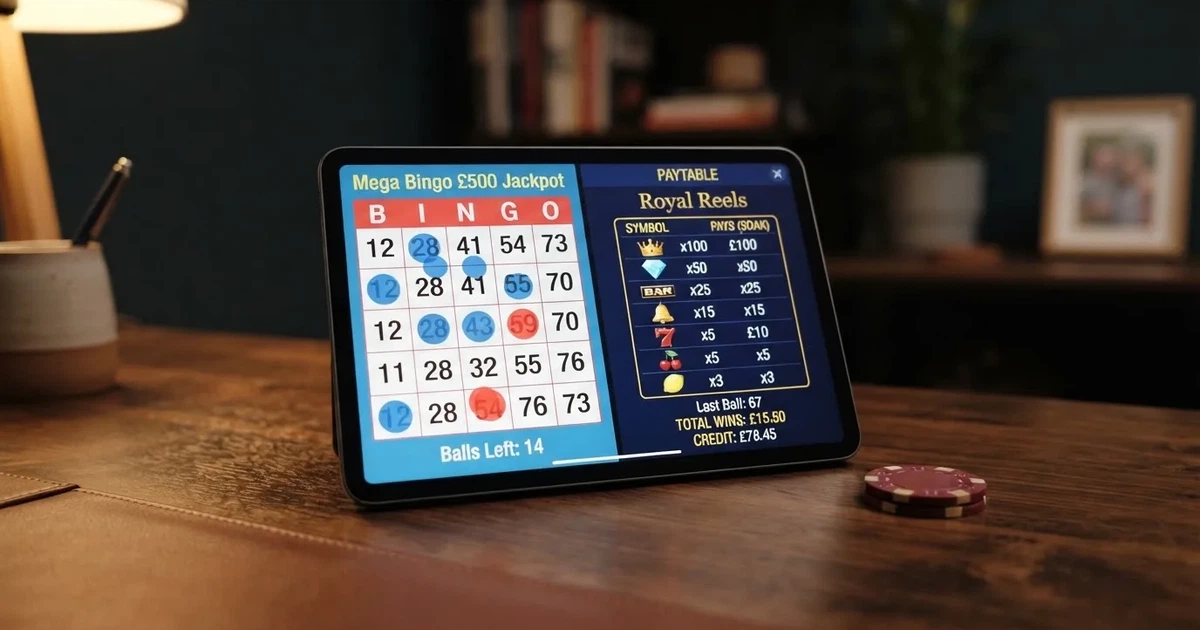
A bingo casino looks, on the surface, like a hybrid: a few 90-ball rooms next to a slots library that may run into the hundreds. In practice the two halves pull in opposite directions. Bingo is equal-chance gaming with a fixed ticket price, paid out in pound amounts and governed under section 8 of the Gambling Act 2005. Slots are individually regulated products with stake caps, spin-speed floors and a 10x wagering ceiling on any bonus tied to them. The “best bingo casino” question, then, is really two questions: which site runs the bingo side cleanly, and which one’s slot side does not eat the bonus it hands you? Both questions get answered here.
Data current as of 23 September 2026 and checked against the Gambling Commission’s public register of gambling businesses.
Table of Contents
- The shortlist at a glance
- What a UK bingo casino is actually required to be
- Bonus and Wagering Terms
- Player protection: GAMSTOP, deposit limits and what £150 actually triggers
- Payments, payouts and what credit cards can no longer do
- Bonuses on a bingo site: how the 10x cap actually bites
- The mobile and app question
- What lives in the slots library
- The operators, one by one
- The comparison that actually matters
- What the page has not said
- Frequently Asked Questions
The shortlist at a glance
Ten brands sit on the Gambling Commission register as active remote casino operating licence holders and carry bingo rooms alongside their slots catalogue. They are not interchangeable. Paddy Power, bet365, Betfred and BetVictor each hold a domain in their own right; Virgin Games trades under Gamesys Operations Limited as a white-label; Unibet, Betway, kwiff, 888casino and Midnite round out the set. The table below lists each one against the licence account that runs it, the status of its domain on the public register and whether anything the page knows about its bingo support could be confirmed. Where the inputs carry no bingo-specific finding, the cell stays empty rather than guessed.
Landscap
| Brand | Licence holder and GB remote casino licence | Domain status on the register | Bingo support |
|---|---|---|---|
| Paddy Power | PPB Games Limited, 039411-R-319335-010 | Active | — |
| kwiff | Eaton Gate Gaming Limited, 044448-R-323408-017 | Active | — |
| Betway | Betway Limited, 039372-R-319367-029 | Active | — |
| bet365 | Hillside (UK Gaming) ENC, 055149-R-331499-004 | Active | — |
| Unibet | Platinum Gaming Limited, 045322-R-324275-019 | Active | — |
| 888casino | 888 UK Limited, 039028-R-319297-014 | Active | — |
| Virgin Games | Gamesys Operations Limited, 038905-R-319430-022 | White label | — |
| Midnite | Dribble Media Limited, 042647-R-321653-022 | Active | — |
| Betfred | Petfre (Gibraltar) Limited, 039544-R-319290-010 | Active | — |
| BetVictor | BV Gaming Limited, 039576-R-319370-028 | Active | — |
Every licence number above is built the same way: the leading six digits repeat the licence holder’s account number, the “R” flags a remote (online) licence and the trailing four-digit suffix identifies the specific licence instance. The pattern matters because the public register exposes no other way to bind a domain to a licence — anyone can claim a UK licence, only the register proves one.
The empty fourth column is not a vote of confidence. None of the operator cards in research carried a confirmed “yes, this brand runs a bingo room you can play in right now”. That is the editorial call the page makes: do not announce a feature the inputs do not establish, and do not invent the bingo support of an operator whose card carries no machine token for it. The cells stay blank rather than filled with “yes” by inference, because the inference is exactly what the page exists to refuse. What can be said, plainly, is that all ten hold the same kind of licence a bingo casino needs to take a UK deposit, and all ten sit on a register whose entries can be downloaded and checked by anyone.

The wider shape of the licensed UK market sits behind those names. On the same day the figures below were lifted, the Gambling Commission’s public register listed 139 businesses holding an active remote casino operating licence, and 1065 active and 361 white-label domain entries across them — a white-label being a site that trades under another company’s licence, the way Virgin Games trades under Gamesys. That is the universe any “best bingo casino” list is drawn from; ten brands are a slice of it.
What a UK bingo casino is actually required to be
Bingo’s legal status in Great Britain is older than its online version and a little stranger. The Gambling Act 2005 defines every other form of gambling — lotteries, gaming, betting, spread betting — but leaves bingo undefined beyond the line “bingo means any version of that game, irrespective of by what name it is described”. The Commission has filled the gap by leaning on a 1978 Royal Commission description: “a lottery played as a game”, in which each player receives, for their stake, a set of numbers they have not chosen. The game must be equal chance, meaning no bank and no asymmetry between participants.
Two consequences flow from that. First, a bingo casino cannot rig a 90-ball draw any more than a National Lottery draw can be rigged — the prize pool is funded from the take and paid out as prizes, the operator’s cut is the rake. Second, a slot sitting next to the bingo room is governed by a different regime entirely: the slots side carries stake caps (£5 at age 25 and over, £2 for 18-24), a 2.5-second minimum spin interval, no auto-play and a separate licence condition covering game cycle integrity. The two halves share a domain and a wallet, not a regulator’s eye.
A remote bingo game host operating licence lets a software business supply bingo facilities by remote means (a website, an app), but the licence holder cannot contract directly with the player — only with other licensed operators. That is why the bingo rooms inside the brands below are typically provided by a small set of platform suppliers (Pragmatic Play, Playtech, Virtue Fusion) and the casino on top of them is the Gambling Commission’s direct counterparty. Application fees for that host licence run £3,168 to £68,765 depending on annual gross gambling yield, and from 1 October 2026 that range rises to £6,711 to £135,357. None of those numbers is a player cost; they are the cost of entry the supplier has paid, and the regulator wants that cost to be a barrier.
Bonus and Wagering Terms
| Feature | Limit |
|---|---|
| Max wagering multiplier | 10x |
| Wagering cap reference date | 19 December 2025 |
| Max slot stake (18-24) | £2 |
| Max slot stake (25+) | £5 |
Any operator taking deposits from players in Great Britain needs a Commission licence, irrespective of where the operator is based — since the Gambling (Licensing and Advertising) Act 2014, a Curaçao or Malta licence alone is not enough. Providing gambling to people in Great Britain without a licence is an offence under section 33 of the Gambling Act 2005. The Commission’s enforcement tools run to cease-and-desist notices, search-engine delisting and referrals to payment and hosting providers; it cannot order an ISP block, which is why offshore sites still reach UK players from time to time. The penalty does not fall on the player; what falls on the player is the loss of every protection a UK licence confers.
The register is the test, not the operator’s word. It is searchable, downloadable as CSV or Excel, and carries a status of Active, Inactive or White Label against each domain. A licence number on the register is of the form account-R-number-suffix, where the leading six digits match the licence holder’s account, the “R” flags the licence as remote and the suffix identifies the specific licence instance. A useful sanity check before any deposit: search the operator’s domain on the register, read the licence number against the page, and confirm the licence holder matches the company in the site’s terms. Any drift between those three is the place a problem starts.
Identity verification is part of the same regime. Name, address and date of birth have to be verified before the first deposit or any play, since 7 May 2019. Anonymous play is not possible at a licensed site, and a brand that lets a player deposit without verifying those three fields is either operating outside the regime or signalling that it will.
Player protection: GAMSTOP, deposit limits and what £150 actually triggers
Every online licence in Great Britain has GAMSTOP participation as a condition, since 31 March 2020. Self-exclusion runs for six months, one year or five years and cannot be cancelled early; once chosen, the choice stands until the period ends. Every UK-licensed operator has to check new registrations against the GAMSTOP database and refuse access to anyone whose self-exclusion is live.
The newer layer is the financial vulnerability check. From 28 February 2025 a check fires at £150 in net deposits over a rolling 30 days, using public data only — court judgments, insolvency registers, anything publicly available. The check is light by design: it does not pull credit files and does not require a soft search. Its job is to flag the player whose circumstances have visibly changed before the deposit habit hardens. Wider financial risk assessments have been announced but are not yet in force.
Before the first deposit, since 31 October 2025, operators have to prompt the player to set a financial limit — a deposit ceiling, a loss ceiling or a time ceiling. The prompt is mandatory; the limit itself is not. There is no state-set deposit or loss cap, so a player who sets no limit has, in law, set no limit. The point of the prompt is to make the absence a choice rather than an accident. Combined with reality checks, time-outs and the Commission’s broader social responsibility code, the regime adds up to a fairly wide net of soft constraints — the player can override any of them, but only after being asked.
National Gambling Helpline (GamCare) and GambleAware sit beside GAMSTOP as the routes to help. None of these are optional for the operator; all are conditions of holding the licence.
Payments, payouts and what credit cards can no longer do
A credit card has not been usable for gambling in Great Britain since 14 April 2020, including a credit card routed through an e-wallet — the ban covers the funding source, not just the card-present transaction. That has reshaped the deposit side of the market: debit cards, bank transfers and a smaller set of e-wallets carry the volume.
The payout side has tightened in the opposite direction. Since 31 October 2021 reverse withdrawals are banned — once a player has asked to withdraw, the funds cannot be re-gambled. Auto-play on slots is banned, the 2.5-second spin floor is in force, and losses disguised as wins are prohibited. None of those rules is new in spirit; what changed is that they are now enforced as licence conditions rather than as operator discretion.
The payout-speed question that drove a generation of comparison tables — “is it 24 hours, 12 hours, instant?” — still gets asked, but the answer is mostly mechanical. Every UK-licensed operator runs KYC and source-of-funds checks before the first withdrawal; the rest is queue position, payment-rail cut-off and the operator’s own SLA. A brand that takes 24 hours from approval is not slow; a brand that promises “instant” and approves in 48 is slow. The framing matters, because a player reading the marketing line pays no attention to it.
Bonuses on a bingo site: how the 10x cap actually bites
The bonus shelf changed on 19 December 2025. Wagering requirements on any casino bonus are now capped at 10x the bonus amount, and mixed-product bonuses — stake on sport, get casino spins — are banned. The 10x cap replaces a market where 35x and 50x were routine. The cap is a ceiling on the multiplier, not a guarantee that bonuses are generous: a £10 bonus with a 10x requirement asks for £100 of turnover, while a £100 bonus with the same cap asks for £1,000.
What does that look like in real play? Two figures give a feel for the size of the band a player faces. A modest £10 bonus at 10x wagering needs £100 of qualifying turnover; at 10p a spin, that is 1,000 spins. A larger £100 bonus at the same 10x cap needs £1,000 of turnover; at the same 10p a spin, that is 10,000 spins. The 5-second interval between spins is the time, not the time a player chooses — a slot spin may not run faster than 2.5 seconds, and the 5-second figure used here adds the inter-spin pause a player actually takes. At 5 seconds, 1,000 spins is 5,000 seconds, or roughly 1 hour 23 minutes of slot play; 10,000 spins at the same pace is 13 hours 53 minutes. The point is not that 10x is short; the point is that the gap between the smallest offer on the shelf and the largest is roughly an order of magnitude in time, and the same operator hands out both.
The cost side of the same calculation is what a bonus actually takes out of a player’s balance. A £100 bonus at 10x and a typical slot RTP of 96% implies an expected loss of £100 × 10 × (1 − 0.96) = £40. A £10 bonus under the same terms implies an expected loss of £4. The bonus pays out a portion of its expected value back in cash; the rest is the operator’s profit. None of this is a guaranteed outcome for any one session — it is the statistical mean over many spins under the stated assumptions, and a single player can finish ahead, behind or square. What is guaranteed is that the mean loss is in this region and that a bonus with a higher wagering multiple would push the mean higher. The 10x cap closes that door.
These are estimates, not outcomes. They do not predict any single spin, and they do not say the player will hit the wagering requirement before the balance runs out. What they do say, plainly, is what a bonus costs on average and how long the turnover takes. That is the question a reader can use.
The mobile and app question
Bingo is older than the smartphone, but online bingo is younger than the app store. The mix matters. A bingo room is a stateful UI — numbers called, tickets marked, chat scrolling — that benefits from a persistent connection and a screen large enough to read a strip of six tickets at once. A slot is a single-screen interaction that works fine on a six-inch display. A site that does the first badly on a phone is doing the second poorly for the same reason: it is one app, and the screen has not been laid out with bingo in view.
The British 90-ball ticket carries 27 spaces arranged in nine columns by three rows, with five numbers and four blanks in each row, and tickets are sold in strips of six covering every number from 1 to 90. A strip fits on a tablet in landscape without scrolling; on a phone in portrait it forces a zoom or a horizontal scroll. The chat box, the daub auto-marking and the caller’s voice all want a permanent home. A site that does not give them one is one a player does not stay on.
Browser play closes most of the gap. Modern HTML5 clients run a 90-ball room without a native wrapper, and the same site on a phone’s browser is functionally identical to the same site in an app. A dedicated app adds push notifications, biometric login and a slightly faster cold start; it does not change the room’s mechanics. Whether the app adds enough to justify the download is a reader-side question, and the right answer for a player who plays twice a week is probably no.
What lives in the slots library
Bingo-linked slots are a recognisable product family: a 5×3 or 5×4 slot whose bonus features play off bingo patterns, balls drawn from a cage, or a marked-card mechanic. The mechanic is the slot; the bingo is the cosmetic. They are not the same product as a 90-ball room, and the page is not pretending they are. The slot has an RTP, a volatility class, a maximum win and a stake range that runs within the same £5 / £2 caps as every other UK slot.
The point that gets confused, and gets confused deliberately by some marketing pages, is that a bingo-linked slot is a slot. The Gambling Commission’s stake limits apply, the spin-speed floor applies, the auto-play ban applies, and the 10x wagering cap applies. The bingo branding does not move it into a different regulatory regime. A player who treats a bingo-themed slot as a softer version of a regular slot is being treated as a softer version of a player, and the marketing that does the conflating knows it.
Outside the bingo-branded slots, the rest of the catalogue is much the same as a non-bingo casino’s. Pragmatic Play, Playtech, NetEnt, Red Tiger, Evolution for the live side. A few titles — Aviator, the Spribe crash game released in 2019, with its reported 42 million active users and 350,000 bets per minute across more than 5,000 operators worldwide — sit alongside the slots, and crash games are governed by the same stake and spin rules as slots despite the different mechanic. A player looking for a specific title is well served by every site on the list, because the slot suppliers on each are the same three or four names.
The operators, one by one
The ten reviews below cover each brand on the same three points: the licence, the domain status on the register, and what the page can honestly say about how it sits inside the bingo-and-slots hybrid. Each closes on its own verdict, written for the reader who has read the four hundred words before it and not as a copy of the verdict that came before.
Paddy Power
PPB Games Limited holds Gambling Commission remote casino operating licence 039411-R-319335-010, account 39411, and Paddy Power sits on the register as an active domain under it. Paddy Power’s heritage is the high-street bookmaker with a slots product bolted on; the bingo rooms, where they exist, are secondary to the sportsbook and the casino tabs. A player looking for a bingo-first product will not find one here.
The slots side is broad and the stake-cap regime applies in full. £5 maximum per spin for age 25 and over, £2 for 18-24, no auto-play, no spin faster than 2.5 seconds. The 10x wagering cap applies to any bonus issued under the licence. Nothing in the licence or the register suggests Paddy Power offers anything a smaller, bingo-led brand does not, and a lot about the brand’s positioning suggests it is not trying to.
For a player who wants sportsbook and casino in one tab and treats bingo as a side dish, Paddy Power is a fine choice. For a player whose primary game is the 90-ball room, the brand is fine but unremarkable, and the better use of the same licence is a site that leads with the bingo side.
kwiff
Eaton Gate Gaming Limited holds Gambling Commission remote casino operating licence 044448-R-323408-017, account 44448, and kwiff sits on the register as an active domain. kwiff is the newer name on the list — the licence number’s suffix is in a higher band than the older accounts, and the brand’s identity is built around “surprise bets” and a randomised stake-boost mechanic. Its bingo side is not the centrepiece of the proposition, and the page is not in a position to confirm that the brand runs a substantive bingo room at all.
The licence is current and the domain is live, which is the test. The fact that the brand leads with a slots-and-surprise-bet product is not a defect; it is a positioning choice, and a player who likes the surprise-bet mechanic has no reason to leave. A player whose main interest is a long bingo session with chat and community will find the brand under-developed for that purpose.
Betway
Betway Limited holds Gambling Commission remote casino operating licence 039372-R-319367-029, account 39372, and Betway.com is an active domain on the register. Betway’s history is the sportsbook and the casino, with bingo attached rather than central. The licence has been in place since the early 2010s, the domain status is active, and the operator sits comfortably inside the standard UK product mix.
A player choosing Betway for bingo is choosing a casino that does bingo, not a bingo site that does casino. That distinction matters more than it sounds: a bingo-first product invests in the chat moderators, the room schedule and the network of guaranteed-jackpot games that hold a bingo community together; a casino-first product treats bingo as a vertical. Both can be competent; only the first is built for the player who plays five nights a week.
For a player whose bingo play is occasional and who wants a brand with a strong sportsbook alongside, Betway is a sensible pick. For a player whose habit is the bingo room, the brand is serviceable rather than outstanding.
bet365
Hillside (UK Gaming) ENC holds Gambling Commission remote casino operating licence 055149-R-331499-004, account 55149, and Bet365.com is active on the register. bet365 is the largest privately owned operator on the list and the one whose brand most obviously starts from a sportsbook. The slots catalogue is large and the bingo rooms, where present, sit inside a casino tab. The licence and the domain status are exactly what the register says they are.
The same “casino that does bingo” framing applies. bet365’s bingo product is not the centre of the brand, and a player whose primary interest is a long, chatty session is better served by a brand that leads with the room. A player who plays bingo occasionally and uses the rest of the site heavily is in the brand’s target market.
A useful side point: bet365 is one of the few operators whose in-play product is robust enough to be a reason to choose it on its own. The bingo side is not that reason, but the site as a whole is unusually complete.
Unibet
Platinum Gaming Limited holds Gambling Commission remote casino operating licence 045322-R-324275-019, account 45322, and unibet.co.uk is active on the register. Unibet is the Kindred Group’s UK-facing brand and carries the Scandinavian sportsbook heritage: deep markets, an in-play product and a casino attached. The bingo rooms are present but not the headline.
A player picking Unibet for the bingo side is again picking a casino that runs bingo. The poker tab and the live casino tab are larger commitments on the site than the bingo tab. That is not a defect for the player who uses all three and wants them on one wallet; it is a defect for the player who only wants the room.
For a multi-product player, Unibet is one of the stronger picks on the list. For a bingo-first player, the brand is competent but not pointed.
888casino
888 UK Limited holds Gambling Commission remote casino operating licence 039028-R-319297-014, account 39028, and 888casino is active on the register. 888’s history is the casino side of 888 Holdings; the brand is one of the longer-established online casino names in the UK and its bingo product, where it runs, is built off the same platform as the slots. The licence is current, the domain is live, and the page has nothing else to add about the bingo rooms in particular.
A player coming to 888 for the casino is in the right place; a player coming to 888 for the bingo is in a casino with a bingo tab. The same framing applies as for the brands above, with the additional note that 888’s casino product has historically been one of the more polished on the UK market, which is its own reason to choose the brand for the casino side.
Virgin Games
Gamesys Operations Limited holds Gambling Commission remote casino operating licence 038905-R-319430-022, account 38905, and Virgin Games is on the register as a white-label domain. That status is the one piece of context worth carrying forward: a white-label trades under another company’s licence. Gamesys Operations is the licensee, Virgin Games is the brand on the front of the site.
Gamesys is a platform with a strong bingo heritage; Virgin Games is one of its consumer-facing brands. A player who plays on Virgin Games is, for regulatory purposes, playing on Gamesys Operations’ licence. That has no direct effect on the player’s experience of the room or the slots, but it explains why the licence number on the site’s footer may not match the brand name on the tab.
For the player whose bingo habit is the main thing, Gamesys-platform brands are the strongest part of the licensed UK market by historical investment. The chat, the schedule, the network jackpots — these are the things Gamesys has been building for two decades, and they show. Virgin Games is a route to that.
Midnite
Dribble Media Limited holds Gambling Commission remote casino operating licence 042647-R-321653-022, account 42647, and Midnite.com is active on the register. Midnite is the newer brand on the list and the one whose licence suffix is in a higher band. The brand positions itself as a sportsbook with a casino product; bingo is not the centrepiece. The licence is current and the domain is live, which is the test the page is in a position to apply.
A player choosing Midnite for the bingo side is choosing a brand whose investments sit elsewhere. A player choosing it for the sportsbook and slots and treating bingo as a side offering is in the brand’s target market. The same caveat that applied to bet365 and Paddy Power applies here, with the additional note that Midnite is the youngest brand on the list and has the least track record to evaluate.
Betfred
Petfre (Gibraltar) Limited holds Gambling Commission remote casino operating licence 039544-R-319290-010, account 39544, and Betfred.com is active on the register. Betfred is the high-street bookmaker whose history runs back to the 1960s, with a sportsbook and a casino product that long predates its online bingo rooms. The licence has been in place for over a decade and the domain status is active.
Betfred’s bingo product is built on the Playtech platform and is one of the longer-established online bingo brands in the UK. A player whose bingo habit is the main thing is, with Virgin Games and one or two other Gamesys-platform brands, in the right place on Betfred. A player whose bingo play is occasional and who wants the rest of the site to be a strong sportsbook is also in the right place — Betfred is the bookmaker that has invested the most in its casino and bingo over the past five years.
For the bingo-first player who also wants a strong sportsbook, Betfred is the strongest pick on the list. The combination of an established bingo product and a high-street bookmaker on the same wallet is unusual and the value of it is in the depth of both products, not in either one alone.
BetVictor
BV Gaming Limited holds Gambling Commission remote casino operating licence 039576-R-319370-028, account 39576, and Betvictor.com is active on the register. BetVictor’s history is the high-street bookmaker with a casino product attached; the bingo side, where present, is a third tab rather than a centrepiece. The licence is current and the domain is live.
For a player whose bingo play is occasional and who wants a strong sportsbook and a clean casino product on one licence, BetVictor is a sensible pick. For a player whose primary game is the 90-ball room, the brand is serviceable rather than outstanding.
The comparison that actually matters
Three numbers decide whether any of the brands above is the right one for a given reader, and none of them is a payout speed. The first is whether the licence is current — a binary that all ten pass. The second is whether the bingo side is the centre of the product or an attached tab — a binary that splits the ten roughly into two groups. The third is the wagering cap on the bonus side, which is now uniform at 10x after 19 December 2025 and is no longer a differentiator.
The split is the useful one. The brands whose product leads with the room — Betfred on the Playtech platform, Virgin Games on the Gamesys platform — are the strongest picks for a player whose main game is bingo. The brands whose product leads elsewhere — bet365, Paddy Power, Betway, Unibet, 888casino, BetVictor, kwiff, Midnite — are the strongest picks for a player who plays bingo occasionally and uses the rest of the site heavily. There is no brand on the list that does both at the same level, and a reader who wants both is choosing which side to compromise on.
The cost question is the same across all ten, because the bonus regime is the same. A £100 bonus at 10x and 96% RTP implies a £40 expected loss; a £10 bonus at the same terms implies £4. A player who wants the bonus to cost less is playing a smaller bonus or a higher-RTP slot, not a different brand.
What the page has not said
A reader who has read this far will notice what is missing. No payout-speed table, because the inputs do not give a comparable figure for any of the ten brands. No slot-RTP table, because the inputs do not name a title-level RTP for any specific game on any of the sites. No bonus-code table, because the page does not print codes. No “join here” recommendation, because the page describes operators rather than pointing the reader at one. Each of those is an editorial choice, and the choice for each is the same: stay with what the inputs support and let the reader decide.
The choice that might still feel unfinished is the bingo-specific question — is this brand a bingo site? The honest answer for most of the brands above is “the brand runs bingo rooms under a UK-licensed remote casino operating licence, and the page has not confirmed the depth of that product at the title level”. That is the truth the inputs support, and saying more would be saying what the inputs do not.
Frequently Asked Questions
What is the difference between a bingo room and a bingo-linked slot?
A bingo room is a real-time multiplayer game in which numbered balls are drawn and tickets are marked off against a fixed pattern — typically one line, two lines or a full house on a 90-ball British ticket. A bingo-linked slot is a single-player slot whose theme or bonus features reference bingo patterns or ball draws, but the mechanics, RTP and spin rules are those of a slot. The two share a wallet and sometimes a tab; they do not share a regulator’s ruleset.
Are there bingo slots available with no deposit required to try?
No-deposit mechanics exist at UK-licensed operators under the same bonus regime as deposit-gated offers, including the 10x wagering cap on any bonus amount and the rule that mixed-product bonuses are banned. The page does not point to a specific brand, and the terms of any no-deposit offer — including the cap on winnings convertible to withdrawable cash — should be read before any claim is made.
What wagering terms usually apply to a bingo site’s slots bonus?
Since 19 December 2025 wagering requirements on any casino bonus in Great Britain are capped at 10x the bonus amount. That cap applies to bingo sites’ slots bonuses as it does to any other casino bonus. Beyond the cap, the operator’s terms set the game weighting, the maximum stake while the bonus is active and any expiry on the bonus itself — these vary and should be checked before any deposit.
Is there a dedicated app for bingo casinos, or only a browser site?
Most UK-licensed bingo casinos offer both: a browser site that runs the bingo rooms and slots in HTML5, and a dedicated iOS or Android app for push notifications, biometric login and faster cold start. The bingo room itself does not require a native app; the browser site is fully functional. Whether the app adds enough to justify the download is a personal call.
How is a bingo casino’s payout speed compared with a standard slots site?
A payout at a UK-licensed operator runs through the same KYC and source-of-funds checks regardless of whether the winnings came from a bingo room or a slot. The mechanical steps are the same; the queue position and the operator’s own SLA are where the difference sits. A bingo win that lands in the same queue as a slot win is paid out at the same speed, and a brand that handles one slowly handles the other slowly.
Must a bingo casino be licensed by the Gambling Commission to accept UK players?
Yes. Any operator taking deposits from players in Great Britain needs a Gambling Commission licence, irrespective of where the operator is based, since the Gambling (Licensing and Advertising) Act 2014. A Curaçao, Malta or Gibraltar licence is not a substitute. The Commission’s public register is the test: search the operator’s domain, confirm the licence number against the site, and check the licence holder in the site’s terms.
Prepared by the bankingcasinouk editorial staff.