
No-wagering casino sign-up offers in the UK for 2026: what they really pay and who each one suits
The appeal of a no-wagering sign-up offer is the small print it doesn’t carry. A bonus you can withdraw the moment it lands in your cash balance — without grinding through a 30x or 40x playthrough — is the rare casino promotion that does what its headline promises. In the UK those offers exist, but they tend to be smaller and tighter than the wagered packages advertised elsewhere, and the reason sits in plain sight: the Gambling Commission’s bonus reforms of late 2025 capped wagering at 10x and banned mixed-product bonuses, so the marketing-friendly “£100 with 40x” structure that defined the 2010s no longer flies. A no-wagering offer is now a deliberate choice an operator makes within those rules, not a loophole around them. This page looks at ten GB-licensed brands taken straight from the Commission’s public register, sets out what a no-wagering sign-up package actually delivers, and says which reader each one fits.

Current as of 6 November 2026. Verified against the Gambling Commission’s public register of gambling businesses.
Table of Contents
- What “no wagering” actually means on a UK sign-up offer
- The licensing frame: what a UK Gambling Commission licence obliges an operator to do
- Responsible gambling around a no-wagering offer
- Payments and payout speed on a UK-licensed casino
- The shape of a no-wagering sign-up offer in 2026
- The £10–£100 bonus band and what it costs to clear
- The licensed UK operator set, side by side
- Grosvenor Casinos — the high-street name’s online arm
- Betfred — the bookmaker-casino hybrid with a UKGC licence
- 32Red — the casino-first brand under Platinum Gaming
- BetVictor — the independent operator with a GB licence
- William Hill — the household-name bookmaker’s casino
- Virgin Games — the white-label brand under Gamesys
- Ladbrokes — the high-street bookmaker under LC International
- Paddy Power — the bold-marketing brand under PPB Games
- Betfair — the casino-tab brand sharing PPB’s licence
- Jackpotjoy — the Gamesys sister brand to Virgin Games
- How to read a no-wagering sign-up offer without being misled
- What an offshore site cannot offer that a GB licence can
- Frequently asked questions on no-wagering sign-up offers
What “no wagering” actually means on a UK sign-up offer
A no-wagering casino offer is one where the bonus — cash, free spins, or both — is paid into a withdrawable balance rather than a locked bonus balance. Anything you win from a free spin lands as cash. Anything you win from a cash bonus is yours to pull out at the point of withdrawal, subject only to the operator’s standard identity check and payment-rail limits. There is no multiplier attached, no playthrough to clear, and no expiry clock on a bonus balance that quietly eats your stake.
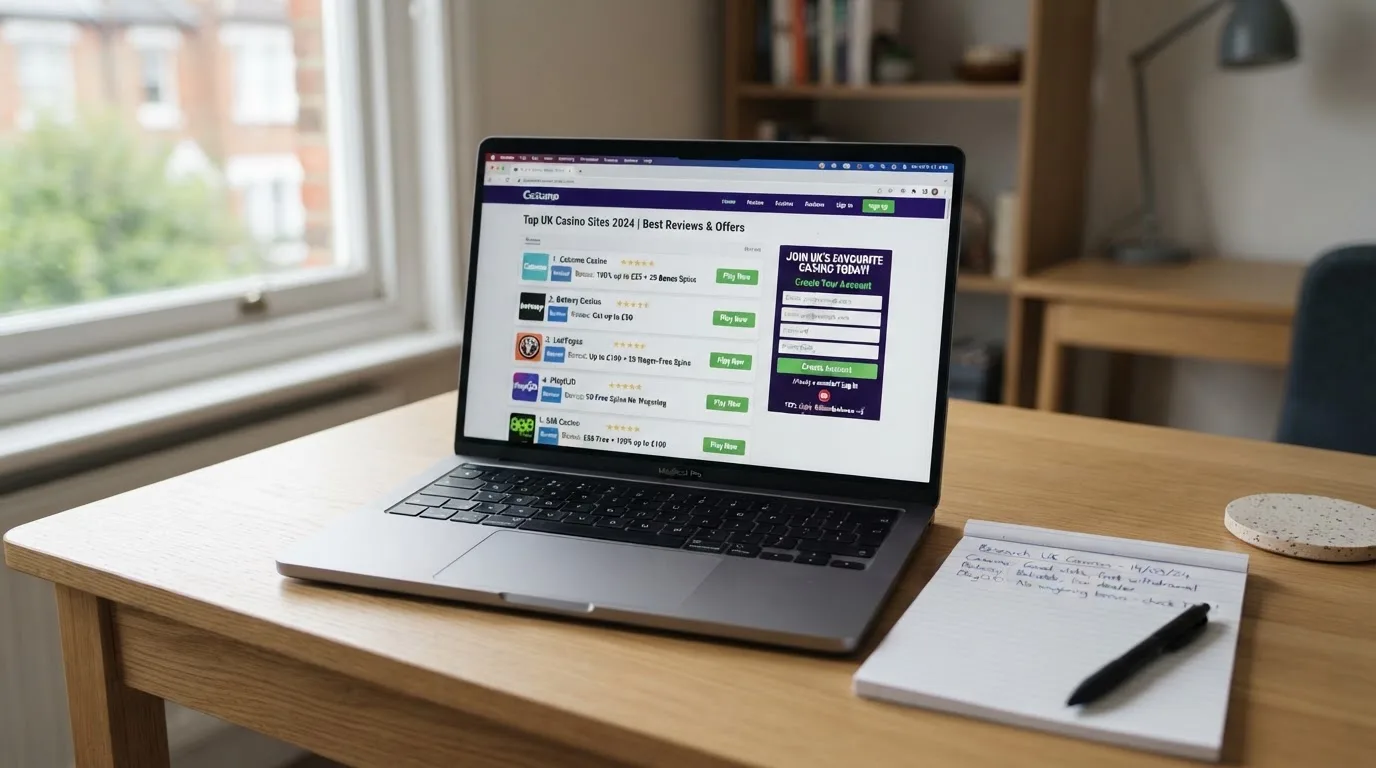
In practice the offer is structured one of three ways. A pure cash bonus — rare on UK sites in 2026 — credits your account with a small amount (£5–£10 is the typical band) that is yours to play with and withdraw. A free-spins package is more common: a fixed number of spins on a named slot, with the spin value set by the operator and the winnings paid as cash. The third is a hybrid — a small cash amount plus a small spins bundle — used by brands that want a sign-up headline with a number in it without straying into promotional excess. All three forms, if genuinely no-wagering, leave one figure on the page: the cash amount, the spin count, and the spin value.
The thing the headline does not say is what is missing. There is usually no deposit match attached, and the no-deposit variants — the ones that do not require you to fund the account before claiming — are thinner still. Free spins attached to a first deposit are larger, but they require the deposit, and the offer is graded by what you put in rather than what the operator gives you for free. A player reading “50 free spins, no wagering” should read it as “50 spins on a named slot at a fixed coin value, winnings paid as cash,” and nothing more.
The licensing frame: what a UK Gambling Commission licence obliges an operator to do
Every brand on this page holds a remote casino operating licence from the Gambling Commission, the regulator sponsored by the Department for Culture, Media and Sport under the Gambling Act 2005. The Commission covers Great Britain — England, Scotland and Wales — and any operator taking customers in those jurisdictions needs its licence, no matter where the company itself is incorporated. A Gibraltar, Malta or Curaçao licence is not a substitute. Since the Gambling (Licensing and Advertising) Act 2014 the test has been where the customers sit, not where the company files its paperwork.

The Commission’s public register is the only reliable test of whether a brand actually holds a licence. On 18 September 2026 the register listed 139 businesses holding an active remote casino operating licence, and 1,065 active domain entries alongside 361 white-label entries — a white-label site being one that trades under another company’s licence, which is why several brand names can sit behind a single licence account. A licence number on the register follows the form account-R-number–suffix, where the leading six digits are the licence holder’s account number and the R marks a remote (online) licence. The register can be searched online or downloaded as CSV or Excel, which is how the operator list further down this page was built.
Holding the licence is not a marketing badge. It carries operational obligations. Name, address and date of birth are verified before a player’s first deposit or first bet — anonymity is not available at a licensed site. Identity is checked against public databases and, where needed, document upload. The Commission’s social responsibility code adds layers on top: affordability prompts, financial vulnerability checks, time-outs and self-exclusion routes. Every online licence is also a mandatory enrolment in GAMSTOP, the national self-exclusion scheme, since 31 March 2020.
The counterweight is the protection it gives the player. A complaint can be raised with the Commission. An approved alternative dispute resolution (ADR) provider hears disputes the operator’s own team can’t resolve. Money in a segregated player account is recoverable if the operator fails. A dispute over a bonus term is heard by a regulator who reads the small print alongside the player. None of this exists on an offshore site, which is why the rest of this page does not consider unlicensed brands at all.
Responsible gambling around a no-wagering offer
The argument for a no-wagering offer is partly that the player never has to keep playing to extract value. A bonus you can withdraw the moment it lands removes the most common harm pattern in online casinos: the bonus-driven session where a player chases a wagering requirement long after they meant to stop. A small, clean offer has a natural finish line.
The safer-gambling infrastructure is the same on every UK-licensed site, no-wagering or otherwise. GAMSTOP self-exclusion, applied at registration, blocks the player from any GB-licensed online operator for six months, one year or five years; the period cannot be cut short once started. Time-outs (24 hours to six weeks) and self-exclusion at the individual operator level are also available. The National Gambling Helpline (run by GamCare) and GambleAware provide independent support, and a licensed operator’s customer service team can route a player to both.
Financial vulnerability checks are now part of the registration process. From 28 February 2025 any player whose net deposits cross £150 in a rolling 30-day window is checked against public data for signs of financial difficulty. From 31 October 2025 the operator must also prompt the customer to set a financial limit before the first deposit. There is no state-set deposit or loss ceiling — the prompt is mandatory, the choice is the player’s. Online slots themselves carry hard limits: a maximum stake of £5 per game cycle for players aged 25 and over (from 9 April 2025) and £2 for those aged 18 to 24 (from 21 May 2025). Auto-play has been banned since 31 October 2021, and spins can run no faster than one every 2.5 seconds. “Losses disguised as wins” — celebratory sounds and visuals on a net loss — are also banned.
The point for someone weighing a sign-up offer is that none of this goes away because the bonus carries no wagering. A small cash bonus is still gambling, and the friction the regulator adds is there because the friction works. Set a deposit limit before the first deposit, use GAMSTOP if gambling has become a problem, and treat the offer as a way to test a site’s games rather than as income.
Payments and payout speed on a UK-licensed casino
A no-wagering offer changes the payout question. The whole point of withdrawing a cash bonus the moment it lands is that the withdrawal has to clear — and on a UK-licensed site the operator is obliged to run the standard verification before paying out, not invent a bonus rule to delay it. Identity is verified at registration, not at withdrawal, which is the structural advantage a UK-licensed site has over its offshore cousins. A player who has cleared KYC at sign-up is paid through the same rails they’d use on any other transaction.
Debit cards and bank transfers are the workhorses. Bank transfers within the UK typically clear through the Faster Payments Service, which Pay.UK has operated since 2008 and which runs 24 hours a day, seven days a week; most arrive in seconds or minutes, with a hard scheme ceiling of £1,000,000 per transaction — though individual banks impose their own lower limits. The Bank of England oversees the system’s safety and provides final settlement, but is not itself a direct participant. Faster Payments is what makes a same-day withdrawal a realistic expectation rather than a marketing line on a UK-licensed site.
E-wallets and bank-redirect services sit alongside. AstroPay, founded in 2009 in Uruguay, runs as a global digital wallet with virtual and physical debit cards and peer-to-peer transfers; in the UK its entity Larstal Limited is authorised by the Financial Conduct Authority under the Electronic Money Regulations 2011, and the wider group operates licensed entities in the Isle of Man, Brazil and Denmark. Apple Pay, launched in October 2014 and supporting UK cards from July 2015, protects card data through tokenisation and dynamic security codes; on iPhone with Face ID a payment is authenticated by double-clicking the side button, with Touch ID models using the Home button. Both work at the deposit end of a UK casino; both face the same Gambling Commission rules once the money lands.
One payment method is off the table. Since 14 April 2020 the Commission has banned the use of credit cards to fund any gambling in Great Britain, online or offline, including credit cards routed through e-wallets. Debit cards, bank transfers and pre-funded e-wallets are unaffected. The Commission’s own evidence at the time pointed to around 800,000 UK consumers using credit cards to gamble in 2018, with 22% of online gamblers who used credit cards to gamble classed as problem gamblers — the basis for a rule that has held since and is not under review. A UK player funding a casino account does so from money they already have.
Withdrawal times vary by method and operator. Faster Payments and most debit cards can arrive the same day once verification is complete; bank transfers during banking hours are usually within an hour. E-wallets are typically same-day once the operator releases the funds. The standard identity check is the only variable the player can’t speed up, and that’s a feature: it is what keeps the player protected if the operator fails, and it is what an offshore site does not have to do.
The shape of a no-wagering sign-up offer in 2026
The 19 December 2025 reforms are what defines what a no-wagering offer looks like in 2026. From that date the Gambling Commission capped wagering requirements at 10x and banned mixed-product bonuses — a casino offer cannot be conditional on a sports bet, a bingo ticket or a lottery entry. The cap is the cap, and a “no wagering” structure simply sits at zero, which is well inside the rule.
What the cap did was compress the spread. A pre-reform wagered bonus of £100 at 40x meant £4,000 of qualifying turnover before any of it could be withdrawn. A 10x offer on the same £100 is £1,000 of turnover — still a real grind, but a smaller one. A no-wagering offer sits beneath even that: the bonus is yours the moment it credits, and the playthrough structure disappears. In exchange the headline number tends to be smaller, and the operator is more selective about which games the spins run on, because every free spin paid as cash is a real liability the moment it lands.
A practical reader looks at three figures on a no-wagering sign-up offer: the cash amount, the number of free spins, and the spin value (sometimes called the coin value or line value). A “50 free spins at 10p” offer is worth up to £5 in spin value before anything is won; on a typical online slot the realised return is well below the spin value because the slot’s RTP and variance both work against the player. A £10 cash bonus is worth exactly £10 — but only if it is genuinely cash, and not a “bonus funds” balance dressed up as cash and quietly excluded from withdrawal. The reading is in the terms, not the headline.
Two practical checks before any no-wagering offer is taken at face value. First, is the cash withdrawable on receipt, or is there a “minimum playthrough” hidden in the small print — sometimes called a “1x turnover” or “playthrough before withdrawal” condition, which is a wagering requirement by another name. Second, are free-spin winnings paid as cash, or paid as bonus funds that themselves carry a wagering requirement? Both are the two ways a “no wagering” headline can mislead. The Commission’s 10x cap does not make those constructions impossible, only more visible when they appear.
The £10–£100 bonus band and what it costs to clear
The question that hides inside a sign-up offer is what it actually costs the player to clear — that is, to convert the bonus into withdrawable cash — and the answer depends on whether the offer is wagered or not. A no-wagering offer clears at zero cost: the bonus is already cash. A wagered offer, even at the current 10x cap, is a different calculation.
The Commission’s 10x cap has been in force since 19 December 2025. Under it, a £10 bonus carries a £100 turnover floor — the player must wager £100 through eligible games before any winnings become withdrawable. A £50 bonus requires £500 of qualifying play, and a £100 bonus requires £1,000. The figures sit in a band rather than a single point because the size of the bonus varies by operator and the eligible games vary by title. What the cap does is set the worst case at 10x and let the market drift down from it. No-wagering offers, of course, sit at the bottom of that band — at zero.
For a wagered offer at the cap, the implied cost is the house edge multiplied through the turnover. At a typical online slot RTP of around 96%, the expected loss on £100 of turnover is roughly £4; on £500 it is around £20; on £1,000 it is in the region of £40. Those numbers are statistical averages over many spins, not guarantees of any single outcome, and they assume the player is grinding the bonus rather than the deposit. The arithmetic matters because the marketing word “free” is doing a lot of work in a £100 bonus headline — the offer is free in the sense that it credits without an additional deposit, not in the sense that it costs the player nothing to clear. A no-wagering offer is the one structure where the headline survives that scrutiny.
The licensed UK operator set, side by side
The brands below all appear on the Gambling Commission’s public register as GB-licensed remote casino operators, taken from the register snapshot of 18 September 2026. The table is a check of who is licensed and how, not a ranking of who pays out fastest — those figures vary by method and time of day and are not in the register. Where two brands sit behind the same licence account, that is shown in the licence column. A “white-label” entry means the domain trades under another operator’s licence rather than holding its own.
| Brand | Licence holder and GB remote casino licence | Domain status on the register | Subject support |
|---|---|---|---|
| Grosvenor Casinos | Rank Interactive (Gibraltar) Limited · 057924-R-334666-005 (account 57924) | Active | — |
| Betfred | Petfre (Gibraltar) Limited · 039544-R-319290-010 (account 39544) | Active | — |
| 32Red | Platinum Gaming Limited · 045322-R-324275-019 (account 45322) | Active | — |
| BetVictor | BV Gaming Limited · 039576-R-319370-028 (account 39576) | Active | — |
| William Hill | WHG (International) Limited · 039225-R-319373-015 (account 39225) | Active | — |
| Virgin Games | Gamesys Operations Limited · 038905-R-319430-022 (account 38905) | White-label | — |
| Ladbrokes | LC International Limited · 054743-R-330863-014 (account 54743) | Active | — |
| Paddy Power | PPB Games Limited · 039411-R-319335-010 (account 39411) | Active | — |
| Betfair | PPB Games Limited · 039411-R-319335-010 (account 39411) | Active | — |
| Jackpotjoy | Gamesys Operations Limited · 038905-R-319430-022 (account 38905) | Active | — |
The two pairings matter. Paddy Power and Betfair both run on PPB Games Limited’s account 39411 — the same licence, the same compliance team, the same GAMSTOP enrolment, but two separate brand fronts and two separate bonus programmes. Virgin Games and Jackpotjoy both run on Gamesys Operations Limited’s account 38905, with Virgin Games sitting as a white-label domain while Jackpotjoy is listed as active. To the player these look like separate operators; on the register they are the same licence seen from different angles.
The columns the register does not carry are also worth naming. It does not list bonus terms, payout times, free-spin counts, or game libraries — none of which can be confirmed against a regulator’s record. Where this page uses an em dash in the subject column it is because the register does not record the kind of bonus a brand runs; the absence is in the data, not in the brand. Each operator write-up below takes a single angle: what kind of reader the brand is best suited to, and what the licence record actually shows.
Grosvenor Casinos — the high-street name’s online arm
Grosvenor Casinos trades on a name most UK players already know from the land-based casino estate. Online it sits on account 57924 under Rank Interactive (Gibraltar) Limited, holding remote casino operating licence 057924-R-334666-005, with Grosvenor Casinos listed on the public register as an active domain. The licence is held by a Gibraltar-incorporated entity but issued by the UK Gambling Commission — which is the structure most large UK-facing online operators use, and one the Commission’s 2014 licensing reforms were written to accommodate.
The strength of the brand is its omnichannel footprint. A player who already has a Grosvenor loyalty card has a familiar account structure to walk into online, and the operator’s game library tends to lean toward the live-dealer and table-game side of the catalogue rather than the slots-only niche. The bonus programme reflects that, with smaller, structurally conservative offers and a relatively conservative playthrough position. For a player who values continuity with the land-based brand and a quieter promotion page, this is the natural fit.
For a player hunting a headline-grabbing no-wagering sign-up package, it is not where the market’s most generous offers sit. The brand’s positioning is the steady mid-market rather than the bonus-driven end, and the licence record confirms it is licensed and active without telling the reader anything about the offer it runs this month.
Betfred — the bookmaker-casino hybrid with a UKGC licence
Betfred is one of the longest-established independent bookmakers in the UK, and its online casino sits on account 39544 under Petfre (Gibraltar) Limited, holding remote casino operating licence 039544-R-319290-010, with Betfred listed as an active domain. The same Gibraltar-incorporated holding company structure that runs the casino also runs the sportsbook — which, after the December 2025 ban on mixed-product bonuses, is a structural detail rather than a promotional one. A casino sign-up offer at Betfred can no longer be conditional on a sports bet, and that change is visible across the rest of this set.
The casino product is broader than the high-street bookmaker’s heritage would suggest, with a reasonable slot catalogue and the usual live-dealer studios. The sign-up offer tends to lean toward free spins rather than cash, which is consistent with a market that has compressed under the new bonus rules. For a player who wants to combine a casino account with a familiar sportsbook, the cross-product convenience is real; for a player whose interest is casino-only, it is one of several GB-licensed options rather than a standout.
The licence check is clean: Betfred is on the register, the domain is active, and the licence is current. None of that resolves the bonus question — which is the case for every brand on this page.
32Red — the casino-first brand under Platinum Gaming
32Red is one of the more purely casino-positioned brands on the list, with the kind of long-running reputation in the UK online casino market that tends to attract players who want a casino product rather than a sportsbook with a casino tab. It sits on account 45322 under Platinum Gaming Limited, holding remote casino operating licence 045322-R-324275-019, with 32red listed as an active domain on the public register.
The Microgaming-anchored heritage is part of the brand’s identity, and the game library reflects that — a deep slots catalogue, a strong live-dealer offering, and a customer base that skews toward the casino-only reader. Sign-up offers tend to be smaller and structurally simpler than the bookmaker-casino hybrids’, and that is the trade-off: less headline noise, fewer mixed-product complications, more focus on the casino product itself. For a player who wants a casino-first account and is happy with a modest sign-up headline, 32Red is a clean choice within the licensed set.
The licence check confirms what the rest of the page confirms for every brand here: 32Red is on the register, the licence is active, and the operator runs a real UK-licensed casino. None of which speaks to what this month’s free-spin count happens to be.
BetVictor — the independent operator with a GB licence
BetVictor sits on account 39576 under BV Gaming Limited, holding remote casino operating licence 039576-R-319370-028, with BetVictor listed as an active domain. The structure is unusual among the larger UK-facing brands in that the licence is held by a UK-incorporated entity rather than a Gibraltar company, and BetVictor has long positioned itself as an independent operator rather than part of a wider group. That independence is part of the brand’s pitch to a player who is wary of the consolidation that has swept the rest of the market.
The casino product is a real one — a reasonable slot catalogue, a competent live-dealer offering, and a sportsbook that runs alongside it under the same licence. As with Betfred and the rest of the bookmaker-casinos, the December 2025 ban on mixed-product bonuses means a sign-up offer can no longer be conditional on a sports wager. The casino sign-up offer is its own product, and the size tends to sit in the mid-market band rather than at the top end.
For a player who values the independent-operator pitch and is comfortable with a mid-sized sign-up offer, BetVictor is a coherent option within the licensed set. The licence record is clean, the domain is active, and the brand’s position on the register is the same as every other brand here: GB-licensed, GAMSTOP-enrolled, and regulated under the Gambling Act 2005.
William Hill — the household-name bookmaker’s casino
William Hill is one of the most recognised names in UK gambling, and its online casino sits on account 39225 under WHG (International) Limited, holding remote casino operating licence 039225-R-319373-015, with William Hill listed as an active domain. The brand’s reach — retail estate, online sportsbook, online casino, bingo — makes it a natural starting point for a player who already has a William Hill account in another product.
The casino product is the largest in the licensed set by raw catalogue size, which is the structural advantage of running under a household-name holding company. Sign-up offers tend to be competitive without being outsized, and the brand’s position on no-wagering packages has shifted with the December 2025 reforms. For a player who values a familiar name and a deep catalogue, William Hill is the obvious entry point; for a player who wants the leanest possible sign-up offer in pure no-wagering form, the brand’s scale is less of an advantage than its mid-market positioning suggests.
The licence record confirms what the brand’s market position already implies: William Hill is on the register, the domain is active, and the licence is current. The reader who wants a household name’s account structure and a competitive — but not headline-grabbing — sign-up offer has it.
Virgin Games — the white-label brand under Gamesys
Virgin Games is a white-label domain on the public register, sitting on account 38905 under Gamesys Operations Limited, which holds remote casino operating licence 038905-R-319430-022. A white-label site trades under another company’s licence, which is the structural detail behind the Virgin Games pitch: the brand front is Virgin, but the operating entity and the licence are Gamesys. Jackpotjoy, further down the list, runs on the same account.
The Virgin name carries obvious consumer-brand recognition, which is part of why the white-label arrangement exists. The casino product behind it is Gamesys’s — a slots-heavy catalogue with the operator’s signature game mechanics — wrapped in Virgin’s front-end design. Sign-up offers tend to be modest and structured toward free spins on Gamesys’s own catalogue rather than third-party slots. For a player who values the Virgin brand and is comfortable with a smaller headline, this is a coherent option; for a player whose interest is in the widest possible slot catalogue, the Gamesys anchoring cuts both ways.
The licence check confirms what the white-label structure implies: Virgin Games is licensed through Gamesys, the domain is listed as white-label rather than active, and the licence is current. A reader choosing between Virgin Games and Jackpotjoy is, in licence terms, choosing between two front ends on the same account.
Ladbrokes — the high-street bookmaker under LC International
Ladbrokes is one of the high-street names whose online brand sits in the licensed set, with Ladbrokes listed as an active domain on account 54743 under LC International Limited, holding remote casino operating licence 054743-R-330863-014. The same LC International account also runs Coral and Gala Bingo, which is why the wider group’s compliance and safer-gambling infrastructure sits behind three familiar brand names. To the player these are separate casinos; on the register they share one licence.
The casino product is a deep one, with the slots catalogue and live-dealer studios that come with a brand of this scale. Sign-up offers tend to sit in the mid-market band — competitive but not the headline-grabber — and the December 2025 mixed-product ban has cleaned up the bonus page in the same way it has across the bookmaker-casinos. For a player who values the high-street recognition and the operational depth of a major group, Ladbrokes is a coherent option; for a player who is hunting a no-wagering sign-up headline, the brand’s positioning is steady rather than aggressive.
The licence record is clean: Ladbrokes is on the register, the domain is active, and the licence is current. None of which resolves the bonus question, which is the same across the page.
Paddy Power — the bold-marketing brand under PPB Games
Paddy Power trades on a deliberately loud marketing voice and an Irish-tinged brand identity that has run for decades. It is listed as an active domain on account 39411 under PPB Games Limited, holding remote casino operating licence 039411-R-319335-010, with Paddy Power on the register. The same PPB Games account runs both Paddy Power and Betfair — two front ends, one licence — which is the structural detail behind the group’s pitch in both casino and sports.
The casino product is competitive, with a broad slot catalogue and a strong live-dealer offering. Sign-up offers tend to lean toward free spins rather than cash, in line with the broader market trend after the 10x cap. For a player who values a brand with a personality and is comfortable with a mid-sized no-wagering sign-up offer, Paddy Power is the natural fit in the PPB Games stable; for a player who wants the deepest possible casino-only catalogue, Betfair’s positioning as the more casino-leaning of the two PPB front ends is the alternative.
The licence record confirms Paddy Power is licensed and active. The same account covers Betfair, which means a player choosing between the two is choosing between brand identities rather than licences.
Betfair — the casino-tab brand sharing PPB’s licence
Betfair is the casino and exchange brand running alongside Paddy Power on the same licence account. Betfair is listed as an active domain on account 39411 under PPB Games Limited, holding remote casino operating licence 039411-R-319335-010 — the same account number and the same licence number as Paddy Power. The two are structurally one operator with two brand fronts.
The casino product is broad, and the brand’s pitch has historically been more exchange-and-sportsbook than pure casino. The sign-up offer tends to be modest — free spins on a named slot, no wagering on winnings — and the December 2025 reforms have shaped the offer in the same way they have across the rest of the set. For a player who already has a Betfair exchange account and wants a casino under the same roof, the convenience is real; for a player whose interest is casino-only, the Paddy Power brand on the same licence offers the alternative framing.
The licence check is identical to Paddy Power’s: same account, same licence, same regulatory obligations. The two brands share a compliance team and a GAMSTOP enrolment, and the player sees them as one operator in every sense that matters for protection.
Jackpotjoy — the Gamesys sister brand to Virgin Games
Jackpotjoy sits on the same Gamesys Operations Limited account as Virgin Games — account 38905, remote casino operating licence 038905-R-319430-022 — with Jackpotjoy listed as an active domain, where Virgin Games is listed as a white-label. The distinction is administrative rather than operational: both brands run on the same Gamesys catalogue and the same licence, with the brand front and the customer base doing the differentiation.
Jackpotjoy’s heritage is in bingo, which is part of why the brand sits on a Gamesys account rather than a sportsbook-led one. The casino product is a real one — a slots-heavy catalogue with the same Gamesys signature mechanics — and the sign-up offer tends to be modest and free-spin-led. For a player who values the bingo heritage and the Gamesys catalogue, Jackpotjoy is the more natural fit; for a player who values the Virgin brand recognition and the consumer-facing pitch, Virgin Games is the alternative on the same account.
The licence record confirms Jackpotjoy is licensed and active, on the same account as Virgin Games. The reader choosing between them is choosing brand identities on a shared licence.
How to read a no-wagering sign-up offer without being misled
The “no wagering” label on a UK casino sign-up offer is reliable in one specific sense: the Commission has capped wagering at 10x since 19 December 2025, and the 30x and 40x structures of the 2010s are not legal. A claim of zero wagering is a real claim at one end of that band, and the smaller the bonus the easier it is for the operator to honour it. The misleading cases sit at the edges: a bonus that turns out to be “bonus funds” rather than cash, free-spin winnings paid into a bonus balance with a separate wagering requirement, and a “minimum playthrough” tucked into the terms that is itself a wagering requirement by another name.
The reading checklist is short. First, is the bonus amount paid as cash or as bonus funds? Second, do free-spin winnings land as cash or as bonus funds? Third, is there any “playthrough before withdrawal” figure, however small, in the terms? Fourth, is there a maximum cashout cap on the bonus — a ceiling on how much of the bonus winnings the player can withdraw? A genuine no-wagering offer answers “cash,” “cash,” “no,” and either “no cap” or “no cap on this specific offer.” Anything else is a softer version of the same package, and the player should read it as such.
Two further practical points. Sign-up offers change — often monthly — and the licence record does not lock an offer in place. A bonus advertised this week may not be the bonus on offer next month, and the operator’s promotion page is the live source. And the bonus is one input into the choice of operator; the catalogue, the live-dealer offering, the deposit and withdrawal experience, and the safer-gambling infrastructure all sit alongside it. A player who values a no-wagering sign-up headline is choosing one feature among many, and the rest of the offer matters as much.
What an offshore site cannot offer that a GB licence can
The argument for staying inside the licensed set is structural rather than promotional. A player on an offshore site has no Commission complaints route, no ADR, no GAMSTOP enrolment, and no segregated player-funds regime if the operator fails. The Commission’s powers against unlicensed sites are real — cease-and-desist notices, payment and hosting referrals, search-engine delisting — but the Commission does not have ISP-blocking power, and providing gambling to people in Great Britain without a licence is an offence under section 33 of the Gambling Act 2005. The player is not penalised for using an offshore site; what the player loses is the protection.
The safer-gambling infrastructure is the part that does the most work in practice. GAMSTOP self-exclusion is the single most effective harm-reduction tool available to a UK player, and an offshore site is not enrolled in it. A player who has self-excluded and then opened an offshore account is unprotected on that account; the self-exclusion applies to GB-licensed operators only. The same applies to the financial vulnerability checks, the deposit prompts, and the time-out tools — all of which exist on the licensed site and on no offshore alternative.
The tax position is also relevant. Players pay no tax on gambling winnings in the UK, and that position is unaffected by the size or structure of a bonus. Operators pay Remote Gaming Duty, raised from 21% to 40% from 1 April 2026, which is a tax on the operator and not on the player. None of this changes the player’s relationship with a winnings withdrawal, but it explains why the licensed set tends to advertise in the way it does — and why an offshore site’s headline offer can sometimes look structurally larger. The structure is not free; it is the protection that has been removed.
Frequently asked questions on no-wagering sign-up offers
How does a casino sign-up offer with no wagering actually work?
The bonus — whether cash, free spins, or both — is paid into a withdrawable balance rather than a locked bonus balance. Free-spin winnings land as cash, and the player can withdraw at any time subject to standard identity verification and payment-rail limits. There is no playthrough multiplier attached. The offer is smaller than a wagered package and is usually tied to a single deposit, a named slot, or a fixed cash amount.
Which UK casino has the fastest sign-up process for claiming an offer?
The Commission requires name, address and date of birth to be verified before the first deposit or any play, which is the floor every licensed site sits on. Beyond that floor, individual operators vary, and the register does not record sign-up times. A player comparing sites should treat any “instant sign-up” claim with the same scepticism as a bonus claim and verify it against the site’s actual flow.
Are no-wagering sign-up offers usually smaller than offers with wagering attached?
Yes. A no-wagering offer has no playthrough attached, so the operator cannot recover the bonus value through a 10x or 40x grind. The headline tends to be a smaller cash amount, a smaller free-spin bundle, or both, in exchange for the cleaner terms. The 19 December 2025 cap at 10x has compressed the gap, but the structural difference remains.
Can a no-deposit sign-up offer also carry no wagering?
Yes, though the no-deposit variant is usually the thinnest of all three structures. A no-deposit free-spin package is the most common form, with a small number of spins at a fixed coin value on a named slot. No-deposit cash bonuses exist but are rare on UK-licensed sites because the operator carries the full cost from the moment the bonus credits.
What should a player check before assuming a sign-up offer has zero wagering?
Three things. Whether the cash amount is paid as cash or as bonus funds. Whether free-spin winnings land as cash or as bonus funds. Whether there is a minimum playthrough figure in the terms, which is a wagering requirement by another name. A genuine no-wagering offer reads “cash,” “cash,” and “no” against those three checks. Anything else is a softer version of the same package.
Do UK casino sign-up offers change from month to month?
Yes. Operators refresh their sign-up offers on their own schedules, often monthly, and the licence record does not lock a specific offer in place. A promotion page is the live source, and the headline number from one visit may not be the headline number from the next. The structural form — no-wagering, free-spins-led, deposit-gated — is usually stable; the size and the eligible games are what change.