Best Online Casino Game Shows UK 2026: What’s Actually Streaming on Licensed Sites
 Available in GB
Live casino game shows have grown into one of the most-watched corners of the UK online casino market, sitting somewhere between a quiz programme and a real-money betting round. The vertical wheel, the studio lighting, the host who keeps the rhythm going — none of it changes the underlying math. Each spin is a wager with a house edge, and the casino always books its slice before the camera cuts away. This page looks at what is on offer on UK-licensed sites in 2026, how the format differs from a standard table game, what the regulator requires of the studios and brands that run the streams, and which ten names actually hold a Gambling Commission remote casino licence you can verify on the public register.
Data current as of 23 September 2026 and verified against the Gambling Commission’s public register of gambling businesses.
Table of Contents
- Safer Gambling Around Live Game Shows
- Live Game Show Formats and Studios
- The Ten GB-Licensed Sites Reviewed
- How Long the Wagering Cap Actually Takes to Clear
- The Wider UK Online Casino Landscape
- Licensing, Limits and What the Commission Requires
- The Online Casino Landscape in Context
- Reading the Commission’s Public Register
- Frequently Asked Questions
Safer Gambling Around Live Game Shows
Live casino game shows look like entertainment. The set is bright, the host is chatty, and a wheel spin takes only a handful of seconds. None of that changes the fact that every wager settles against a margin in the operator’s favour, and the Gambling Commission treats a game show as a real-money product with the same protections as any other online casino vertical. Players who walk into a Crazy Time lobby without thinking about pace, time on device, or net spend are the ones the rules were written for, and several of those rules apply specifically to this format after the Commission’s January 2025 RTS update extended slot-style requirements to other online gaming products, including live game shows.

The starting point for any player on a UK-licensed site is GAMSTOP. Self-exclusion has been a mandatory condition of every online operating licence since 31 March 2020, and the minimum exclusion period is six months, with one-year and five-year options available. GAMSTOP cannot be cancelled once it is in force, and registering with the scheme blocks new account creation at every GB-licensed brand, not just the one the player used. A player who has self-excluded and then opens an account with a different licensed operator has not beaten the system — they have broken the rule every site enforces.
The other obligation every UK licensee carries is the financial vulnerability check. From 28 February 2025, operators must run a public-data financial vulnerability assessment when a customer’s net deposits cross £150 in a rolling 30-day window. The check uses publicly available data, not a credit search, and the operator must take “reasonably practicable” steps before accepting further deposits. Wider financial risk assessments, which use bureau data, have been announced but are not yet in force; the £150 threshold is the rule that applies today.
Then there are the design rules that sit inside the product itself. Live game shows may not use winning-style sound effects or visual celebrations for any return that is less than or equal to the stake — a stake-returning outcome must look flat on screen, not flash and chime. Autoplay is banned. A round must not run faster than 2.5 seconds from wager to result, which matters most on the crash-style formats where the temptation is to let the multiplier tick up by itself. Players must be shown their net spend and net time in play during a session, and the operator is required to surface that information in a way that survives the visual excitement of the studio.
Age and identity sit upstream of all of this. UK-licensed sites verify name, address and date of birth before the first deposit or any real-money play, and that has been the rule since 7 May 2019. Anonymous play is not available at a licensed site, and any brand offering it is one a UK player should not be on. Minimum age is 18 across Great Britain; Northern Ireland is regulated separately under its own legislation.
These protections exist because the format itself invites long sessions. The studio is engaging, a wheel spin resolves quickly, and the player is rarely waiting. A stake-limit framework that does not exist for live game shows (it applies to online slots, where the cap is £5 per game cycle for players 25 and over and £2 for 18–24-year-olds) means a live game show session is gated mostly by what the player sets as a deposit ceiling and what GAMSTOP blocks at the account-opening stage. The deposit ceiling itself is voluntary until prompted — operators must invite the customer to set a financial limit before the first deposit, but the player can decline. What the player cannot decline is the reality-check prompt, the net-spend display, and the no-celebration rule on losing outcomes.
Two further protections complete the picture. Credit cards have been banned for gambling since 14 April 2020, and the ban covers credit cards funded through e-wallets as well as cards used directly. Reverse withdrawals — letting a customer re-gamble funds they had already asked to cash out — were banned from 31 October 2021, so a withdrawal request is final once it has been made. National Gambling Helpline (GamCare) and GambleAware are the support routes the Commission points players to; the Commission’s own disputes route only covers disputes with a licensed operator, which is one reason the public register check matters in the first place.
Live Game Show Formats and Studios
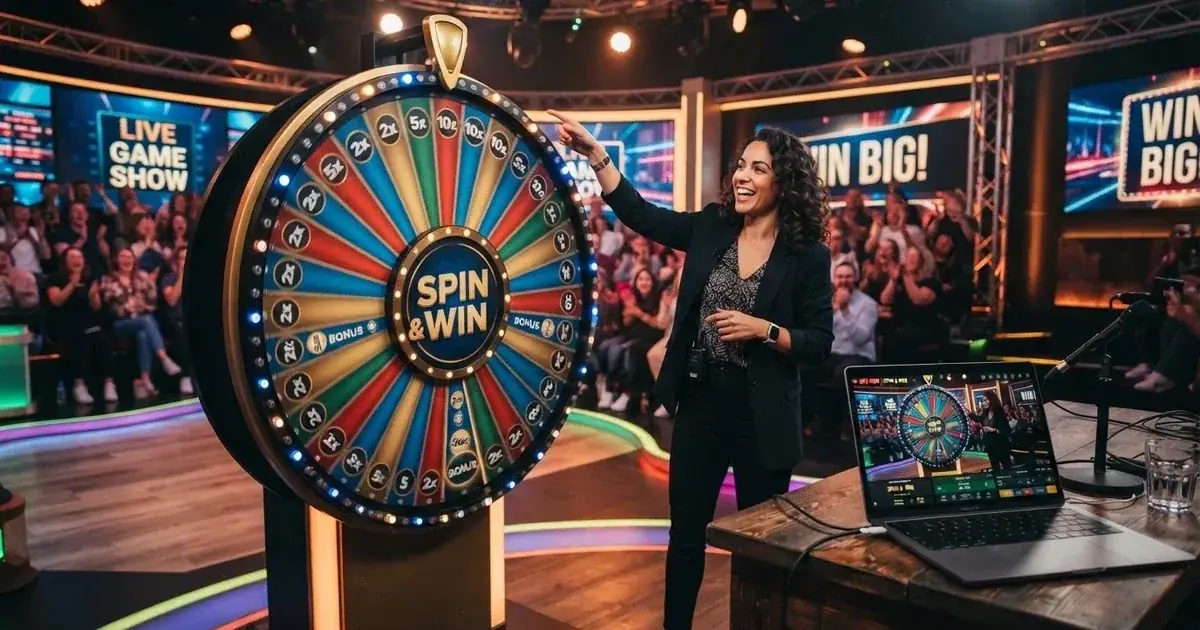
The live “Game Shows” category is a relatively recent invention. Evolution AB, a live casino studio founded in 2006 and headquartered in Stockholm, states that its Dream Catcher title launched in 2017 and created the format as it now exists. The original is a vertically mounted money wheel with 54 segments: 52 are numbered (1, 2, 5, 10, 20 or 40) and two are multiplier segments (2x and 7x). Players bet on the number they think the wheel will stop on, and a multiplier segment doubles or septuples the payout on the next winning number. That single product moved the live casino lobby away from green-baize table games and into studio production.

Evolution expanded the category in 2019 with MONOPOLY Live and Deal or No Deal Live, both built around familiar board-game and game-show formats. Crazy Time followed in 2020 and is now one of the studio’s best-known titles; Funky Time, a 1970s disco-themed spin-off, arrived in 2023. Through the same 2020 deal that brought NetEnt and Red Tiger into the group, Evolution broadened its slot output, but the live game show line — wheel-based, presenter-led, fixed-paytable — has stayed its own lane.
The crash-style format is the other main shape a UK player will meet. Aviator, developed by Spribe (a games studio founded in 2018), was released in 2019 and is described by Spribe’s CEO as the first true multiplayer crash game in the regulated igaming space. A multiplier curve rises from 1.00x until the round randomly crashes, and a player must cash out before the crash to win their stake multiplied by the value shown at that instant. Spribe reports that Aviator has more than 42 million active users and processes around 350,000 bets per minute across more than 5,000 operators worldwide. The format is not Evolution’s; it is a different studio’s answer to the same appetite for fast, present-tense betting.
A live casino game show, then, is a real-money product streamed from a studio with a live presenter, built around a wheel, a card draw, a multiplier curve or a money-prize board, with a fixed paytable published by the studio. That last point matters: the paytable is set by the studio and is the same on every licensed site that carries the title. The operator cannot negotiate a sweeter version of Crazy Time than the one its competitor runs. What the operator can change is the bet limits, the bonus terms applied to it, and whether the title is even in the lobby.
The distinction from a table game is structural rather than cosmetic. A standard live blackjack or roulette table is a real casino game streamed with a dealer, and the player is making decisions against a fixed house edge. A live game show is a wager on a fixed-paytable event produced for television, and the player’s only decision is which outcome to back, at what size, and when to stop. Both are real-money products on the same licence; both are covered by the same January 2025 RTS update. The slot-style stake cap does not apply to a live game show round in the way it does to a slot spin, which is one reason a player who has been nudged to set a deposit limit on slots should think about whether the same ceiling fits a Crazy Time session that resolves every twenty seconds.
Wheel-based titles and their mechanics
Wheel-based live game shows — Dream Catcher, MONOPOLY Live, Crazy Time, Funky Time — share a mechanic. The wheel has numbered and bonus segments, the player bets on a segment or a bonus round, and a fixed paytable governs the payout. Multiplier segments can multiply the next spin’s win, and bonus rounds typically introduce a separate wheel, a board game, or a pick-style feature with its own paytable layered on top. The house edge is built into the paytable itself: a 1-number segment pays 1 to 1, a 40-number segment pays 19 to 1 on a 54-segment wheel, and the gap between those payouts and the true odds is the studio’s margin.
Card and board-based titles
MONOPOLY Live and Deal or No Deal Live sit closer to a television game show than to a wheel. MONOPOLY Live drops the player onto a 3D board after a bonus segment lands, with Mr Monopoly collecting rent as the board is walked. Deal or No Deal Live uses a qualification phase (a brief bank-and-prize round) followed by an offer ladder that increases as more briefcases are opened, with the player choosing when to bank. Both have a fixed expected value the studio has calibrated; both can run for several minutes per round, which makes them a different pacing proposition from a 20-second wheel spin.
Crash-style titles
Aviator’s curve rises until it crashes. The player cashes out before the crash, or loses the stake. The RTP is set by the studio’s curve parameters, and the format is closer to a binary option than to a wheel. The 2.5-second minimum round speed and the no-celebration rule both apply; the autoplay ban is what keeps a player from queueing a string of auto-cashouts, because the round is fast enough that autoplay would otherwise be the default.
The Ten GB-Licensed Sites Reviewed
The ten brands below are taken from the Gambling Commission’s public register, where each domain is listed against the licence account that runs it. None of this is a ranking by product quality; it is the register’s ten featured entries, ordered as they appear in the operator set. Several brands sit under the same licence account — Virgin Games and Jackpotjoy are both white-label domains of Gamesys Operations Limited — and they are presented here as separate brand entries because the register lists them as separate websites, not as independent operators.
Every GB-licensed online operator must take part in GAMSTOP, must verify identity before the first deposit, must honour the 10x wagering cap that came into force on 19 December 2025, and must offer the safer-gambling protections described in the section above. The two facts the register confirms for each brand are the licence holder and the licence number. Anything beyond that — the bonus, the game-show lobby size, the payout speed — is the operator’s own claim and not part of the verification a register check provides.
| Brand | Licence holder | GB remote casino licence | Domain status | Live game show coverage |
|---|---|---|---|---|
| Virgin Games | Gamesys Operations Limited (account 38905) | 038905-R-319430-022 | White-label | — |
| Betfred | Petfre (Gibraltar) Limited (account 39544) | 039544-R-319290-010 | Active | — |
| Betfair | PPB Games Limited (account 39411) | 039411-R-319335-010 | Active | — |
| Sky Vegas | Bonne Terre Gaming Limited (account 65519) | 065519-R-339675-002 | Active | — |
| Gala Bingo | LC International Limited (account 54743) | 054743-R-330863-014 | Active | — |
| 32Red | Platinum Gaming Limited (account 45322) | 045322-R-324275-019 | Active | — |
| Casumo | Recro Limited (account 61549) | 061549-R-336718-002 | Active | — |
| Midnite | Dribble Media Limited (account 42647) | 042647-R-321653-022 | Active | — |
| PokerStars | Stars Interactive Limited (account 39108) | 039108-R-319334-026 | Active | — |
| Jackpotjoy | Gamesys Operations Limited (account 38905) | 038905-R-319430-022 | Active | — |
The dashes in the right-hand column reflect that the register does not record which live game show titles a brand stocks; that is product-level information the operator controls, not a register entry. A reader who wants to know whether a specific title is in the lobby has to look at the brand’s own lobby, not the Gambling Commission’s domain list.
Virgin Games (Gamesys Operations Limited)
Virgin Games appears on the register as a white-label domain of account 38905, with the active remote casino licence 038905-R-319430-022. White-label means the site trades under another company’s licence rather than holding its own, so Virgin Games is in the same regulatory envelope as Jackpotjoy, which sits on the same Gamesys account. The Gamesys platform carries Evolution’s full live casino catalogue on most of its UK-facing brands, so a player signing in to Virgin Games in 2026 is likely to see Dream Catcher, MONOPOLY Live, Crazy Time and the rest of the wheel-and-card titles the studio publishes. Whether each individual title is in the lobby is the brand’s call, and the register does not record that.
Betfred (Petfre (Gibraltar) Limited)
Betfred is registered as an active domain of account 39544, with the remote casino licence 039544-R-319290-010 held by Petfre (Gibraltar) Limited. The brand is best known as a high-street bookmaker, and its online casino runs alongside the sportsbook under the same Commission licence. Live casino game shows are part of the Evolution catalogue most large UK brands stock, and Betfred’s casino lobby has historically carried the studio’s flagship titles; again, the register does not say which titles are currently in the lobby, and the live-game-show column above is marked with a dash for that reason.
Betfair (PPB Games Limited)
Betfair sits on the register as an active domain of account 39411, with the remote casino licence 039411-R-319335-010 held by PPB Games Limited. Like Betfred, the brand is associated primarily with a betting exchange and sportsbook, and the casino vertical is an add-on under the same licence. The Commission’s 10x wagering cap and the mixed-product bonus ban both apply to any promotion the casino runs in 2026, which means a “bet on sport, get live game show spins” offer is no longer a structure the operator can build.
Sky Vegas (Bonne Terre Gaming Limited)
Sky Vegas is registered as an active domain of account 65519, with the remote casino licence 065519-R-339675-002 held by Bonne Terre Gaming Limited. Sky’s casino brand has a recognisable media tie-in, and the casino lobby is built around slots and live tables. Live game show titles on a Bonne Terre Gaming–licensed site depend on which studios the operator has integrated; the brand’s lobby is the only place to verify them.
Gala Bingo (LC International Limited)
Gala Bingo is listed as an active domain of account 54743, with the remote casino licence 054743-R-330863-014 held by LC International Limited. LC International also licences Ladbrokes and Coral in the UK market, so the three brands share one regulatory envelope. The bingo heritage shapes what a player meets at the lobby — bingo rooms tend to lead, with the casino and live verticals behind them — but live game shows from Evolution are a standard fixture on LC International’s casino products.
32Red (Platinum Gaming Limited)
32Red is registered as an active domain of account 45322, with the remote casino licence 045322-R-324275-019 held by Platinum Gaming Limited. The brand has a long-running association with Evolution’s live casino catalogue, having been one of the studio’s earliest UK-facing partners; that history is consistent with a live game show lobby in 2026, though the register does not list the current contents.
Casumo (Recro Limited)
Casumo is listed as an active domain of account 61549, with the remote casino licence 061549-R-336718-002 held by Recro Limited. The brand runs its own gamified loyalty layer on top of the standard casino product, and the live casino lobby is one of the advertised centrepieces. The register provides licence details, while lobby specifics remain at the operator’s discretion.
Midnite (Dribble Media Limited)
Midnite is registered as an active domain of account 42647, with the remote casino licence 042647-R-321653-022 held by Dribble Media Limited. Midnite is a newer UK-facing brand than the others on this list, and its product leans on sportsbook and casino. The register confirms the licence; the operator’s site should be consulted for the full inventory of live game shows.
PokerStars (Stars Interactive Limited)
PokerStars appears on the register as an active domain of account 39108, with the remote casino licence 039108-R-319334-026 held by Stars Interactive Limited. The brand’s identity is built around poker, and the casino vertical is an adjacent product on the same licence. A live game show lobby on PokerStars will typically reflect the same studio integration the wider Stars Group uses; information on specific titles is available in the brand’s own lobby.
Jackpotjoy (Gamesys Operations Limited)
Jackpotjoy is registered as an active domain of account 38905, with the remote casino licence 038905-R-319430-022 held by Gamesys Operations Limited — the same account and licence number as Virgin Games above. The two brands share a regulatory envelope, and the live casino product is typically the same Gamesys integration. A player who has used Virgin Games in 2026 will recognise the lobby layout at Jackpotjoy for that reason.
How Long the Wagering Cap Actually Takes to Clear
The wagering requirement is the multiplier the operator attaches to a bonus before the bonus funds, and any winnings earned from them, can be withdrawn. Until 19 December 2025 the UK market had no statutory ceiling, and operators routinely set 30x, 40x or 65x playthroughs on casino bonuses. From 19 December 2025 the cap is 10x, and a bonus on a UK-licensed site cannot legally carry a higher wagering requirement than that. The cap is enforced by the Commission under its licence conditions and codes of practice; a brand that tried to offer a 20x bonus in 2026 would be in breach.
The 10x cap changes what a bonus is worth in real terms. The arithmetic the page needs is the time it takes to clear a bonus at the new ceiling, because that is the figure a player actually feels. Turnover is the bonus multiplied by the wagering factor — a £100 bonus at 10x means £1,000 of qualifying wagers. Spins are turnover divided by the stake per spin — at £1 a spin, that is 1,000 spins. Time is spins multiplied by the 5-second interval that the Commission’s minimum round speed effectively sets as a floor for fast casino rounds, divided by 3,600 seconds per hour — 1,000 spins at 5 seconds each is 5,000 seconds, or roughly 1 hour 23 minutes.
What the result actually says depends on the stake size. The cap is 10x and the round-time floor is 5 seconds; what varies is the stake and the bonus amount. The result is therefore a band, not a single figure.
At the bottom of the band: a £10 bonus at 10x requires £100 of qualifying wagers, which is 100 spins at £1 a stake, taking about 8 minutes to clear — fast enough that the player will probably finish a session still feeling fresh. In the middle: a £50 bonus at 10x requires £500 of qualifying wagers, which is 500 spins at £1, taking about 42 minutes. At the top of a realistic small-stake band: a £100 bonus at 10x requires £1,000 of qualifying wagers, which is 1,000 spins at £1, taking roughly 1 hour 23 minutes, or — at a 50p stake — 2,000 spins at just over 2 hours 46 minutes. A player who has set a deposit limit that is smaller than the bonus itself is the one the 10x cap helps most, because the cap means a smaller bonus can clear in a manageable session rather than dragging across two or three deposits.
Two conditions shape what the band means in practice. First, the 10x cap applies to the bonus alone, not to bonus plus deposit — a “£100 bonus, 10x bonus only” structure is the kind of structure the cap was designed to allow. A structure that applied 10x to bonus plus deposit would be a different, harsher figure. Second, the time band assumes the player is wagering the full bonus amount and nothing else. A player who mixes in non-qualifying bets or plays at a stake below the bonus’s minimum-qualifying wager will see the time extend; a player who finishes early on a smaller bonus than the example will see it contract. The estimate is an average over many spins under the stated assumptions, not a guaranteed outcome for any single session, and it promises no win, no payout and no return — only the time the math says the playthrough will take.
The Wider UK Online Casino Landscape
The Gambling Commission’s public register listed 139 businesses holding an active remote casino operating licence on 18 September 2026, and the register can be searched online or downloaded in full as a CSV or Excel file. A remote casino licence number has a fixed form: a six-digit account number, then “R”, then a six-digit licence number, then a three-digit suffix — for example, 065519-R-339675-002, which is Sky Vegas’s licence. The “R” marks a remote (online) licence; the leading digits repeat the licence holder’s account number. A player who can read that string can identify the licence holder without trusting any other source.
The register’s domain list is the second piece of the picture. It records each website against the licence account that runs it, with a status of Active, Inactive or White Label. On 18 September 2026 the list held 1,065 active and 361 white-label domain entries. White-label means the site trades under another company’s licence; the 361 white-label entries are not 361 separately licensed businesses, they are 361 websites sharing licences with the 139 active licence-holding businesses. A brand that markets itself as independent and turns out to be a white-label domain of a larger licensee is not unlicensed — it is regulated under the parent licence — but the player should know which company is actually answerable for complaints.
The wider landscape is a fragmented one for a reason. Online casino is licensable under the Gambling Act 2005, and any operator taking customers in Great Britain needs a Commission licence wherever it is based. A Curaçao, Maltese or Gibraltar operating licence is not a substitute; since the Gambling (Licensing and Advertising) Act 2014, an offshore operator serving GB customers without a Commission licence is breaking section 33 of the 2005 Act. The Commission does not have the power to block ISPs, but it does issue cease-and-desist notices, refer sites for payment and hosting disruption, and ask search engines to delist. The penalty is aimed at the operator, not the player — but the player’s loss on an unlicensed site is the loss of every protection the licensed site has to offer: no GAMSTOP, no ADR route, no Commission complaints process, no 10x wagering cap, no £150 financial-vulnerability check, no credit-card ban, no deposit-prompt, no reality check, no net-spend display, no autoplay ban.
The tax and bonus position a UK player meets is set by statute and Commission rules. Players pay no tax on gambling winnings in the UK. Operators pay Remote Gaming Duty, raised from 21% to 40% from 1 April 2026 — a change that is the operator’s problem, not the player’s, but one that affects the margin operators can afford to run and therefore the bonus value a player can realistically be offered. The 10x wagering cap is the other big statutory pressure on bonus design, and the ban on mixed-product bonuses (bet on sport, get casino spins) closes off the cross-vertical offers that used to be common.
Licensing, Limits and What the Commission Requires
The Gambling Commission is sponsored by the Department for Culture, Media and Sport and regulates under the Gambling Act 2005, which covers Great Britain — England, Scotland and Wales — not Northern Ireland, where gambling is regulated separately. The Commission’s work runs on three instruments: the operating licence (the permission to take bets), the LCCP — Licence Conditions and Codes of Practice — and the Remote Technical Standards (RTS), which set the engineering-level requirements a remote product must meet.
The RTS is where most of the design rules a player actually feels live. The revised standards took effect on 17 January 2025 and extended slot-style rules — autoplay ban, 2.5-second minimum round speed, no-celebration on stake-returning outcomes — to other online gaming products including live game shows. The same update requires gambling systems to display a player’s net spend and net time in play during a session. The Commission also bans reverse withdrawals (since 31 October 2021) and has required operators to invite customers to set a deposit limit before the first deposit (since 31 October 2025).
Stake limits apply to online slots, not to live game shows. The £5-per-game-cycle ceiling for players 25 and over came into force on 9 April 2025; the £2 ceiling for 18–24-year-olds came in on 21 May 2025. The Government cited the highest average problem gambling score in the 18–24 age group, alongside lower disposable income and ongoing neurological development, as the reason for the lower cap. Live game shows are not subject to that cap, and the stake on a Crazy Time round is set by the operator’s table limits rather than by statute. That is one reason the deposit-prompt and GAMSTOP self-exclusion carry more of the burden on a live-game-show session than they do on a slot session.
Financial-vulnerability checks are the newest layer. From 28 February 2025 operators must run a public-data assessment when net deposits cross £150 in a rolling 30-day window, and must take “reasonably practicable” steps before accepting further deposits. The Commission has announced wider financial-risk assessments using bureau data, but those are not yet in force; the £150 threshold is the active rule.
Bonus and payment rules round out the picture. Credit cards have been banned for gambling since 14 April 2020, including credit cards routed through e-wallets — a player who tries to fund a deposit with a credit card funded through PayPal or Revolut will be declined. Wagering requirements have been capped at 10x since 19 December 2025, and mixed-product bonuses are banned. Anonymous play is not available at a licensed site; name, address and date of birth are verified before the first deposit.
The offshore alternative is not a substitute. Providing gambling to people in Great Britain without a Commission licence is an offence under section 33 of the Gambling Act 2005. The Commission disrupts illegal sites through cease-and-desist notices, search-engine delisting, and payment and hosting referrals, but it has no power to order ISP-level blocking. The player on an unlicensed site keeps whatever they win and loses whatever protection a licensed site would have given them — and that is the trade the offshore frame means for the reader.
The Online Casino Landscape in Context
| Brand | Licence holder | GB remote casino licence | Domain status | Live game show coverage |
|---|---|---|---|---|
| Virgin Games | Gamesys Operations Limited (account 38905) | 038905-R-319430-022 | White-label | — |
| Betfred | Petfre (Gibraltar) Limited (account 39544) | 039544-R-319290-010 | Active | — |
| Betfair | PPB Games Limited (account 39411) | 039411-R-319335-010 | Active | — |
| Sky Vegas | Bonne Terre Gaming Limited (account 65519) | 065519-R-339675-002 | Active | — |
| Gala Bingo | LC International Limited (account 54743) | 054743-R-330863-014 | Active | — |
| 32Red | Platinum Gaming Limited (account 45322) | 045322-R-324275-019 | Active | — |
| Casumo | Recro Limited (account 61549) | 061549-R-336718-002 | Active | — |
| Midnite | Dribble Media Limited (account 42647) | 042647-R-321653-022 | Active | — |
| PokerStars | Stars Interactive Limited (account 39108) | 039108-R-319334-026 | Active | — |
| Jackpotjoy | Gamesys Operations Limited (account 38905) | 038905-R-319430-022 | Active | — |
The 10x wagering cap, the deposit-prompt rule, the £150 financial-vulnerability threshold and the no-mixed-product-bonus rule are the four pieces of statutory pressure that changed the market in 2025. Each one compresses an operator’s margin or restricts a promotion structure; together they explain why a £50 free-spins offer is the new normal and a £500 welcome package with 65x wagering is not. For a player who has signed up to a UK-licensed site in the last six months, the experience is materially different from what the same player would have met in 2023. The site is required to ask before the first deposit, required to check at £150 in 30 days, and unable to apply a wagering multiple above 10x.
The studio side of the market is concentrated. Evolution AB’s live casino catalogue — Dream Catcher, MONOPOLY Live, Deal or No Deal Live, Crazy Time, Funky Time, and the wider wheel and card-based live range — is the dominant UK-facing live game show inventory. Spribe’s Aviator is the other title a UK player is likely to meet, as the leading crash-style multiplayer game. Pragmatic Play Live runs a competing live studio with its own game show titles, and several smaller studios publish wheel-based products, but Evolution’s footprint is the one that sets the tone of the lobby. When a UK player opens a live casino tab on a licensed site in 2026, the first titles in the lobby are most likely to be Evolution’s.
The wider market’s growth path is constrained by the 40% Remote Gaming Duty from 1 April 2026, which sits above the 21% rate that applied before. The duty is the operator’s, not the player’s, but it compresses the margin a brand can run, which in turn compresses the bonus value and the loyalty rewards the same brand can offer. A player who has watched welcome packages shrink across 2025 has watched one of the effects of that duty rise.
Reading the Commission’s Public Register
The public register is the test the Commission applies to itself: a brand either appears on it, with a current remote casino licence, or it does not. The register’s search tool is at gamblingcommission.gov.uk, and the full register is downloadable as a CSV or Excel file. Three fields are the ones a player needs.
The first is the licence number. A remote casino licence number has the form account-R-number-suffix — six digits, then R, then six digits, then three digits. The R marks a remote (online) licence; the leading six digits repeat the licence holder’s account number. A licence number that does not parse to that shape, or that the register does not return, is the sign of a brand that is not where it says it is.
The second is the licence holder. The register names the company that holds the licence, separately from the brand name. Several brands in this list — Virgin Games and Jackpotjoy, Ladbrokes and Gala Bingo — sit under one licence holder, and the register is the only place that fact is recorded cleanly. A player who has a dispute with a brand needs the licence holder’s name to route it through the Commission’s ADR process.
The third is the domain status. Active, Inactive or White Label. Active means the domain is the licence holder’s principal site. White-label means the domain trades under another company’s licence; the player on a white-label site is regulated through the parent licence, and complaints go to the parent. Inactive means the domain is parked; a player who reaches an inactive domain has reached a brand that the Commission is no longer treating as a current point of customer contact.
The register does not record bonus terms, payout times, game-show lobby contents, or any of the product-level information a player uses to compare brands. It records the licence, and that is the entire test of whether a brand belongs on a list of UK-licensed operators.
Frequently Asked Questions
What is a live casino game show, and how does it differ from a table game?
A live casino game show is a real-money casino product streamed from a studio with a live presenter, built around a fixed-paytable event — typically a wheel, a card draw, a multiplier curve or a board-game round — rather than a casino game played against a fixed house edge. A live table game (blackjack, roulette, baccarat) is a real casino game streamed with a dealer; the player is making decisions against the house. Both are licensed under the same Gambling Commission remote casino operating licence and covered by the same January 2025 RTS update, but the maths is different and the time-on-device shape is different.
Are live casino game shows streamed from a real studio?
Yes. Evolution’s live game shows — Dream Catcher, MONOPOLY Live, Crazy Time, Funky Time — are streamed from Evolution’s studios using a vertically mounted wheel, a board-game set or a card apparatus, with a live presenter on camera. Spribe’s Aviator is a different shape: a multiplayer crash game with a software-driven multiplier curve and no studio set. Both formats are streamed live; the studio is the difference, not the live-ness.
Do UK-licensed sites publish odds or payout structures for game shows?
The paytable is published by the studio and is the same on every UK-licensed site that carries the title — Dream Catcher’s 1, 2, 5, 10, 20 and 40 segment payouts, Crazy Time’s bonus-round pays, MONOPOLY Live’s board pays. The operator cannot vary the paytable; the operator varies the table limits and the bonus terms that sit on top. The fixed-paytable structure is why the house edge on a live game show is the same on every licensed site that stocks it.
Can a bonus be used to play a live casino game show?
It depends on the operator’s bonus terms. The 10x wagering cap that took effect on 19 December 2025 limits how heavy the playthrough can be, but it does not require an operator to allow a bonus to be cleared on a live game show. Many UK-licensed brands restrict bonus wagering to slots, with live tables and live game shows contributing 0% or a small percentage. The bonus terms — not the headline figure — are where a player should look.
Is a live casino game show hosted by a real presenter?
The wheel- and card-based formats (Dream Catcher, MONOPOLY Live, Crazy Time, Deal or No Deal Live, Funky Time) are presented by a live on-camera host. The crash-style formats (Aviator) have no host; the multiplier curve and a chat window are the entire interface. Both styles fall under the live game show category on most UK-licensed sites and are covered by the same January 2025 RTS rules.
Are live casino game shows covered by the same licence as slots on the same site?
Yes. A Gambling Commission remote casino operating licence covers all online casino products the operator runs — slots, live tables, live game shows — under one licence number. The brand’s domain on the public register is registered against one licence account, and the same account and licence number cover the full product set. The studio that supplies the live game show (Evolution, Spribe, Pragmatic Play Live) holds its own software licence with the Commission, separately from the operator’s licence.
Written by the editors at bankingcasinouk.