
Online craps at UK-licensed casinos in 2026: paytables, bonuses and the maths behind the bets
 Available in GB
Online craps in Great Britain lives behind a paywall the player never sees: a Gambling Commission remote licence. That credential is the only one that lets a brand take a sterling deposit, deal a digital or live craps table, and stay on the right side of section 33 of the Gambling Act 2005. The ten brands reviewed below all hold such a licence. None of them is being recommended as a place to play; the comparison is a starting point, and the choice belongs to the reader.

Craps is also a thin game online. The bet types that drive the table — Pass Line, Don’t Pass, the Odds layer behind them — carry low single-digit house edges that look attractive until the marketing arrives and rewrites them as “huge wins”. They are not huge. They are arithmetic.
The page below covers what an offer actually costs the player, what a UK licence actually requires, and what each of the ten brands actually is. The numbers come from research; the conclusions are the writer’s.
Current as of 23 September 2026. Verified against the Gambling Commission’s public register of gambling businesses.
Table of Contents
- The ten UK-licensed brands at a glance
- Craps at UK casinos: the fundamentals of the table
- How the UK licensing frame shapes the market
- Safer gambling at a UK-licensed casino
- Crypto, anonymity and the limits of “no verification”
- Bonuses on craps: the 10x ceiling in force since 19 December 2025
- Craps on a phone: browser, app and live dealer
- Craps paytables, providers and the closest neighbours
- Grosvenor Casinos — the brand with the deepest high-street footprint in the set
- Betfred — a family-controlled book that predates the online era
- 32Red — a single-brand licensee running the operation alone
- BetVictor — the longest-surviving founder-named book in the line-up
- William Hill — the high-street legacy with the broadest public recognition
- Virgin Games — a white-label domain running under Gamesys’s licence
- Ladbrokes — one of LC International’s brands on this list
- Paddy Power — the Flutter-owned marketing-led brand of the pair
- Betfair — Paddy Power’s exchange-rooted sibling under the same licence
- Jackpotjoy — Gamesys’s second white-label in the set, with bingo roots
- The bonus’s real cost: turnover at the 10x ceiling
- Frequently asked questions about UK online craps
The ten UK-licensed brands at a glance
| Brand | Licence holder and GB remote casino licence | Domain status | Craps availability | Licence account |
|---|---|---|---|---|
| Grosvenor Casinos | Rank Interactive (Gibraltar) Limited · 057924-R-334666-005 | Active | — | 57924 |
| Betfred | Petfre (Gibraltar) Limited · 039544-R-319290-010 | Active | — | 39544 |
| 32Red | Platinum Gaming Limited · 045322-R-324275-019 | Active | — | 45322 |
| BetVictor | BV Gaming Limited · 039576-R-319370-028 | Active | — | 39576 |
| William Hill | WHG (International) Limited · 039225-R-319373-015 | Active | — | 39225 |
| Virgin Games | Gamesys Operations Limited · 038905-R-319430-022 | White Label | — | 38905 |
| Ladbrokes | LC International Limited · 054743-R-330863-014 | Active | — | 54743 |
| Paddy Power | PPB Games Limited · 039411-R-319335-010 | Active | — | 39411 |
| Betfair | PPB Games Limited · 039411-R-319335-010 | Active | — | 39411 |
| Jackpotjoy | Gamesys Operations Limited · 038905-R-319430-022 | Active | — | 38905 |
The table above lists the ten brands reviewed on this page, ordered by the licence number’s account prefix rather than by any ranking of craps quality. None of them is “the best craps casino”; the comparison is structural, not editorial.

The first thing the spread shows is concentration. Four licence holders account for seven of the ten front doors: Gamesys Operations runs both Virgin Games and Jackpotjoy off the same account (38905), PPB Games runs both Paddy Power and Betfair off the same account (39411), and the other three licence holders each put one brand on the register. The remaining six brands — Grosvenor, Betfred, 32Red, BetVictor, William Hill and Ladbrokes — each occupy their own licence account.
A second pattern sits in the domain-status column. Eight of the ten sites are listed as Active domains of their licence account, meaning the same legal entity operates the brand. Two are listed as White Label. Virgin Games trades under Gamesys Operations Limited’s licence as a white-label site — Gamesys is the licensee, the Virgin brand pays for the licence. Jackpotjoy, despite running off the same account, is listed as Active. White-label status is a register flag rather than a quality judgement; what it tells the reader is that the operator behind the brand is Gamesys rather than the brand-named entity.
Third, the craps availability column is a row of em dashes. That is the honest answer to the craps question: research found no evidence — neither from the Commission’s register nor from any operator’s own published terms — that confirms a specific craps game at any of these ten brands as of the register snapshot. Several likely do, several clearly do not. A reader who wants craps will need to check the lobby of the brand they choose rather than rely on a comparison table to settle the matter. The rest of this page describes the frame within which that choice is made.
Craps at UK casinos: the fundamentals of the table
Craps is a simplification of an older English dice game called Hazard. The form played in casinos today traces to a Philadelphia dicemaker named John H. Winn, whose 1907 layout introduced the Don’t Pass wager and let casinos profit whichever side a bet was on — removing any incentive to weight the dice.
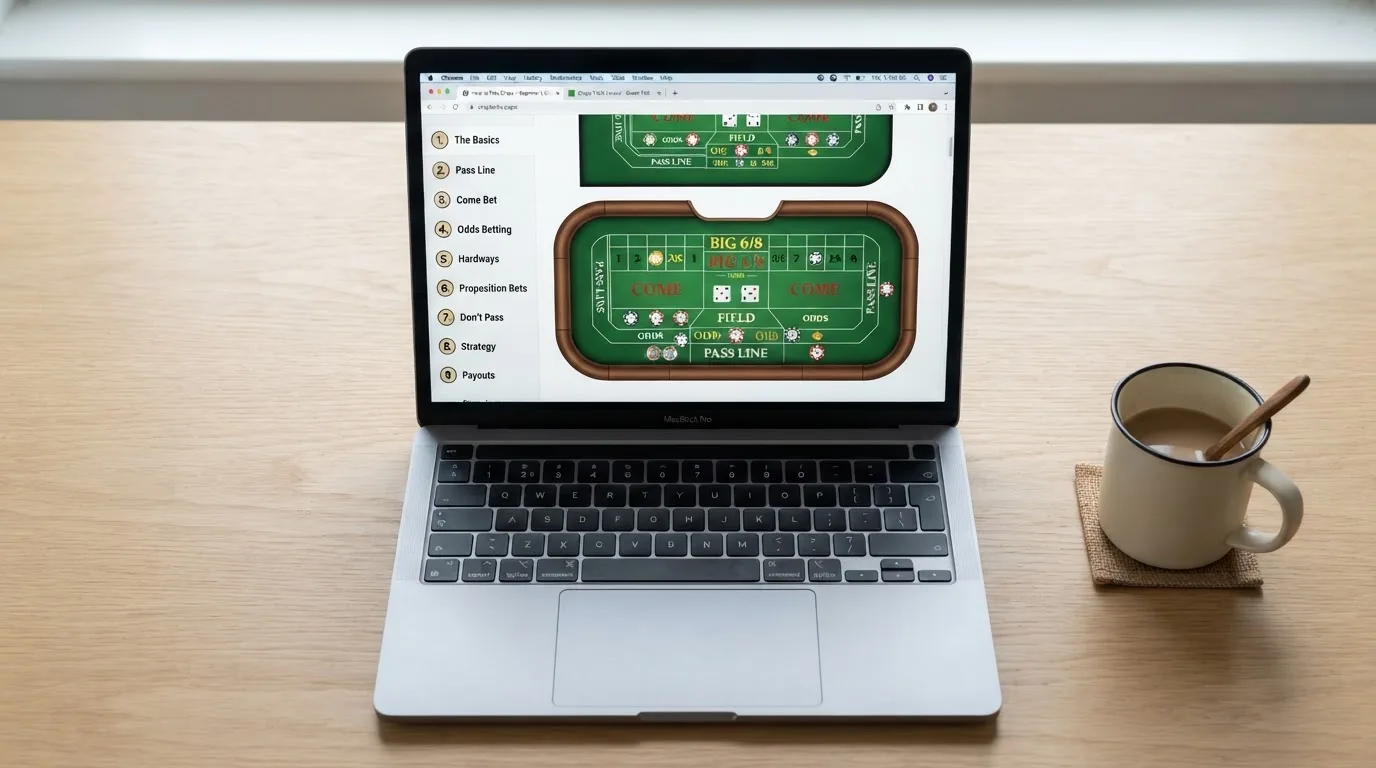
The physical table is U-shaped, with duplicate betting areas at each end and pyramid-textured walls along the rails designed to randomise the throw. Online, the layout is reproduced on screen and bets are placed by tapping or clicking. The maths, however, is the maths of the physical table. Nothing about the digital format changes the dice.
The bet that matters most is the Pass Line. It carries a house edge of 1.41%, which is low for a casino game but not zero. The Don’t Pass bet is its mirror: the player wins when the shooter loses, and the edge is fractionally lower, at roughly 1.36%. Behind either of these a player can stack an Odds bet, which pays at true mathematical odds and carries a 0% house edge. The catch is that an Odds bet can only be placed alongside an existing Pass or Don’t Pass wager, so it is not a standalone strategy — it rides on the main bet being live.
The proposition bets — Any Seven, Hardways, the Field — look bigger on the paytable because they pay more for a winning roll. They also lose more often. The maths behind a proposition bet at a craps table is, like every proposition bet in every casino game, the maths of a worse deal dressed up as a better one. The house edge on most prop bets runs from roughly 5% to over 11%. They exist because players like them, not because they are smart.
How a craps round is structured
Each round splits into two phases. The first roll, called the Come Out roll, decides whether a point is established. A 7 or 11 on the Come Out wins the Pass Line immediately; a 2, 3 or 12 loses it. Anything else — 4, 5, 6, 8, 9 or 10 — becomes the point, and the round enters its second phase. The shooter keeps rolling until either the point is rolled again (Pass Line wins) or a 7 appears first (Pass Line loses). Some bets resolve on the Come Out roll alone: the Field, Any Seven, Any Craps, the Horn bets. Others span the full point cycle: Pass Line, Don’t Pass, Come, Don’t Come, the Odds layer, Place bets. The two-phase structure is what gives craps its rhythm and what makes the table harder to read than roulette, where every spin stands alone.
Why craps is thin on the ground online in the UK
Online, craps is rarer than blackjack, roulette or baccarat. The reason is partly game design and partly commercial. The craps layout is the most complex of any casino game, and translating it into a tap-friendly mobile interface takes more design work than a wheel or a card. The proposition bets, which are the casino’s most profitable wagers, sit alongside the low-edge core bets that the smart player would rather make — so the house edge per player per minute is lower at craps than at almost any other live-dealer game.
The result, at UK-licensed sites in particular, is a thin supply. Evolution is essentially the only provider that runs a live craps table in the regulated European market; their Live Craps game, set in a speakeasy-themed studio, ships with an interactive tutorial and an Easy Mode aimed at players new to the layout. RNG craps, where a random number generator decides the dice, is rarer still — some sites carry it under their “Other” or “Dice” tab; many do not.
The wider UK market context is larger than the craps shelf would suggest. The Commission’s public register, as of the snapshot used for this page, listed 139 businesses holding an active remote casino operating licence and held 1,065 active and 361 white-label domain entries for online operators more broadly. The craps shelf is a small corner of a much larger catalogue.
How the UK licensing frame shapes the market
The Gambling Commission is the regulator for Great Britain (England, Scotland and Wales). Northern Ireland operates its own regime. The Commission is sponsored by the Department for Culture, Media and Sport and operates under the Gambling Act 2005, which was amended in 2014 by the Gambling (Licensing and Advertising) Act to require any operator taking customers in Great Britain to hold a Commission licence — wherever the operator is based.
Before that 2014 amendment, a UK-facing operator could legally run from Gibraltar, Malta or the Isle of Man and serve British customers without a Commission licence. The 2014 Act closed that loophole. From then on, a Curaçao, Maltese or Gibraltar licence is necessary but not sufficient for the UK market; the Commission’s own remote licence is the only credential that lets a brand take a sterling deposit from a customer in England, Scotland or Wales.
What holding a Commission licence obliges a brand to do
The Commission’s Licence Conditions and Codes of Practice (LCCP) and Remote Technical Standards set the rules every online licensee must follow. They include the safer-gambling protections covered in the section below — GAMSTOP, age and identity verification, the deposit-limit prompt — and the financial-conduct rules that govern how customer funds are held. They also cover the technical standards for game fairness, the rules around marketing, and the dispute resolution process a customer can use if they have a complaint.
An operator that fails to meet these conditions risks regulatory action: suspension, financial penalties, or revocation. The Commission’s enforcement record, published on its website, includes both — though the more common consequence for a serious breach is a settlement that includes a financial penalty and a published warning. The Commission does not advertise these settlements; readers who want to check can search the enforcement page directly.
What the public register actually shows
The Commission’s public register is the only place a reader can confirm whether a brand holds a UK licence. The register can be searched online and downloaded in full as CSV or Excel files, and it carries every active, inactive and white-label entry against the licence account that runs it.
The licence number format encodes the structure. A remote casino licence number has the form account-R-number-suffix, where the leading six digits repeat the licence holder’s account number and the “R” marks a remote (online) licence. So 32Red’s licence, 045322-R-324275-019, tells the reader that account 45322 (Platinum Gaming Limited) holds remote licence number 324275 with suffix 019. Two brands under the same account — Paddy Power and Betfair both run off PPB Games Limited’s account 39411 — share the same six-digit prefix, and the table above makes that visible.
The register also records each domain against the licence account that runs it. A status of Active means the same legal entity operates the brand. A status of White Label means the brand is trading under another company’s licence. Both statuses are legal under the Commission’s regime; the difference is structural, not regulatory.
Safer gambling at a UK-licensed casino
A UK licence imposes specific safer-gambling obligations that an offshore site does not have to meet. The obligations cover age and identity checks, mandatory participation in the national self-exclusion scheme, deposit limits, financial vulnerability checks, and the visibility of help services.
GAMSTOP has been a mandatory condition of every UK online gambling licence since 31 March 2020. Players can self-exclude for six months, one year or five years; the exclusion cannot be cancelled early and applies across every UK-licensed gambling site the customer tries to use. There is no equivalent at an unlicensed site. Signing up to GAMSTOP means a UK-licensed operator is required to refuse the customer’s deposit and close their account.
Identity checks have been mandatory before the first deposit or any play since 7 May 2019. Name, address and date of birth must be verified, and the verification must happen before money changes hands — not after. The same requirement applies whether the customer is depositing in sterling, in cryptocurrency, or via an e-wallet.
Deposit limits have moved into a different gear. Since 31 October 2025, every UK-licensed operator must prompt a customer to set a financial limit before accepting a first deposit. There is no state-set ceiling; the prompt is the obligation. The customer can set a limit, decline to set one, or change the limit later — but the prompt must appear before the first deposit can be made. A reader who wants to set a deposit limit on day one rather than accept the default can do so at any time through the responsible-gambling area of any UK-licensed site.
Financial vulnerability checks run on a different trigger. Since 28 February 2025, an operator must run a check using publicly available data when a customer’s net deposits in a rolling 30-day window reach £150. The check is a public-data screening rather than a credit check; wider financial risk assessments have been announced but are not yet in force. Where the check flags a concern, the operator must engage with the customer before further deposits are accepted.
Help services are not optional. Every UK-licensed site must display signposting to the National Gambling Helpline (run by GamCare) and to GambleAware. The helpline is free, confidential, and operates 24 hours a day. GambleAware funds treatment and research. Both appear in the responsible-gambling area of every licensed site.
The wider safer-gambling framework extends to game design. The Gambling Commission has banned auto-play for online slots entirely, requires a minimum spin duration of 2.5 seconds on slots, and has banned losses disguised as wins. The framework does not cover craps in the same way: craps is not a slot game, the 2.5-second rule does not apply to a dice throw, and auto-play is not a craps feature. The framework still binds the operator, just through different conditions.
What a player loses on an unlicensed site is protection: no GAMSTOP, no Commission complaints route, no approved alternative dispute resolution (ADR), and no recourse if the operator refuses to pay out. The Commission can disrupt unlicensed sites — cease-and-desist notices, payment and hosting referrals, search-engine delisting — but has no ISP-blocking power in Great Britain. No penalty is aimed at the player; the penalty is the absence of the framework above.
Crypto, anonymity and the limits of “no verification”
Search interest in “no verification” craps casinos runs high; the UK reality is that none of them is a UK-licensed brand.
A UK licensee has been required to verify a customer’s name, address and date of birth before any first deposit since 7 May 2019. The verification is mandatory whether the deposit is in pounds, in euros or in bitcoin. Cryptocurrency is not an anonymity workaround at a UK-licensed site; the operator still needs the same identity documents before the first deposit clears.
What cryptocurrency does at a UK-licensed site is mostly faster settlement and the absence of chargeback risk for the operator. Some licensed brands do accept crypto deposits — through their own conversion to sterling on receipt — but the conversion happens inside a verified account. There is no “anonymous crypto deposit” path at a licensed brand. The credit-card ban that came in on 14 April 2020 covered credit cards routed through e-wallets as well as direct credit-card deposits, so the only card-based routes left are debit cards and the e-wallets the operator has approved.
A crypto-only casino that does not hold a UK licence is a different proposition. It is not covered by GAMSTOP, not subject to the LCCP’s safer-gambling rules, and not within the Commission’s complaints jurisdiction. The Commission can disrupt such sites but cannot make them refund a customer. From the player’s side, the question is not whether the site accepts bitcoin; it is whether the site is licensed, and the only register that answers that question is the Commission’s.
The same logic applies to e-wallets, prepaid vouchers, and any other payment method advertised as “no ID needed”. The payment method is the easy part of the verification; the identity check still has to happen at the operator side, and a UK licensee cannot waive it. Offshore sites that do waive it are not subject to the Commission’s jurisdiction when the player wants to complain.
The marketing line that pairs crypto with craps is doing two jobs at once: it sells the player on a faster settlement path, and it sells the brand on the appearance of frictionless play. Neither claim survives a check against the register. The player who wants both — crypto funding and Commission protection — has the licensed brands to choose from. The player who wants anonymity has only the unlicensed ones, and the trade is everything the Commission framework was built to provide.
Bonuses on craps: the 10x ceiling in force since 19 December 2025
A UK-licensed casino cannot run a bonus that requires the customer to wager the bonus more than ten times before withdrawal becomes possible. That ceiling came in on 19 December 2025. Before that date, wagering requirements of 30x, 40x or higher were common on UK sites, especially on deposit bonuses. The 10x cap has changed what an offer can legally look like, and the maths of what a bonus costs the player has shifted with it.
The same package of reforms banned mixed-product bonuses — offers that combine a sportsbook bet with casino free spins or casino credit. The point of the ban was the same: the customer was being steered into a worse deal than the headline suggested, and the marketing framing was obscuring it. The market has moved since; welcome packages are now casino-only or sportsbook-only, and the bundling that used to dress up a small offer is gone.
What a craps player should look for in a bonus, given the new ceiling, depends on three things the terms state and one thing they sometimes do not.
Game weighting is the first. Many welcome packages list their game weighting by category — slots, table games, live casino — and craps can sit under any of the three depending on the operator. Some sites exclude craps entirely from bonus play; others count it at 10% or 20% of the wagering requirement, meaning the player has to put five or ten times the headline turnover through craps to clear the bonus. The terms will state the weighting. A reader who wants craps should look at the weighting before claiming, because a 10x cap on a £100 bonus is £1,000 of turnover at full weighting and £10,000 at 10% weighting.
Maximum stake per round while a bonus is active is the second. UK sites commonly cap this at £5 or lower for bonus play, and breach of the cap can void the bonus and any winnings from it. The cap is a defensive rule for the operator, not the player; the player who exceeds it usually does so without noticing.
Expiry window is the third. Most UK bonuses expire 30 days from issuance; some expire faster. A bonus with a tight window plus a wagering requirement the player cannot reasonably clear is, in practice, no bonus at all. The window is the constraint that determines whether the maths is even worth working through.
Withdrawal cap is the fourth, and the one the terms sometimes bury. Some bonuses carry a maximum cashout — a cap on how much of the bonus winnings the customer can actually withdraw. Where one is in place, it is stated in the terms. Where it is not, the bonus is more straightforward than the market average.
The 10x cap means the absolute worst case for a £100 bonus is £1,000 of required play at full weighting. The maths of that figure is in the calculation section below. The cap is the ceiling on what a bonus can cost the player; the game weighting is what determines whether the ceiling is the actual figure.
Craps on a phone: browser, app and live dealer
UK-licensed brands generally offer three mobile paths: a responsive browser site, a downloadable native app on iOS and Android, or both. The browser path is universal; the native app is not. Some brands have invested heavily in app design — William Hill, Betfair and Ladbrokes among them — while others run a browser-only mobile product and call that an “app” in marketing copy.
For craps specifically, the choice of path matters less than it does for a live-dealer blackjack table. The craps layout is the same in a browser tab as it is in a native app — the screen real estate is similar and the bets are placed by tapping the layout. The performance difference, where it exists, is in the load time and the responsiveness of the betting interface under network latency. A poor network will punish a craps interface more than a roulette one, because craps demands rapid bet placement across multiple areas during a single round.
Evolution’s Live Craps streams at the standard live-dealer resolutions and scales down to phone screens without losing the layout. The stream is the same stream a desktop player sees; what changes is the chip-placement interface, which the studio has redesigned for touch. Easy Mode, the studio’s newcomer-friendly interface, hides the proposition bets by default and exposes only the Pass Line, Don’t Pass, Come, Don’t Come and Odds bets — a sensible first exposure for a player who has never played craps before.
What does not change on mobile is the maths. The house edge on the Pass Line is 1.41% on a phone in the same way it is on a desktop. The 0% edge on Odds bets applies on a phone in the same way it does at a physical table. The mobile interface is a delivery mechanism; it does not change the game.
For tablet play, the experience is closer to desktop than to phone, because the screen real estate allows the full layout to render at usable size. The craps proposition bets, which are hard to tap accurately on a phone, become workable on a tablet. A reader who plays craps seriously and wants the full layout is better served by a tablet than by a phone, and better served by a desktop than by either.
Craps paytables, providers and the closest neighbours
The most visible craps product at a UK-licensed site is Evolution’s Live Craps. Set in a speakeasy-themed studio with dark wood and brass fittings, it includes a built-in interactive tutorial and an Easy Mode aimed at players new to the game. The round structure splits each turn into a Come Out roll followed by a Point roll, with some bets resolved after a single roll (the Field, Any Seven, the prop bets) and others spanning several rolls until the point is made or missed (Pass Line, Don’t Pass, the Odds layer).
The paytable at Evolution’s Live Craps is the standard craps paytable: Pass Line pays 1:1, Don’t Pass pays 1:1, the Odds layer pays at true mathematical odds (2:1 on a point of 4 or 10, 3:2 on a point of 5 or 9, 6:5 on a point of 6 or 8). The proposition bets pay at the standard craps proposition paytable (Any Seven 4:1, Hardways 7:1 to 9:1 depending on the number, the Field 1:1 or 2:1 depending on the roll). The house edge on each bet is the standard craps house edge.
The closest RNG alternative at some UK-licensed sites is a simpler dice game rather than a full craps layout. The interface tends to be a stripped-down Pass Line bet with optional Odds and a single proposition bet exposed. The maths is broadly the same, but the table feels thinner and the round structure is shorter.
The closest neighbours: dice games and crash formats
For players who cannot find craps at their UK-licensed brand, the closest neighbours in a casino lobby are dice games (Sic Bo, for example, a three-dice Asian table game with a similar feel but a different layout) and crash games. Spribe’s Aviator is the most prominent crash game at UK sites: it was released in 2019 by a studio founded the year before, and is described by Spribe’s own chief executive as “the first true multiplayer crash game in the regulated igaming space”. In an Aviator round, a multiplier curve rises from 1.00x and crashes at a random point; the player must cash out before the crash to win their stake multiplied by the current value. Spribe has reported more than 42 million active users and around 350,000 bets per minute across more than 5,000 operators worldwide.
Aviator is not craps. The maths is different, the format is different, and the regulatory framework treats it as a different game. The crash mechanic creates a volatility profile that is closer to a high-variance slot than to a table game: most rounds end with the player cashing out at a small multiplier, a few rounds run for tens of seconds at higher multipliers, and the long tail of crashes is what powers the house edge.
Sic Bo carries its own house edge structure, with payouts ranging from 1:1 on the small/big bets to 180:1 on a specific triple. The maths is wider and flatter than craps: more ways to lose, more ways to win a small amount, and a few long-odds bets that look generous until the maths catches up. A craps player who moves to Sic Bo is trading the structured Come Out/Point sequence for a single-die outcome with more bet types.
For a reader who has decided they specifically want craps, the closest substitute at a UK-licensed site is Live Craps where it is offered; the next-closest is Sic Bo; the next after that is a crash game. None of these is craps, and the reader who wants craps should ask the brand directly before depositing rather than assume a dice or crash game will do.
Grosvenor Casinos — the brand with the deepest high-street footprint in the set
Grosvenor Casinos runs a remote casino operating licence through Rank Interactive (Gibraltar) Limited, account 57924. The domain Grosvenor Casinos is listed as Active on the register against that account, and the licence number is 057924-R-334666-005.
The brand sits inside the Rank Group’s UK operation. Rank also runs Mecca Bingo and a string of regional casinos under the Grosvenor name; the online arm is the thinnest part of that business by customer count, though not by revenue per customer. The high-street Grosvenor estate gives the brand a recognisable footprint among UK players who may never have used the online product, and a customer walking into a Grosvenor casino on a Saturday night is a customer the online arm knows it can reach.
The licence account is the same one that backs any other Rank Interactive domain; the operator’s compliance obligations run through the Gibraltar-resident company. The regulator, however, remains the Gambling Commission, and the LCCP obligations are the same as for any other UK-licensed brand. A reader should not assume that a Gibraltar corporate vehicle means Gibraltar regulation; the Commission’s regime applies to the operator regardless of where the company is incorporated.
The Commission’s register is the only place to confirm whether Grosvenor currently carries a craps table in its online lobby; the brand’s own marketing page will list game categories rather than specific titles, and the lobby itself is the final authority.
Grosvenor’s structural case rests on the high-street estate — a chain that predates online and still anchors the brand in a recognisable UK footprint.
Betfred — a family-controlled book that predates the online era
Betfred runs through Petfre (Gibraltar) Limited, account 39544, under licence 039544-R-319290-010.
Betfred is one of the few large UK-licensed operators that remains under family ownership. The Done family controls the parent company; the high-street book was founded in 1967 in Salford, and the online operation was added in the 2000s. The company is not listed on a public exchange, which gives the Done family a freedom from quarterly earnings pressure that the plc-owned competitors on this list do not have.
The Gibraltar-resident corporate vehicle is the operator on the register; the underlying ownership is unchanged from the high-street years. The Commission’s safer-gambling and conduct obligations apply to the operator in the same way as to any other licensee. Betfred has been the subject of Commission enforcement action in the past, and the operator’s published settlements are part of the public record that any reader can check.
The Done family’s continued control is Betfred’s structural quirk in a market where most large operators are now plc-owned. That ownership profile is independent of the licence number behind the brand.
32Red — a single-brand licensee running the operation alone
32Red runs through Platinum Gaming Limited, account 45322, under licence 045322-R-324275-019.
Platinum Gaming operates 32Red as its only brand on the register. That is unusual among the ten on this list: most of the other licence accounts run two or more brand domains, but Platinum Gaming’s account carries one. The brand was founded in 2002 and has run as a focused casino-and-sportsbook product since the early years of the UK online market, and the parent group’s corporate structure has narrowed around the brand rather than expanding behind it.
A single-brand licensee has the same Commission obligations as a multi-brand one; the difference is purely structural. The reader should not infer product quality from the number of brands on the licence account. A licensee with one brand can run a tighter operation than a licensee running five, but the LCCP and the Remote Technical Standards are the same for both.
Platinum Gaming’s one-brand licence account is the narrowest footprint in this comparison — small, focused, no sister brands under the same number. The reader who prefers a single-product operator will find that footprint visible on the register.
BetVictor — the longest-surviving founder-named book in the line-up
BetVictor runs through BV Gaming Limited, account 39576, under licence 039576-R-319370-028.
The brand takes its name from its founder, Victor Chandler, who moved the operation to Gibraltar in the 1990s to take advantage of a more permissive regulatory regime for online betting at the time. The Chandler family’s involvement has reduced over time, but the founder’s name remains on the front door and the brand has retained a sportsbook-led identity in a market that has tilted toward casino-first operators.
BV Gaming is the operator; the brand is licensed through that corporate vehicle. The Commission’s framework applies in full. BetVictor’s product range has broadened over the years to include a casino vertical alongside the sportsbook, but the brand identity still sits closer to the betting side than to the casino side, and the craps offering, if any, sits inside the casino vertical rather than as a featured product.
BetVictor’s founder name has stayed on the front door across two decades of corporate change. That continuity is independent of who owns the company now, and independent of the licence number behind the brand.
William Hill — the high-street legacy with the broadest public recognition
William Hill runs through WHG (International) Limited, account 39225, under licence 039225-R-319373-015.
William Hill is the most widely recognised UK high-street betting brand, founded in 1934 and operating from hundreds of shops in Great Britain before the online operation grew to dominate the business. The online arm now sits within the same broader group as 888, which has rebranded as Evoke plc; the Commission’s register records WHG (International) Limited as the licence holder rather than the high-street chain directly. The high-street estate and the online licence are two different legal entities on the register, and a reader who picks William Hill by the high-street name is picking the WHG International licence behind it.
The Commission’s framework applies to WHG (International) Limited; the brand recognition is the brand recognition; the regulator does not inherit reputation from either. A reader who picks William Hill by name is picking the brand, not the corporate group above it.
William Hill’s public recognition is broader than any other brand in the comparison, and that recognition is independent of the WHG International licence behind it.
Virgin Games — a white-label domain running under Gamesys’s licence
Virgin Games runs through Gamesys Operations Limited, account 38905. The domain Virgin Games is listed as White Label on the register, and the licence number is 038905-R-319430-022.
A white-label domain is one that trades under another company’s licence. Gamesys Operations Limited is the licensee; Virgin Games is the brand that pays for the licence. The legal obligation to meet the LCCP’s safer-gambling, technical and conduct rules runs through Gamesys, not through the Virgin brand. The Commission treats both as responsible for the customer outcome, and a complaint made by a Virgin Games customer is a complaint against Gamesys Operations Limited as the licensed operator.
Virgin Games is part of the Gamesys stable; the same account also runs Jackpotjoy, which is listed as Active (the difference is a register flag, not a regulatory distinction). The Commission’s complaints route runs to Gamesys Operations Limited regardless of which front door the customer used to reach the site.
The Virgin brand and the Gamesys operator are two different entities on the register, and the regulator follows the operator. A reader who cares about who is on the hook for safer-gambling compliance should read Gamesys, not Virgin.
Ladbrokes — one of LC International’s brands on this list
Ladbrokes runs through LC International Limited, account 54743, under licence 054743-R-330863-014.
LC International Limited is the operator for the wider Ladbrokes-Coral-Gala Bingo stable within the Entain group. Three brands from the group are on the Commission’s register; Ladbrokes is the one on this list. The operator on the register is the same legal entity behind all three, and the licence account is shared.
A reader who picks Ladbrokes for craps is picking one front door of one operator; the licence account is shared with sibling brands they may not have heard of. The Commission’s framework applies to LC International Limited as a single regulated entity, and a complaint made by a Ladbrokes customer sits in the same operator’s complaint file as a Coral customer’s complaint.
LC International runs a stable of brands from the same licence account; Ladbrokes is one of three on the register, and the others are part of the same operator’s record.
Paddy Power — the Flutter-owned marketing-led brand of the pair
Paddy Power runs through PPB Games Limited, account 39411. The domain Paddy Power is listed as Active, and the licence number is 039411-R-319335-010.
PPB Games Limited is the operator for the Paddy Power and Betfair brands within the Flutter group. Paddy Power carries the marketing-led identity of the pair; Betfair carries the exchange heritage. The two share one licence account; the Commission treats them as one operator with two front doors.
The Flutter group is one of the largest gambling groups globally. The Commission’s framework applies to PPB Games Limited; the corporate group above it is outside the Commission’s direct jurisdiction, though the Commission’s enforcement can reach the operator on the register where a group-level decision causes harm.
Paddy Power and Betfair share one PPB Games Limited licence, so the marketing-led identity sits alongside the exchange-rooted one under one roof. The reader who treats them as separate operators is reading the front doors, not the licence account.
Betfair — Paddy Power’s exchange-rooted sibling under the same licence
Betfair runs through PPB Games Limited, account 39411. The domain Betfair.com is listed as Active, and the licence number is 039411-R-319335-010.
Betfair was founded in 2000 and built its identity around the betting exchange, a peer-to-peer betting format that predated the current wave of sportsbook-led operators. The merger with Paddy Power in 2016 brought the two brands under one corporate roof; the Commission’s register records them under one licence account. The exchange product is still distinct from a sportsbook, and the brand retains its own identity in the market.
For a reader comparing this list, Betfair and Paddy Power are not two separate operators. They are one PPB Games Limited licence with two front doors, and the Commission’s enforcement record on PPB Games Limited covers both. A complaint made by a Betfair customer and a complaint made by a Paddy Power customer land in the same operator’s file.
Betfair keeps its distinct identity inside Flutter, but the Commission’s licence account is the same as Paddy Power’s, and the operator behind both is the same legal entity.
Jackpotjoy — Gamesys’s second white-label in the set, with bingo roots
Jackpotjoy runs through Gamesys Operations Limited, account 38905. The domain Jackpotjoy.com is listed as Active, and the licence number is 038905-R-319430-022.
The Jackpotjoy brand has roots in the bingo-led online market that grew up in the early 2000s. Gamesys Operations Limited is the operator; the brand sits alongside Virgin Games on the same licence account, with Virgin Games listed as White Label and Jackpotjoy as Active. Both flags are register-level classifications; the regulatory framework treats them identically.
The brand is most associated with bingo, slots and game-show formats; its craps offering, if any, is not something research confirmed for this page. The reader who wants craps will need to check the lobby directly rather than rely on the brand’s primary vertical as a guide.
Jackpotjoy’s bingo roots set it apart from the sportsbook-heavy brands on the rest of the list, and the Gamesys account behind it is the same one that runs Virgin Games. The constant is the operator, not the front door.
The bonus’s real cost: turnover at the 10x ceiling
The 10x wagering cap that came in on 19 December 2025 is the most consequential recent change to UK bonus terms. It puts a ceiling on the worst case a player can face: a bonus can never require more than ten times its value in turnover before withdrawal becomes possible.
The maths is straightforward. A £10 bonus puts £100 of required turnover on the table. A £50 bonus carries £500 of required turnover. A £100 bonus carries £1,000. A £500 bonus — at the upper end of what a UK welcome package typically offers — carries £5,000 of required play. The band is the range of bonus sizes that the UK market currently runs, multiplied by the 10x ceiling. A player picking a bonus is picking a point on that band, and the band’s lower end (£100) is the cheapest case the law now allows.
The qualifier matters. A 10x cap is the maximum rather than the norm. Many UK bonuses still run at lower multiples, and a bonus running at the cap is the worst legal case, not the most common one. The reader should treat any UK bonus as living somewhere on this band and check the actual figure in the terms before claiming. The cap is the ceiling on what a bonus can cost; the actual figure is whatever the operator has set below the ceiling.
The other qualifier is the game weighting. A £100 bonus at 10x wagering still requires £1,000 of play at full weighting; if craps is weighted at 10% of turnover at the operator in question, the player has to put £10,000 through craps to clear the bonus. That figure is not on the band above because the band is the cap on turnover, not the weighted turnover at a specific game weighting. A reader should multiply the cap by the inverse of the game weighting to find the real required play at their chosen game, and the result will often sit well above the headline cap.
The expected loss at a craps table is roughly turnover times (1 minus RTP). At a house edge of 1.41% on the Pass Line, the expected cost of clearing a £100 bonus at 10x wagering is roughly £14 — the £1,000 of required turnover multiplied by the 1.41% edge the house carries on that bet. A larger bonus and a higher cap multiply that figure linearly. The marketing word for the resulting offer is “player-friendly”; the 10x cap is the ceiling on how unfriendly a bonus can legally be, and the reader should treat the two as one.
The cap is not the only constraint. Maximum stake, expiry window, and the withdrawal cap (where one applies) all sit on top of the turnover figure. A £100 bonus at 10x with a £5 max stake and a 30-day window is the cheapest version of that bonus; the same £100 bonus with a tighter window or a lower max stake is harder to clear. The 10x cap is the headline; the rest of the terms are what determine whether the headline is real.
Frequently asked questions about UK online craps
How do payouts work at a UK-licensed online craps table?
Payouts at an online craps table follow the same maths as a physical one. The Pass Line pays 1:1, the Odds layer pays at true mathematical odds (2:1 on points of 4 or 10, 3:2 on 5 or 9, 6:5 on 6 or 8), and the proposition bets pay at the craps-standard rates. A UK-licensed operator cannot alter these rates without separate approval from the Commission, and the rates visible in the lobby are the rates that apply.
Is online craps offered as a live-dealer game in the UK?
Yes, at some UK-licensed brands. Evolution is the main provider; their Live Craps game, set in a speakeasy-themed studio, runs at several major UK operators. Live craps is not universal, however — many UK-licensed brands carry other live tables but not craps specifically. The reader should check the live lobby of the brand they are considering before depositing.
Can craps be played through a UK casino’s mobile app?
Mostly yes, with the same caveat as the desktop product. Evolution’s Live Craps streams to phone screens at the standard resolution and offers a touch-friendly betting interface. A UK brand with a native app will carry the same game as the desktop site; a browser-only mobile product will carry it through the mobile browser. The maths is the same either way.
Do online craps tables in the UK use the same bets as a physical casino?
Yes. The standard craps bet types — Pass Line, Don’t Pass, Come, Don’t Come, the Odds layer, Place bets, the Field, the proposition bets — are all present at an online craps table. Easy Mode, Evolution’s newcomer-friendly interface, hides the proposition bets by default and exposes only the core bets. A reader who wants the full craps layout should turn Easy Mode off.
Are crypto-friendly UK casinos’ craps tables any different from standard ones?
The craps table itself is identical; the same provider streams the same game to every brand that carries it. The payment side is different: a crypto-friendly UK-licensed brand accepts bitcoin or other cryptocurrencies, converts them to sterling on receipt, and runs the game in pounds. The Commission requires identity verification at the deposit stage regardless of payment method, so a UK-licensed crypto-accepting brand is not an anonymous one.
Published by the bankingcasinouk team.