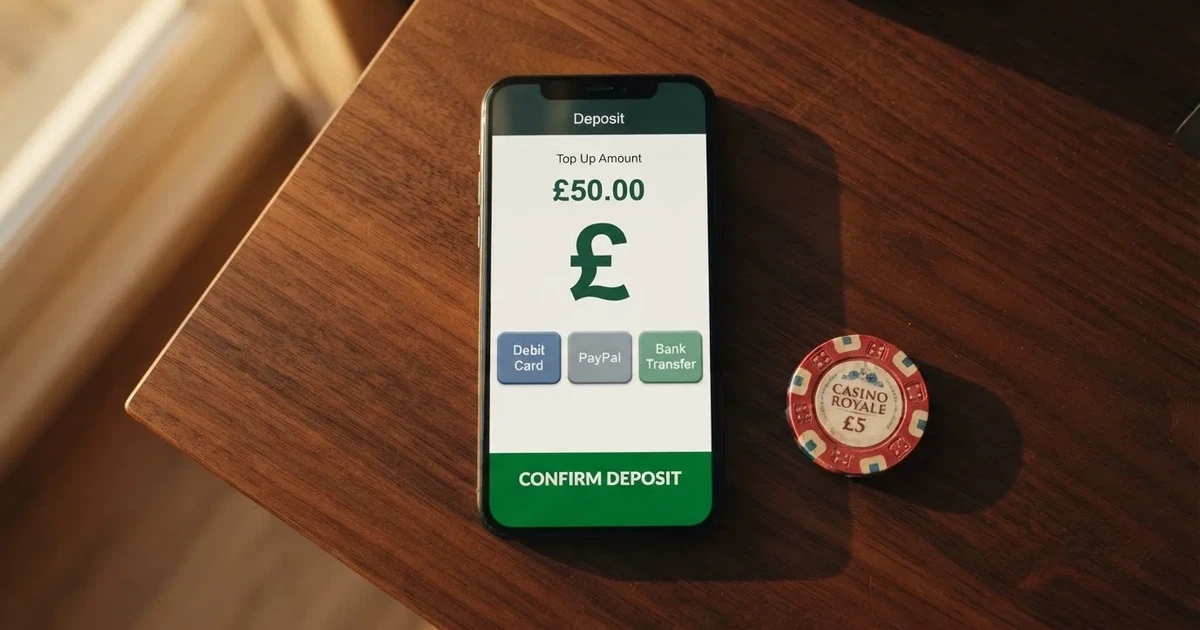
Debit card deposits at UK-licensed casinos: a register-first comparison
 Available in GB
23 September 2026 · verified against the Gambling Commission’s public register of gambling businesses.

A debit card is the funding method most British players already hold in their pocket, so a search for casino sites that accept debit card in the UK is really a search for two things at once: which licensed operators take it as a matter of course, and how the licence sitting behind each one shapes what a player can actually do with the money once it lands. The Gambling Commission’s public register is the place where both questions answer themselves, because every remote casino serving customers in Great Britain appears there with a current licence, an operating company and the exact domain a player types into a browser. On 18 September 2026 that register listed 139 businesses holding an active remote casino operating licence and 1,065 active domain entries — the universe a comparison has to be drawn from.
This page is built around that register. Ten licensed brands sit side by side below; each carries its licence number, the licensee behind it, and the domain status the Commission recorded on the snapshot date. Where the register is silent on a feature research could not verify, that silence shows up in the comparison rather than getting dressed up as a finding. The closing sections move from the payment itself to what a debit card deposit runs into on the way through — verification, the £5 and £2 online slot caps, GAMSTOP self-exclusion, and the 10x wagering cap that has applied to every bonus at a GB-licensed site since 19 December 2025.
Table of Contents
- Responsible gaming: what the licence actually obliges
- Payments and payout speed at a licensed UK casino
- The ten licensed brands: a register-first comparison
- Overview: what a debit card deposit really is at a GB-licensed casino
- Legality and regulation: what the licence file confirms
- What the 10x wagering cap means for a bonus at a GB-licensed site
- What a debit card deposit does and does not decide
- The bank-side picture: which UK banks shape what a deposit looks like
- How to read the register if you want to check any brand yourself
- Choosing between these ten brands
- What changes when a player has set a bank-side gambling block
- Where this page stops
- Frequently asked questions
Responsible gaming: what the licence actually obliges
A deposit by debit card drops into an account that is, by law, a controlled environment. The licence condition the Commission attaches to every remote operating licence is the reason a GB-licensed site can be compared against another on anything other than bonus wording: the rules that shape how a deposit behaves are not the operator’s choice, they are written into the licence.

The mandatory safeguards
Three safeguards apply to every licensed brand on this page, regardless of how the account was funded. GAMSTOP self-exclusion has been a mandatory condition of every online licence since 31 March 2020, and a player who signs up for a six-month, one-year or five-year exclusion cannot reverse it during the term. Deposit limits and reality checks sit alongside it — operators must prompt a customer to set a financial limit before the first deposit (a rule in force from 31 October 2025), and the same date brought the prompt-driven reality check that interrupts play at regular intervals. Anonymous play is not possible at a licensed site: name, address and date of birth are verified before the first deposit or any play, and the rule has stood since 7 May 2019.
The credit-card ban and what it means for debit
Credit cards have been banned for gambling since 14 April 2020, including credit-card transactions routed through e-wallets. The same payment rails that take a credit card in everyday retail are the ones a debit card rides on, which is why the ban draws the line by source of funds rather than by card network: a Visa debit card draws straight from a current account and stays legal, while a Visa credit card on the same checkout gets declined. The rule reshaped the UK deposit market in one stroke and is the reason this page is a debit-card comparison rather than a card-acceptance comparison in the broader sense.
Where the offshore gap sits
A Curaçao, Malta or Gibraltar licence does not cover players based in Great Britain. Since the Gambling (Licensing and Advertising) Act 2014, any operator taking customers in Great Britain needs a Commission licence wherever it is based, and providing gambling to people in Great Britain without one is an offence under section 33 of the Gambling Act 2005. The Commission’s enforcement tools are cease-and-desist notices, search-engine delisting and payment and hosting referrals — no ISP-blocking power — and the consequence for a player who ends up on an unlicensed site is the loss of protection rather than a penalty: no GAMSTOP, no Commission complaints route, no approved alternative dispute resolution. A search for “debit card casinos not on GAMSTOP” pulls up that offshore gap; this page does not, because the brands compared below all hold a GB licence.
Payments and payout speed at a licensed UK casino
A debit card is processed like any other UK funding method at the deposit step, but the withdrawal side of the same transaction follows a slower path. The contrast between the two — near-instant in, multi-day out — is the practical detail that decides whether a brand feels responsive or slow, and it does not depend on the card used.
How deposits behave
A deposit by Visa or Mastercard debit typically clears on the casino side within seconds, the bank side within minutes, and the funds show as playable balance almost immediately. Verification runs before the first deposit rather than after it, so a returning player will see the speed that gives debit cards their everyday appeal. The minimum deposit varies by brand, and operators commonly set it at £5 or £10 — a number that the page’s comparison surfaces rather than assumes.
How withdrawals behave
Withdrawals back to the same debit card follow the same settlement timetable as any other method at the operator, typically minutes for a same-brand fast-track and up to a few working days where the bank processes through Faster Payments or BACS. The licensed brand does not control that downstream timetable: a withdrawal marked “complete” on the operator’s side still waits on the card issuer. The honest read is that withdrawals are operator-paced up to a point and bank-paced beyond it, and a player who treats the two as one number is treating two different things as one.
Why the funding method matters less than the licence
The payment rails inside a GB-licensed operator are broadly similar because the licence sets the same baseline: KYC before first deposit, source-of-funds checks at trigger thresholds, segregation of player funds. The differences that show up in a comparison are operator-level choices — minimum deposit, withdrawal ceiling per transaction, internal pending window — rather than rail-level differences. That is why the comparison below focuses on what each brand’s licence file says and where its terms vary, rather than on a feature-by-feature payment-method checklist the register does not carry.
The ten licensed brands: a register-first comparison
The brands below are taken in the order research sets from the Gambling Commission’s public register. Each entry carries the licence number and licensee as the Commission records them, and the domain status the register showed on 18 September 2026. Where research could not verify a feature the comparison invites, the entry holds that absence rather than naming it.
| Brand | Licence holder | GB remote casino licence | Domain status on the register |
|---|---|---|---|
| Betfair | PPB Games Limited | 039411-R-319335-010 | Active |
| kwiff | Eaton Gate Gaming Limited | 044448-R-323408-017 | Active |
| 888casino | 888 UK Limited | 039028-R-319297-014 | Active |
| Grosvenor Casinos | Rank Interactive (Gibraltar) Limited | 057924-R-334666-005 | Active |
| Gala Bingo | LC International Limited | 054743-R-330863-014 | Active |
| Virgin Games | Gamesys Operations Limited | 038905-R-319430-022 | White Label |
| PokerStars | Stars Interactive Limited | 039108-R-319334-026 | Active |
| 32Red | Platinum Gaming Limited | 045322-R-324275-019 | Active |
| bet365 | Hillside (UK Gaming) ENC | 055149-R-331499-004 | Active |
| MrQ | Tek Fox Ltd | 060629-R-337532-004 | Active |
Ten operators, ten licence numbers, one register. The licence numbers are not interchangeable: every number on this table starts with the same six-digit account number that the Commission assigns to the operating company, followed by -R- to mark a remote licence, a serial, and a suffix that increments as a licence is renewed. A player who wants to check any of these can paste the number into the Commission’s public register and pull up the same record this page is built from.
Betfair — the longest-running sportsbook on the list
Betfair sits in this comparison through its PPB Games Limited licence, account 39411, with the active remote casino operating licence 039411-R-319335-010. The Betfair.com domain is logged as active on the register. The brand’s profile is the sportsbook-casino hybrid: the casino product runs beside an exchange, and a player comparing this entry to a casino-only brand is comparing two different product shapes rather than two operators. The licence file does not list a debit-card-specific feature, and the comparison leaves that field open.

For the player who already uses Betfair for sports and wants the casino product alongside it, this entry is the natural fit. If you prefer a pure casino experience, the dedicated casino brands below offer a more streamlined alternative.
kwiff — the most recently licensed operator on the comparison
kwiff operates under Eaton Gate Gaming Limited, account 44448, holding remote casino operating licence 044448-R-323408-017. The Kwiff.com domain is logged as active. The relatively higher suffix on the licence number — compared with the long-established 039-prefixed entries above — reflects the later issue date rather than any difference in regulatory standing, and the same baseline rules apply: GAMSTOP, KYC before first deposit, the £5 and £2 slot caps.
The brand has built its identity around a stake-size mechanic that surprises the player at the point of a wager, which is why it sits on the comparison even though the Commission’s register carries no debit-card-specific row for it. For a player who wants a different shape of stake from the conventional fixed-odds line, this entry fits; for a player who wants the conventional line, the longer-established entries are the closer comparison.
888casino — the standalone casino brand
888casino operates under 888 UK Limited, account 39028, with remote casino operating licence 039028-R-319297-014. The 888casino domain is logged as active. Unlike Betfair or Gala Bingo, this brand is built as a casino-first product rather than a hybrid, and that is what the licence file alone does not show — what it does show is the same GB-licensed baseline as every other entry on the comparison.
For the player whose benchmark is casino-first product depth, this entry is the closer fit. If your preference is casino-first, this brand is an excellent choice. Those who also value sports betting may find hybrid platforms a more comprehensive solution.
Grosvenor Casinos — the high-street name behind an online licence
Grosvenor Casinos operates online under Rank Interactive (Gibraltar) Limited, account 57924, holding remote casino operating licence 057924-R-334666-005. The Grosvenor Casinos domain is logged as active. The high-street casino name behind it is well known, but the online product is run by a different legal entity from the bricks-and-mortar estate — a separation that the licence file makes explicit through the Gibraltar-registered operating company.
For a player who knows the high-street name and wants the online product to feel like it, this entry is the natural fit. Fans of the high-street brand will likely find the online experience familiar and consistent. Players seeking a purely online, standalone casino may prefer other entries in this list.
Gala Bingo — a brand inside a multi-brand licensee
Gala Bingo operates under LC International Limited, account 54743, with remote casino operating licence 054743-R-330863-014. The Gala Bingo domain is logged as active. LC International Limited is also the licensee behind other high-street gambling brands, so a player searching for this brand on the register will find it sitting alongside sister brands under the same licence account — a structure research flagged because presenting them as independent operators would be wrong.
For a player who plays Gala products specifically, this entry is the match. For a player comparing sister brands under one licence, the comparison above and below this entry is the place to look rather than the individual brand pages.
Virgin Games — the white-label entry on the register
Virgin Games operates under Gamesys Operations Limited, account 38905, with remote casino operating licence 038905-R-319430-022. The Virgin Games domain is logged on the register as a white-label entry, not as active. A white-label site trades under another company’s licence, which is what the register’s status field records. The licence and the operating company are unchanged from any other entry on this comparison; the difference is that Virgin Games does not run its own licence account.
For a player who has heard the Virgin brand and wants the licensed casino product under that name, this entry is the fit. The brand is ideal for those who recognise the name and want that experience. Players who specifically look for operators running their own licence account might prefer the active-domain sites listed above.
PokerStars — the poker-first entry
PokerStars operates under Stars Interactive Limited, account 39108, with remote casino operating licence 039108-R-319334-026. The Pokerstars.uk domain is logged as active. The brand’s identity is poker-first, with a casino product sitting beside the poker client, and the licence is a remote casino licence rather than a remote poker-only one because the same licence covers both products at the operator.
For a player who plays poker first and casino alongside, this entry fits. For a player whose benchmark is casino-first product, the casino-only entries are a closer match.
32Red — the casino-only brand
32Red operates under Platinum Gaming Limited, account 45322, with remote casino operating licence 045322-R-324275-019. The 32red domain is logged as active. The brand has run as a casino-only operator for years, and the licence file sits in line with that focus: a remote casino licence, no sportsbook product attached.
For the player whose benchmark is a focused casino product, this entry fits. For a player who wants a sportsbook alongside, the hybrid entries above are the closer comparison.
bet365 — the largest UK-licensed operator on the list
bet365 operates under Hillside (UK Gaming) ENC, account 55149, holding remote casino operating licence 055149-R-331499-004. The Bet365.com domain is logged as active. By customer count the brand is the largest GB-licensed operator a British player will encounter, and the licence file sits at the centre of a multi-product platform that includes sports, casino and gaming.
For the player who wants scale and a one-account fit across products, this entry is the natural choice. For a player whose benchmark is a casino-only product, the entries above and below it are closer matches.
MrQ — the most recently licensed single-account entry
MrQ operates under Tek Fox Ltd, account 60629, with remote casino operating licence 060629-R-337532-004. The Mrq.com domain is logged as active. The licence is the highest-numbered on this comparison by account number, and the brand runs as a casino-only operator without a sportsbook. The same baseline rules apply as for every other entry.
For a player who wants a casino-only brand under a recently issued licence, this entry fits. For a player whose benchmark is a long-established brand, the lower-numbered licence entries above are the closer comparison.
Overview: what a debit card deposit really is at a GB-licensed casino
The deposit step at a GB-licensed operator is built around three rails: the card itself, the operator’s payments system, and the Commission’s KYC and source-of-funds obligations that sit on top. Each rail has its own behaviour, and a comparison that flattens them into one number is comparing the wrong thing.
The card rail
A debit card draws money directly from the cardholder’s bank account at the time of the transaction, unlike a credit card which defers payment. UK debit brands Switch and Solo have been rebranded as Maestro for international compatibility, and the five dominant global card networks are UnionPay, American Express, Discover, Mastercard and Visa. A Visa or Mastercard debit from a UK high-street bank or one of the digital-only banks — Monzo, founded 18 February 2015 and headquartered in London; Starling Bank, founded by Anne Boden in January 2014 and headquartered in London — works at every GB-licensed operator’s deposit page, because no licence-level rule restricts the card network that can be used.
The bank-side controls
Some banks layer their own controls on top. Barclays lets customers block debit card payments to gambling providers it can detect, managed through the “Manage your cards” section of the Barclays app; customers remain responsible for transactions it cannot detect. Digital-only banks have published different approaches, but the bank’s own block — where one is set — sits on top of whatever the operator does, and a player who has set one will find the operator’s deposit page declines even where the licence and the card would otherwise allow it.
The operator-side verification
The operator runs KYC before the first deposit, and the rule has stood since 7 May 2019. The verification is on the operator’s side, not the bank’s: name, address and date of birth must be checked before any play, and the same rule applies regardless of how the deposit is funded. The financial vulnerability check that runs at £150 net deposits in a rolling 30 days (in force from 28 February 2025) uses public data only and is the operator’s, not the bank’s. A player who treats the operator’s deposit screen as a payment-method question is missing the licence-side question sitting on top.
Legality and regulation: what the licence file confirms
The register is the only place a GB-licensed operator’s standing can be checked, and the comparison above is built directly from it. A licence number’s structure — the leading six digits repeat the licence holder’s account number, the R marks a remote (online) licence — is the same shape across every entry in the comparison and the same shape the Commission uses for every licence it issues.
What a GB licence covers
The Gambling Commission is the regulator, sponsored by DCMS, operating under the Gambling Act 2005, which covers Great Britain (England, Scotland, Wales) and not Northern Ireland. Online casino is licensable; the public register is the whole test of whether a brand holds a licence. A licence number’s format — licence-account-R-number-suffix — is the same shape on every row of the comparison above, and a player can paste any of those numbers into the register to confirm the same entry the page is built from.
The slot stake caps
Online slots carry a maximum stake per game cycle — £5 for players aged 25 and over (from 9 April 2025) and £2 for 18-24 (from 21 May 2025). The caps apply regardless of how the account was funded, so a debit-card deposit does not raise or lower the stake ceiling a player sits under. The same rules also ban auto-play, require a slot spin to take at least 2.5 seconds, and ban losses disguised as wins — three rules that sit on the operator side of the licence rather than on the deposit side.
The bonus-side rules
Wagering requirements are capped at 10x and mixed-product bonuses (such as bet on sport, get casino spins) are banned, with the rules in force since 19 December 2025. The 10x cap is the number a player should compare any bonus against, because any offer that exceeds it at a GB-licensed site is either misstated or non-compliant. The mixed-product ban ends a category of bonus that was common at GB-licensed sites through 2024 and is one of the bigger practical changes in the recent rule set.
The duty and the player
Players pay no tax on gambling winnings in the UK. Operators pay Remote Gaming Duty, raised from 21% to 40% from 1 April 2026 — a model-only number a player should check with HMRC, because operator-side duty is not the same as player-side tax and the two are easy to confuse.
What the 10x wagering cap means for a bonus at a GB-licensed site
The 10x cap that came into force on 19 December 2025 is the number that decides what a bonus actually costs a player at a GB-licensed site. The arithmetic below maps a typical bonus amount to the turnover a player must generate, the spins that turnover represents at a single-stake-per-spin stake size, and the time the spins take at the 2.5-second minimum interval the licence sets for every slot.
A £100 bonus carries a turnover requirement of £1,000 at the 10x cap — bonus multiplied by wagering factor. At a £1 stake per spin, that turnover is 1,000 spins, and at the 2.5-second minimum spin interval the licence sets, those spins take roughly 42 minutes of continuous play assuming only the bonus amount is wagered. A £250 bonus moves the same calculation to £2,500 of turnover, 2,500 spins at £1 per spin, and roughly 104 minutes of continuous play at the same interval.
A £50 bonus — at the lower end of what a GB-licensed site commonly advertises — generates £500 of turnover, 500 spins at £1 per spin, and roughly 21 minutes of continuous play. The numbers run as a band: the lower end of typical bonus sizes clears in roughly 20 minutes of assumed play, the upper end in roughly 100 minutes, and the band widens linearly with the bonus amount because the 10x multiplier is fixed. The arithmetic is a statistical estimate, not a guaranteed outcome for any single player.
The number that matters is the time. A £250 bonus at a £1 stake takes about 104 minutes of assumed play to clear, and that is roughly a feature-length film’s worth of slot spins in a row. A player comparing bonus offers at GB-licensed sites can read the bonus amount and read the time it implies directly from the same multiplication, because the wagering factor is capped and the spin interval is fixed by the licence.
What a debit card deposit does and does not decide
A debit card deposit at a GB-licensed site is the funding method, not the licence, and the two answer different questions. The card decides how the money moves and which bank-side controls apply; the licence decides what the money can be spent on and what rules the operator has to follow once it lands.
What the card controls
The card network — Visa, Mastercard, Maestro, American Express — sits on the player’s side, and the player’s bank decides whether the transaction is approved, declined or blocked. The bank’s own gambling block, where one is set, sits on top of the operator’s deposit page, and the operator’s debit-card support does not override it. A player whose bank has a gambling block will see a decline at the deposit step regardless of the brand, and a comparison of operators is the wrong place to look for a fix.
What the licence controls
The licence controls everything else: KYC before first deposit, GAMSTOP self-exclusion, the £5 and £2 slot caps, the 10x wagering cap, the 2.5-second minimum spin interval, the auto-play ban, the ban on losses disguised as wins, and the duty rate the operator pays. None of these is a brand-level decision, and a player comparing brands on any of them is comparing identical rules. The differences between brands sit on operator-level choices — minimum deposit, withdrawal ceiling, pending window, product shape — rather than on the licence baseline.
Where the comparison actually pays off
A brand comparison pays off where the licence baseline ends and the operator-level choice begins: minimum deposit, withdrawal pending window, product shape (casino-only, sportsbook-casino hybrid, poker-first), and whether the brand runs its own licence account or trades as a white-label domain under another operator’s licence. Those four axes are where the ten entries above differ, and they are the axes a player comparing brands should look along. The rest is the same on every row, because the licence writes the same rules.
The bank-side picture: which UK banks shape what a deposit looks like
A debit card deposit is the bank’s product, not just the operator’s, and a player who treats the deposit page as a single-side question is missing half of what the transaction depends on. Three categories of UK bank are worth knowing for this comparison: the high-street banks, the digital-only banks, and the prepaid-and-e-money products that some players use as a buffer.
The high-street banks
Barclays lets customers block debit card payments to gambling providers it can detect, managed through the “Manage your cards” section of the Barclays app; customers remain responsible for transactions it cannot detect. Other high-street banks run their own gambling-block features with different scope and different opt-in paths, and a player who wants a hard block should check the bank’s app rather than the operator’s deposit page. The bank’s block is a player-side control, and a comparison of operators does not unblock it.
The digital-only banks
Monzo was founded on 18 February 2015, is headquartered in London, and moved from a restricted banking licence with prepaid cards to a full UK banking licence from the Prudential Regulation Authority and FCA in April 2017. Starling Bank was founded by Anne Boden in January 2014, received its UK banking licence in July 2016, is headquartered in London, and reported total assets of £16.6 billion as of 2026. Both banks offer gambling-block features through their apps, and a player who banks with either can layer a block on top of the operator’s deposit page in the same way as a high-street customer.
The wallet-side picture
Apple Pay is developed and operated by Apple Inc. and launched on 20 October 2014, initially supporting only US-issued payment cards, with UK-issued card support from 14 July 2015. Apple Pay protects card data through tokenization, replacing the actual card number with a device-specific tokenised Device Primary Account Number and generating a dynamic security code for each transaction. Apple Pay in-store payments use near-field communication (NFC) to communicate wirelessly with contactless payment terminals. On an iPhone with Face ID, Apple Pay in-store purchases are authenticated by double-clicking the side button; on models with Touch ID, by double-clicking the Home button. Apple states that a supported card from a participating card issuer is required to use Apple Pay, and that Apple Pay is not available in all markets. A debit card funded into Apple Pay behaves the same way at the operator’s deposit page as the same card funded directly — the funding source is the same and the operator’s deposit step reads it the same way. AstroPay was founded in 2009, is headquartered in Uruguay, and operates as a global digital wallet offering online payments, virtual and physical debit cards, and peer-to-peer transfers. AstroPay spun off its payment-processing business, dLocal, as a separate company in 2016, and runs separate regulated entities in the UK, Isle of Man, Brazil and Denmark. A wallet that fronts a debit card sits on top of the card and the bank behind it, and the operator’s deposit step reads the wallet as the funding source rather than the card.
How to read the register if you want to check any brand yourself
A player who wants to check any brand on this comparison can do so directly on the Commission’s register, and the same register is the place to check a brand not on this comparison. The check is short: paste the brand name, the operating company, or the licence number into the register’s search box and confirm the entry matches what the brand’s own page says.
What to look for
Three fields matter. The licence status — Active, Inactive or White Label — tells a player whether the brand sits on its own licence account or trades on someone else’s. The licence number’s leading six digits tell a player which operating company is behind the licence, and the same six digits repeat across any sister brands under the same company. The domain status field tells a player whether the brand’s URL is the one the register has on file, and a URL the register does not have is not a GB-licensed site.
What the register does not show
The register does not show bonus terms, payout speed, minimum deposit, game library size, customer support response time, or any operator-level feature research could not verify. Those fields belong on the operator’s own page, and a comparison built from the register should not pretend to fill them in. The register is the licence-side half of the picture, and the operator’s own page is the product-side half.
Choosing between these ten brands
A choice between the ten entries above comes down to the four axes the licence baseline does not cover: product shape, account structure, scale and recency. The rest of the comparison is the same on every row.
The product shape axis
A casino-only brand — 888casino, 32Red, MrQ — fits a player whose benchmark is casino-first product depth. A sportsbook-casino hybrid — Betfair, bet365 — fits a player who wants the sportsbook alongside the casino. A poker-first brand — PokerStars — fits a player who plays poker first and casino alongside. A high-street name with a separate online licence — Grosvenor Casinos — fits a player who knows the bricks-and-mortar brand and wants the online product. A bingo product inside a multi-brand licence — Gala Bingo — fits a player who plays that specific product. A white-label brand — Virgin Games — fits a player who knows the Virgin name and accepts that the brand does not run its own licence account. The shape is the operator-level choice; the licence baseline is the same on every row.
The scale axis
bet365 is the largest GB-licensed operator a British player will encounter by customer count, and a player who wants scale and a one-account fit across products will find it the natural fit. Smaller-scale operators — kwiff, MrQ — sit at the other end of the scale, and a player who wants a focused product on a smaller platform is their match. The middle of the scale is where the longer-established brands sit, and the comparison does not pick a winner because the scale question is a player-side preference.
The recency axis
MrQ’s licence account number 60629 is the highest on this comparison, and a player who wants a casino-only brand under a recently issued licence will find it the natural fit. The lower-numbered licence accounts — 888casino’s 39028, PokerStars’s 39108, Betfair’s 39411 — are longer-established, and a player whose benchmark is a long-established brand will find them the closer match. The recency axis is independent of regulatory standing, because every licence on this comparison is active on the register on 18 September 2026.
What this comparison does not do
This comparison does not recommend a brand. It maps the register, names what the licence baseline writes, and surfaces the four axes where the entries differ. The choice is the player’s, and a brand that fits one player’s profile can be a poor match for another’s. The register is the common ground; the player-side preference is the choice.
What changes when a player has set a bank-side gambling block
A bank-side gambling block sits on top of the operator’s deposit page, and a player who has set one will see a decline at the deposit step regardless of which brand the comparison points them toward. A comparison of operators is the wrong place to look for a fix, because the block is on the player’s side.
The block’s scope
Barclays’ block applies to gambling providers it can detect; transactions it cannot detect remain the customer’s responsibility. Other banks run similar features with different scope and different opt-in paths. A player who has set a block and is seeing declines should check the bank’s app to confirm the block is in force, rather than working through a list of operators to find one that bypasses it.
The block’s complement
GAMSTOP is the operator-side complement to a bank-side block. GAMSTOP applies to every GB-licensed operator by licence condition, while a bank-side block applies to whichever bank the player uses. A player who wants both layers set should set GAMSTOP for the longer of the two periods they want covered, and the bank-side block for the bank’s own product range. The two are independent and stacking them closes more of the gap than either does alone.
Where this page stops
This page is built from the Gambling Commission’s public register on 18 September 2026 and from the rules the licence writes. The ten brands above sit in that frame; the four axes — product shape, account structure, scale, recency — are where the entries differ; the rest is the licence baseline. A player who reads the register and the licence rules in the same breath as the comparison will see what the comparison can and cannot say. A player who wants the operator-level features the register does not carry should read the brand’s own page beside this one, because the register is the licence-side half and the brand’s page is the product-side half, and a comparison built from one without the other is half a picture.
Frequently asked questions
Is it legal for a licensed UK casino to accept debit card?
Yes. Every GB-licensed casino accepts debit card deposits by default; the legal prohibition is on credit card deposits, which have been banned for gambling since 14 April 2020. A debit card draws from a current account and stays legal, while a credit card on the same checkout gets declined.
Is there a minimum deposit when paying with debit card?
Operators commonly set the minimum at £5 or £10, and the figure varies by brand. The licence does not set a minimum, so the operator’s own terms are the source. A player who wants to confirm the figure should check the cashier page before funding.
How long does a debit card deposit take to show up in my account?
Deposits by Visa or Mastercard debit typically clear on the casino side within seconds, the bank side within minutes, and the funds show as playable balance almost immediately. The speed is one of the everyday reasons debit cards are the most common UK funding method.
Do I need to verify my identity before depositing with debit card?
Yes. Name, address and date of birth must be verified before the first deposit or any play, and the rule has stood since 7 May 2019. The verification is on the operator’s side, and a player who has not completed it cannot deposit regardless of the card used.
Does GAMSTOP self-exclusion cover an account funded with debit card?
Yes. GAMSTOP has been a mandatory condition of every online licence since 31 March 2020, and a player who signs up for a six-month, one-year or five-year exclusion is excluded from every GB-licensed operator regardless of funding method. The exclusion cannot be reversed during the term.
Are there any fees for depositing with debit card?
GB-licensed operators do not typically charge a deposit fee on debit card transactions; the operator’s terms page is the source for any fee that does apply. A bank-side fee on the card transaction is the bank’s, not the operator’s, and the two should be checked separately.
Written by the editors at bankingcasinouk.