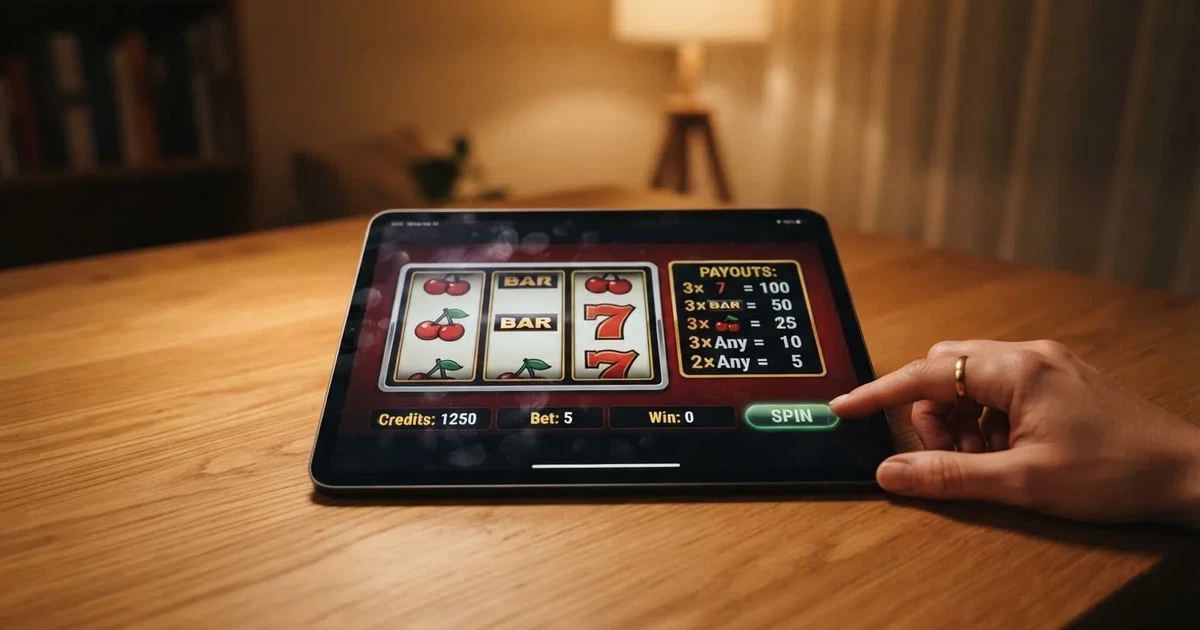
What it costs to skip to the bonus round, and ten UK sites licensed to offer it
 Available in GB
A bonus-buy slot is a slot where the casino lets you pay to enter the bonus round directly rather than wait for it to trigger. That single payment is a stake like any other: at a UK-licensed site it counts toward the £5 (or £2 for 18 to 24 year-olds) per game-cycle cap, sits inside the same GAMSTOP perimeter, and feeds the same monitoring the regulator requires. The catalogue runs wider than the headlines suggest. At the time of writing, 139 businesses hold an active remote casino operating licence on the Gambling Commission’s public register, and ten of them run slot floors that include bonus-buy titles. The pages below explain what that single payment actually buys, why operators cannot sweeten it with a “free” promotion afterwards, and where each of the ten falls in the comparison.

Data current as of 23 September 2026, verified against the Gambling Commission’s public register.
Where the feature sits in a UK slot catalogue
The fundamentals of the GB-licensed landscape in 2026
The public register at the Gambling Commission is the only reliable test of whether a casino is licensed to take bets from players in Great Britain. Every operator named in this article is on it, against a licence account that names the operating company and a licence number that begins with the same six digits as that account. The register can be searched online and downloaded in full; the licence number sits beneath the seal on the operator’s own site, and a five-second check is usually enough to confirm a match.

The size of the field matters even for a player who only wants a handful of titles. On the day the data was pulled, the register held 1,065 active domain entries and another 361 white-label entries — meaning 361 websites trade under another company’s licence and answer to that company’s regulators, not their own. A white-label brand is not an independent operator. Players who treat it as one can end up reading one set of bonus terms and playing under another. The point for this page is narrower: of all those domains, the ones discussed below run a slot floor that includes bonus-buy games, and every one of them holds the same kind of licence.
The single register entry covers the full legal test of who may take what kind of bet from whom. There is no second test. If a site you are considering is not on it, the operator behind it is providing gambling to people in Great Britain without a licence — an offence under section 33 of the Gambling Act 2005, regardless of where the company is based. That distinction matters for the rest of this comparison, because the page is built around licensed sites and there are offshore brands that will take UK players in spite of that.
What a bonus buy actually pays for
The bonus-buy button is a paid shortcut past the base game. In an ordinary online slot the bonus round is what pays the largest prizes, and it triggers when a scatter or a feature symbol lands in the right place — usually three or more scatters, sometimes a held-and-respin feature, sometimes a “ways” mechanic that needs a specific symbol pattern on a single reel set. The probability of triggering on any individual spin is set by the game’s mathematics and is usually small — sometimes a fraction of one per cent per spin, sometimes higher, but rarely high enough that the average player gets there quickly.
The buy button removes the wait. It costs a multiple of the base bet — typically 50× to 100× the stake of one ordinary spin, sometimes more — and in return it triggers the same bonus round (or an enhanced version of it) on the next spin. The round plays out under the same rules as the triggered version. The winnings, including any free spins awarded inside the round, are subject to the same paytable and the same volatility profile as the untriggered version; nothing is added, nothing is upgraded by the act of buying.
That is where the marketing and the mechanism diverge. The marketing tends to position the buy as a “fast pass” or a “guaranteed entry” to the bonus round, with the implicit frame that the round is the valuable part and the base game is filler. The mechanism treats both halves of the slot as parts of one game with a fixed return-to-player. The combined RTP of a buy-heavy session is not higher than the combined RTP of a slow-trigger session; it is the same number reached by a different path. The advantage of the buy is the certainty. The cost of the buy is that the certainty has a price, and the price is usually higher than the player would have spent waiting.
Why it spread through the catalogue
Feature-buy mechanics have been in online slots since the late 2010s and have moved from a single developer’s signature move into a near-default option on most modern slot releases from major studios. Operators running multiple suppliers find the same titles in their lobbies that they always have; what changes is which titles carry the buy button, and that list shifts faster than the rest of the catalogue. A player who only played bonus-buy games a year or two ago would today find that several of their old favourites have dropped the feature, while fresh releases from studios such as Pragmatic Play, Hacksaw Gaming and Nolimit City have made it a standard fixture.
The spread is partly down to player demand and partly down to regulator pressure. The Gambling Commission treats a feature-buy stake as a single stake within the meaning of its stake-limit rules — a decision the industry broadly adopted after the limits came in — and that single-stake framing gave developers confidence to keep the feature prominent. It also created a commercial opening that the studios have been quick to fill. Operators running licensed UK slot floors have responded by filtering or featuring bonus-buy titles the way they would filter volatility or theme, and the buy button is now a routine part of the way a UK slot floor looks.
Where the bonus round sits in the game’s mathematics
The published return-to-player figure on a slot covers both halves. For a slot advertised at, say, 96 per cent, that 96 per cent is the theoretical long-run return across base-game spins and bonus-feature spins combined, weighted by their relative frequency. The bonus round usually pays back at a higher rate than the base game, sometimes substantially higher; the base game pays back at a lower rate to compensate, because the bonus round triggers less often. The buy button changes the weighting but not the average.
The split matters for two reasons. First, a player who buys bonuses exclusively is playing a higher-volatility version of the game than a player who spins normally; the variance per pound staked is higher, even though the long-run return is the same. Second, a player who buys but reads the slot’s volatility class as if it applied to ordinary play will misjudge the variance of the session they have just paid for. Volatility on a bonus-buy slot is best read as volatility of the buy, not of the spin.
The player’s stake under the bonus-buy button
Why “skip the boring spins” is the marketing frame
The simplest pitch for the bonus-buy is that it is the antidote to waiting. Slot base games are not designed to be skipped through quickly; they are designed to be played, with the bonus round sitting at the end of a stretch of base-game spins that produces the small wins and the near-misses that fill the time between triggers. Skipping that stretch through a buy changes the rhythm of the session in a way that some players prefer and others find unsettling. The marketing normally describes the change as a pure improvement; the mechanism treats it as a substitution.
Two things follow for the player weighing one against the other. The first is that the buy itself is a stake and is subject to every protection the regulator places on stakes — the £5 per-game-cycle cap for those aged 25 and over, the £2 cap for those aged 18 to 24, the GAMSTOP perimeter, the operator’s own affordability checks. The second is that the buy is the only stake a player makes during a bought session that does not feed back into triggering anything else. Once the round is paid for, the rest of the wagers are inside it. There is no second buy; there is no recovery bet that brings the player back to base game and starts the trigger logic over again.
The stake limits and player protections
| Feature | Limit / Condition | Scope |
|---|---|---|
| Max stake (25+) | £5 | Per game cycle |
| Max stake (18-24) | £2 | Per game cycle |
| Self-exclusion | Mandatory (GAMSTOP) | All licensed sites |
| Vulnerability check | £150 net deposits | Rolling 30 days |
The mathematical effect on bonus-buy slots is uneven. Studios have responded in two ways. Some have reduced the buy multiple — the same title released today at 60× base stake rather than 100× base stake, bringing the maximum buy back inside the £5 cap on most bet sizes. Others have raised the base stake of the slot so the maths of the game’s feature set continues to work at the same buy multiple. Either way, the buy is now within the cap on essentially every UK-licensed slot the operator offers, which is one reason the feature has continued to thrive despite the new ceiling on stakes.
GAMSTOP and the financial vulnerability check
GAMSTOP is the UK’s national online self-exclusion scheme, and it has been a mandatory condition of every Gambling Commission online operating licence since 31 March 2020. Players can register for six months, one year or five years; the period cannot be cancelled early. Every operator named later in this article is signed up. Every slot on every one of their floors is covered, including bonus-buy slots, including bonus-buy slots with a £500 buy. A player who has self-excluded cannot reach the buy button.
The financial vulnerability check is a separate condition that came in from 28 February 2025. Operators must run a check using publicly available data, not credit-reference data, on customers whose net deposits pass £150 in a rolling 30-day window. The check does not block play; it adjusts what the operator does next. A player whose check returns a positive vulnerability signal is moved into a more intensive affordability conversation, and the operator is expected to act on what it finds. The bonus-buy purchase is one of the easiest transactions to identify in that conversation because it is a single stake that is usually larger than the player’s typical spin, so it tends to be flagged earlier than repeated small wagers.
Why offshore sites advertising unlimited bonus-buy aren’t doing you a favour
A site that advertises unlimited stake sizes or unlimited buys is, by definition, not on the Gambling Commission register. That absence removes the £5/£2 cap, the GAMSTOP perimeter, the financial vulnerability check, the dispute-resolution route through an approved ADR, and the operator-side liability under the Gambling Act 2005. The Commission’s response to such sites is to disrupt them where it can — cease-and-desist notices, search-engine delisting, payment and hosting referrals — but the Commission has no power to block internet service providers, and there is no ISP-level block on gambling in Great Britain. The player faces the full downside and gives up the protections that licence-holding sites are required to provide.
The “unlimited” pitch is also misleading on its own terms. The slot’s RTP is the slot’s RTP, regardless of stake; what changes is the variance and the size of the buy. A higher cap on the buy is not a higher return on the game. It is a higher ceiling on how much a player can lose in a single feature, with no commensurate increase in the theoretical return, and no recourse if the operator refuses to pay out.
Buying the round, reading the offer
A bonus-buy is a stake, not a promotion
A common misunderstanding is that the bonus-buy is some kind of casino-issued promotion, comparable to a deposit match or a free-spin package. It is not. A bonus-buy is a button inside the game itself, paid to the game provider’s slot, settled against the game’s paytable, and audited under the same game-testing regime as every other element of the slot. The operator does not issue it, the operator does not pay for it, and the operator does not apply bonus terms to it. There is no wagering requirement because there is no bonus.
This is why the 10x cap on wagering requirements, in force since 19 December 2025, has nothing to say about bonus-buy slots. The cap is on the wagering requirements an operator can apply to its own bonuses — the kind you opt in to when you make a deposit. The bonus-buy purchase is not a bonus, so the cap does not apply to it; the only caps that apply are the per-game-cycle stake limits covered earlier. A player who treats the buy as a bonus-protected transaction will not find protection they were not offered.
RTP inside the round, in plain words
Return-to-player is the share of every pound staked that the slot is programmed to return to players across a very large number of spins. The figure on the game’s information panel is the long-run theoretical average; in any given session a player will see something different, and the spread around the average is wider on a high-volatility slot than on a low-volatility one. The Gambling Commission requires operators to monitor the actual return achieved on each game against the theoretical figure, and to submit a key event if a confirmed deviation crosses a defined threshold.
The bonus-buy rounds up that monitoring for the operator, because the buy is a larger stake concentrated into a single transaction. A player who buys four bonus rounds in a session has generated four transactions of, say, £2.50 to £5 each, against hundreds of base-game spins of £0.05 elsewhere on the slot floor. The monitoring triggers more readily on those concentrated transactions, so any malfunction is caught faster. This is one quiet benefit of the buy, often obscured by the marketing focus on skipping to the round: the audit trail on what a player paid and what the slot paid back is unusually detailed.
Free spins attached to a deposit don’t pay the buy
Operators in the UK offer a stream of deposit-attached free-spin packages that credit a player with a number of spins on selected slots at a fixed stake size. These are bonuses, with their own terms — a wagering requirement capped at 10x since 19 December 2025, a list of eligible games, often a maximum win cap, and a time limit on using them. They do not extend to the bonus-buy button. A free-spin package that credits 50 spins on a bonus-buy slot uses the spins at the base-game stake, on the game’s ordinary reels. The buy button is not exercised by the package, and the player cannot use the credited spins to buy the round; the credits are nominal funds for the base game, not for the feature.
This is one of the more frequent sources of player confusion, because the slot looks identical whether the player is on a free-spin package or has paid for the spins themselves. The buy button is grayed out, or it remains lit and the player simply pays for it in their own cash — there is no mixing of the two balances. The cleanest way to read the offer is that deposit-attached free spins are an entry-level way to play a slot, and the bonus-buy is a separate entry to the slot’s high-volatility round. Both can apply in the same session; the player pays for both.
What a pay-for-feature does to your deposit limit conversation
Operators are required to prompt a customer to set a financial limit before the first deposit, since 31 October 2025. The limit applies to net deposits in the conventional sense — the player’s deposits minus withdrawals — and it does not change because a player spends a session on bonus-buy stakes rather than ordinary spins. A player who sets a £200 weekly deposit limit and then runs through £400 in bonus-buy purchases has technically broken the limit because the deposited funds, not the buy amounts, are the metric; the buy is settled against the deposit. The operator’s monitoring will pick up the discrepancy between the limit and the spend, and the player will be invited to a conversation about it.
That conversation is the right place for an honest reckoning. A buy-heavy session has spent the deposit faster than an equivalent-stake slow-trigger session would have, because every round is bought rather than earned. The limit does not need to react to that; the conversation does.
Ten licensed operators, side by side in 2026
What this comparison can and cannot answer
The Gambling Commission’s public register is the single source of truth on who holds a licence to take bets from players in Great Britain. It is not a source of truth on which slots any operator runs. Operators change slot floors weekly; titles are added and removed across a calendar that is not published in full. What the register can confirm, for every brand listed below, is that the operator behind it holds the licence it claims to hold and that the domain listed under that licence is still active. What the register cannot confirm is the presence or absence of any specific bonus-buy title on any operator’s slot floor.
The comparison below uses that register data in the table, alongside the wider context — the operator’s catalogue depth, its brand profile, its track record — that a player needs to make a decision. The subject-support column is empty on every row: nothing in the public register confirms bonus-buy availability per title per operator, and that absence is itself information. A player who needs to confirm that a specific bonus-buy slot is on a specific operator’s floor today has to check the operator’s own lobby; the register has done its job once the licence is verified.
| Brand | GB remote casino licence | Account number |
|---|---|---|
| Paddy Power | 039411-R-319335-010 | 39411 |
| kwiff | 044448-R-323408-017 | 44448 |
| Betway | 039372-R-319367-029 | 39372 |
| bet365 | 055149-R-331499-004 | 55149 |
| Unibet | 045322-R-324275-019 | 45322 |
| 888casino | 039028-R-319297-014 | 39028 |
| Virgin Games | 038905-R-319430-022 | 38905 |
| Midnite | 042647-R-321653-022 | 42647 |
| Betfred | 039544-R-319290-010 | 39544 |
| BetVictor | 039576-R-319370-028 | 39576 |
Every brand above holds a remote casino operating licence issued under the Gambling Act 2005 and is therefore required to take part in GAMSTOP, to verify every customer’s name, address and date of birth before the first deposit or any play, and to submit to the Commission’s ongoing monitoring of return-to-player performance across its slots catalogue. The empty right-hand column reflects what the register itself records, not an oversight in the comparison: the public register confirms who is licensed, not what is on the floor.
Paddy Power — the standard bookmaker’s slot floor
PPB Games Limited holds the licence behind Paddy Power, which is a registered domain for account 39411. The brand’s slot catalogue sits inside the broader Paddy Power betting product — sportsbook, bingo, casino under one roof — and the casino section carries a wide range of slots across a long list of providers, including the studios that build most of the bonus-buy titles on the UK market. The bonus-buy selection inside that catalogue is solid without being the deepest on the page; what the catalogue offers is the convenience of having an account that can also take a sports bet on a Saturday afternoon, with a slot floor that already includes the major bonus-buy releases.
The depth of the bonus-buy catalogue here reflects the broader shape of the well-known bookmaker’s slot floor: a player moving from the sportsbook into the casino finds the same titles they would find at any major UK brand, and the bonus-buy list is essentially the union of what the major studios are releasing this year. A player looking for a specific niche title from a smaller studio may need to look elsewhere; a player looking for the canonical bonus-buy slots will find them on the first page of the lobby.
kwiff — newer domain, focused catalogue
Eaton Gate Gaming Limited is the licence-holder behind kwiff, with kwiff appearing in the regulator’s database for account 44448. The brand has been on the register for a handful of years, and its slot floor is built around a focused list of providers and titles rather than the broadest possible catalogue. The smaller floor is partly a positioning choice — kwiff leans into a distinct product identity around its sportsbook and instant-win games — and partly a practical consequence of a newer licence holder that has not yet built the integration depth of older operators.
The narrower slot library is the trade-off for a domain that has been on the register only since 2021. The bonus-buy selection inside that library tracks the headlines rather than the long tail, which is fine for a player who only wants the canonical releases and unhelpful for a player who collects niche variants. The brand is part of the same GAMSTOP perimeter as every other GB-licensed operator, and the same £5/£2 stake caps apply, so a player self-excluding for any reason will be blocked here in the same way.
Betway — long-standing brand, slot-heavy lobby
Betway Limited holds the licence behind Betway, which is a recognised site for account 39372. Betway has been on the register for decades and runs one of the more consistent slot floors in the UK market. The catalogue is supplied by a long list of providers and is organised around the standard volatility and theme filters, with the major studios’ bonus-buy titles prominently featured. The slot product is what the brand is best known for among casino players, even though its sportsbook carries the bulk of its revenue.
What this catalogue lacks in headline-grabbers, it makes up for in consistency across game cycles. A player who has used Betway for years will see the same names on the lobby today that they saw a year ago, with the same buy buttons on the same titles. That consistency is the brand’s signature on the slot floor; it is also a ceiling on how surprising the catalogue feels. The bonus-buy selections at the time of writing track the standard releases from the major studios, not any one studio’s full back catalogue.
bet365 — the largest British slot book
Hillside (UK Gaming) ENC holds the licence behind bet365, listed on the register as an active domain of account 55149. bet365 runs the deepest slot catalogue of any GB-licensed operator, organised across categories that include a dedicated bonus-buy section. The integration of the casino product with the wider bet365 platform — sportsbook, poker, bingo, games — is one of the more technically refined in the UK market, and the catalogue quality reflects the volume of player traffic the brand handles.
The depth of the library is the main reason a comparison like this one leads with it. The bonus-buy selection inside that library covers the major studios in greater depth than most of the smaller operators can, and the lobby’s filtering makes it easier to find specific titles than the lobby filtering at most competitors. A player who wants to browse the long tail of bonus-buy releases from a single studio will find the most material here.
Unibet — Platinum Gaming’s catalogue, with a Nordic accent
Platinum Gaming Limited holds the licence behind Unibet, with Unibet holding an approved site status for account 45322. The Platinum Gaming catalogue powers both the UK Unibet brand and a wider set of European brands under the Kindred Group umbrella, and a player browsing the lobby will see titles from studios that feature strongly on the Nordic market — particular emphasis on certain Swedish and Maltese studios that are less prominent on UK-only floors.
The catalogue here is best read as Platinum Gaming’s combined Nordic and UK offering. The bonus-buy selections include the major releases common to other UK floors, with several additional Nordic-market titles that may or may not carry the buy button depending on the game. A player who plays the same slot on both Unibet UK and a Unibet brand in another jurisdiction may find the bonus-buy list differs between the two, because the same game can be configured differently by jurisdiction.
888casino — exclusive-branded slots over breadth
888 UK Limited holds the licence behind 888casino, with 888casino validated as a licensed site for account 39028. The catalogue has long emphasised 888’s exclusive-branded slots — games developed for the brand and not licensed to other operators — alongside a long tail of third-party titles. The exclusive focus shapes the catalogue more than breadth does; a player browsing the lobby will encounter the same 888-branded titles that have been at the centre of the brand’s marketing for years, with a varying rotation of third-party slots around them.
The exclusive-branded slots are not always bonus-buy games. Studios that build exclusives for 888 tend to ship those titles without the feature, or with the feature appearing only on a subset of releases. The bonus-buy selection within the catalogue is therefore solid but not the deepest on the UK market. A player who values exclusives will find more value here than a player who values the canonical bonus-buy releases, and the page is the wrong place to rank those preferences.
Virgin Games — white-label under Gamesys, with the MGM tie-in
Gamesys Operations Limited holds the licence behind Virgin Games, with Virgin Games listed on the register as a white-label domain of account 38905. The “white-label” status on the register is the key piece of information: Virgin Games trades under Gamesys’s licence, with Virgin Games found in the register as a white-label domain for account 38905.
Inside the wrapper is a slot catalogue that runs the canonical UK releases, including the major studios’ bonus-buy titles. The brand has a separate identity tied to MGM Resorts via a joint venture between Gamesys and MGM, which has led to a number of MGM-themed exclusives. A player who wants the exclusives will find them; a player who only wants the canonical bonus-buy releases will find those too, on the same floor.
Midnite — bonus-buy incentive stacked behind a mobile-first build
Dribble Media Limited holds the licence behind Midnite, with Midnite found in the register as an active domain for account 42647 under the licence 042647-R-321653-022. Midnite launched as a mobile-first product built around the smartphone screen, and the slot floor was constructed for that constraint. The catalogue is slimmer than the largest operators and the bonus-buy list inside it is shorter still, but the titles on the floor are picked for how well they work on a smaller display, and the buy button is presented cleanly inside the mobile UI in a way that larger, older catalogues have not always managed.
The slot library is the slimmest of the ten and the bonus-buy list inside it is shorter still. A player who plays only on mobile and prizes a smaller, more curated catalogue will find more appeal here than in the long-tail libraries of bet365 or Paddy Power. A player who wants every bonus-buy release from every studio will need to look elsewhere.
Betfred — high-street name, complete slot rotation
Petfre (Gibraltar) Limited holds the licence behind Betfred, with Betfred found in the register as an active domain for account 39544. Betfred is one of the larger high-street bookmakers in the UK and runs a slot floor that reflects that scale. The catalogue covers the major studios and rotates titles frequently, with bonus-buy releases appearing on the floor soon after release from the major UK-facing studios. The retail heritage shows up in the marketing weight behind certain titles rather than in the technical shape of the slot floor.
The high-street name carries more weight than its slot floor does on a title-by-title comparison. Betfred’s catalogue is comparable in shape to the catalogues at Paddy Power, Betway and bet365; the difference is in the brand identity the player is buying into, the integration with the rest of the Betfred product, and the cross-promotional offers that surface between the sportsbook and the casino. The bonus-buy selection is complete for what the major studios are releasing, without distinguishing itself as the deepest anywhere on the page.
BetVictor — independent brand, full catalogue
BV Gaming Limited holds the licence behind BetVictor, with BetVictor found in the register as an active domain for account 39576. BetVictor is one of the more genuinely independent operators on the UK market, owned by the Victor Chandler family interests rather than one of the larger gaming groups, and the catalogue reflects that independence in its choices. The slot floor carries the major studios’ releases alongside a meaningful number of titles from smaller studios that the bigger groups sometimes overlook.
Independent ownership shows up in the catalogue breadth. BetVictor’s bonus-buy selection covers the canonical UK releases and includes a wider rotation of titles from studios that are not always picked up by the larger operators, which gives the catalogue a longer tail than several of its GB-licensed competitors. A player who values the smaller studios will find more to work with here than at the higher-volume operators; a player who only plays the largest studios will find the same canonical releases they would find elsewhere.
The register, the cap, and the arithmetic
The jurisdictional certificate, what the register actually shows
On the day the data was pulled, the Gambling Commission’s domain register held 1,065 active domain entries and 361 white-label domain entries. The two numbers describe two different relationships: an active domain is operated by the licence-holder under whose account it is listed, and a white-label domain trades under another company’s licence — meaning the licence-holder named on the row is the one that answers to the regulator, while the domain name is a brand that may have its own marketing and its own products. The distinction matters because the protection the player expects from a GB-licensed site depends on the licence-holder, not the brand on the site.

The register is also the only credible source for the licence numbers themselves. Every licence number follows the same shape — six digits for the licence-holder’s account number, then “R” for a remote licence, then a six-digit activity number, then a two-digit suffix — and a quick check against the register confirms the licence-holder, the licence number and the active status. Any operator whose licence details do not match the register, or which is not on the register at all, has no business taking bets from players in Great Britain. The Commission’s disruption work — cease-and-desist notices, search-engine delisting, payment and hosting referrals — is what stops most of those sites from being easily discoverable in the first place.
How the 10x cap sits against a single bonus-buy purchase
The 10x cap on wagering requirements came in on 19 December 2025 and applies to bonuses that operators issue — the kind attached to a deposit, where a player opts in to a promotional offer with terms attached. The cap limits the total amount a player must wager before a bonus and its associated winnings can be withdrawn to no more than ten times the bonus value, with mixed-product bonuses (a sportsbook bet that comes with casino spins attached) banned in the same package. It is one of the more substantial consumer-protection changes to UK bonus terms in the past decade, and it has reduced the size of wagering requirements across the market to a narrow band.
Bonus-buy slots sit outside that band. The buy is not a bonus; the operator does not issue it, the wagering cap does not measure it, and the game’s paytable settles it. What the cap does is change the kind of “free” offer an operator can attach to a deposit, which in turn affects how a player reads any deposit-attached free-spin package they are offered. A player who combines a deposit bonus with bonus-buy play is paying for the buy in their own cash and clearing the bonus on a separate set of stakes; the two flows do not interact, even though they share one session.
The arithmetic of a single feature purchase
A typical bonus-buy slots in a multiplier of the base bet — 50× to 100× is the common band, with some titles outside that range in either direction. At the £5 per-game-cycle cap for adults aged 25 and over, a 50× buy on a £0.10 base game produces a £5 buy (at the cap); the same 50× buy on a £0.05 base game produces £2.50; a 100× buy on a £0.05 base game produces £5. At the £2 cap for adults aged 18 to 24, the same arithmetic produces smaller buys — a 50× buy on a £0.04 base game is £2, at the cap.
Against the 10x wagering cap, the comparison is straightforward. A £10 welcome bonus with a 10x wagering requirement means £100 of total staking before withdrawal. A single bonus-buy purchase at £5 of stake contributes £5 of that £100 of total staking; one-tenth of the requirement is cleared in a single transaction. A bonus-buy purchase at the £2 stake cap for a younger player clears one-fiftieth of the same £100 requirement in a single transaction. The point is not that one transaction covers the bonus — the buy is not a bonus — but that the bonus-buy stake is a more efficient unit of wagering activity for the operator’s bonus terms than a base-game spin of £0.05.
The arithmetic also shows why the £5 cap has not killed the feature. A buy at £5 is meaningfully smaller than the buys available on the same titles in offshore markets, where the per-spin cap does not apply. The feature survives because the buy at the cap is still profitable for the operator and still affordable for the player. What has changed is the ceiling on the cost of a single round, and the implicit message that the regulator is willing to use that ceiling to shape the product.
Offshore without the licence, and what that costs
Providing gambling to people in Great Britain without a Gambling Commission licence is an offence under section 33 of the Gambling Act 2005, and the relevant section of the Act applies regardless of where the operator is based. The Gambling (Licensing and Advertising) Act 2014 brought this into effect by making a GB-facing presence a licensable activity anywhere in the world; a Curaçao, Maltese, Gibraltar or Isle of Man licence is not a substitute. The Commission’s response to unlicensed sites is the disruption work described earlier, but the Commission has no power to order ISP-level blocking, and there is no equivalent in Great Britain to the geographic IP-blocking that other jurisdictions use to limit unlicensed access.
The cost to a player on an unlicensed site is the loss of the protection the licence requires: no GAMSTOP, no Commission complaints route, no approved ADR for disputes, no requirement on the operator to monitor return-to-player performance and report deviations, no enforced identity-and-age verification at the door. The Commission does not penalise players who play on unlicensed sites; the player loses the structure around the game, not the right to play. The practical consequence is that a complaint about a held withdrawal, an altered bonus term, or a changed slot configuration has nowhere to go.
Frequently Asked Questions
What does buying the bonus round on a slot actually cost?
A bonus-buy purchase is paid to the game’s paytable, not to the operator’s bonus wallet. The amount is a multiple of the base stake — typically 50× to 100× — and is settled under the slot’s ordinary RTP. A bought round plays out the same as a triggered one, with the same winnings subject to the same game rules; nothing is added by the act of buying. The “cost” of the buy is the stake that funds it; the upside is the same return the untriggered round would have paid, just reached on a different schedule.
Do bonus-buy slots count toward the same stake limits as ordinary spins?
Yes. The Gambling Commission’s per-game-cycle stake limit of £5 for adults aged 25 and over, and £2 for those aged 18 to 24, applies to every stake on an online slot, including a single bonus-buy purchase. Studios have adapted most titles so the maximum buy inside the cap remains meaningful, and the bonus-buy selection on a UK-licensed slot floor is now broadly accessible without breaking either limit. The bonus-buy round is also captured by the GAMSTOP self-exclusion scheme and the operator’s affordability processes, in the same way as a base-game spin.
How does the return-to-player rate change when the bonus is bought?
It does not, on the long-run average. The published RTP on a slot covers both halves of the game — base-game spins and bonus rounds — weighted by trigger frequency. The buy changes the weighting by guaranteeing the bonus round on the next spin; the theoretical return on the combined session is the same figure the slot advertises. What does change is the variance per pound staked: a session composed almost entirely of buys is higher variance than a session composed mostly of base spins, because the same RTP is reached through fewer, larger transactions.
Are bonus-buy slots covered by GAMSTOP self-exclusion in the same way as ordinary slots?
Yes. GAMSTOP is a mandatory condition of every Gambling Commission online operating licence, and every slot on every operator named in this article — bonus-buy or otherwise — is inside the GAMSTOP perimeter. Self-exclusion applies for six months, one year or five years, and the period cannot be cancelled early; an operator outside the register has no obligation to honour a GAMSTOP registration, which is why playing on a site not on the register removes that protection.
Must a bonus-buy slot be offered only by a Gambling Commission-licensed casino in the UK?
Yes, if the casino wants to take bets from players in Great Britain. The Gambling (Licensing and Advertising) Act 2014 made a GB-facing presence a licensable activity for any operator anywhere in the world, and the Gambling Commission’s public register is the single test of who holds that licence. Unlicensed sites may offer bonus-buy slots to players outside Great Britain, but offering them to players in Great Britain is an offence under section 33 of the Gambling Act 2005. The list above is built around operators whose licence details match the register; players who choose an unlicensed brand do so outside the protection the licence provides.
Prepared by the bankingcasinouk editorial staff.