
Casinos that accept Ethereum in the UK in 2026: which ones are licensed and what to check
Ethereum moves value over a public blockchain rather than through a card network, but the currency that lands in a casino account does not redraw the rules it sits inside. A British player funding a session with Ether still deposits at an operator that must hold a Gambling Commission licence, still verifies name and date of birth before a first bet, still routes through GAMSTOP for self-exclusion, and still sits under the £5 and £2 online slot stake caps that took effect across 2026. The shape of this page is shaped by that distinction: the rail changes, the regulator does not.

Data current as of 23 November 2026, cross-checked against the Gambling Commission’s public register of gambling businesses (CSV download, 18 September 2026).
Table of Contents
- The licensing frame: a Commission licence is the whole test
- Responsible gambling rails that apply regardless of how the deposit is funded
- How Ethereum sits inside a licensed casino
- Game selection, live tables and the deposit rail
- The licensed landscape: how the ten brands on this page stack up
- Licence Holder Summary
- What each operator actually brings
- How the wagering cap bites, in plain arithmetic
- Offshore and “not on GAMSTOP” — what the absence of a Commission line costs
- Verdict — choosing the rail, not the operator
- Frequently asked questions
The licensing frame: a Commission licence is the whole test
Every casino serving customers in Great Britain needs a Gambling Commission operating licence. The Commission became the licensing authority for remote gambling through the Gambling (Licensing and Advertising) Act 2014, which closed the previous arrangement under which an offshore licence was enough to take British customers. A Curaçao, Malta or Gibraltar licence no longer covers British play on its own; the operator must hold a UK remote casino licence on top, and the public register is the only place that licence can be verified.

On 18 September 2026 the register’s account list showed 139 businesses holding an active remote casino operating licence. Each entry on the domain list sits against the licence account that runs it, with a status of Active, Inactive or White Label. That same day the domain list held 1065 active and 361 white-label entries; a white-label site trades under another company’s licence, so a brand name alone is not the licence holder. A remote casino licence number has the form account-R-number-suffix, where the leading six digits repeat the licence holder’s account number and the “R” marks a remote (online) licence.
What this means in practice is that a casino accepting Ether from a British customer has to clear the same checks as one accepting pounds: age 18 or over, verified name, address and date of birth before the first deposit, and registration with GAMSTOP at the operator level. The cryptoasset side sits one layer above — the exchange or wallet provider that hands the Ether to the operator falls under the FCA’s Money Laundering Regulations — but the gambling side is unchanged.
Responsible gambling rails that apply regardless of how the deposit is funded
Deposit limits, reality checks and mandatory GAMSTOP enrolment apply to every licensed British online casino, and a session funded with Ether runs through exactly the same machinery as a card-funded one. GAMSTOP is the national online self-exclusion scheme and has been a condition of every online operating licence since 31 March 2020; the self-exclusion can run for six months, one year or five years and cannot be cancelled early. A player who has registered with GAMSTOP cannot open a new account at any Commission-licensed operator for the duration of the exclusion, and a casino has no discretion to waive that, because the exclusion sits above the operator.
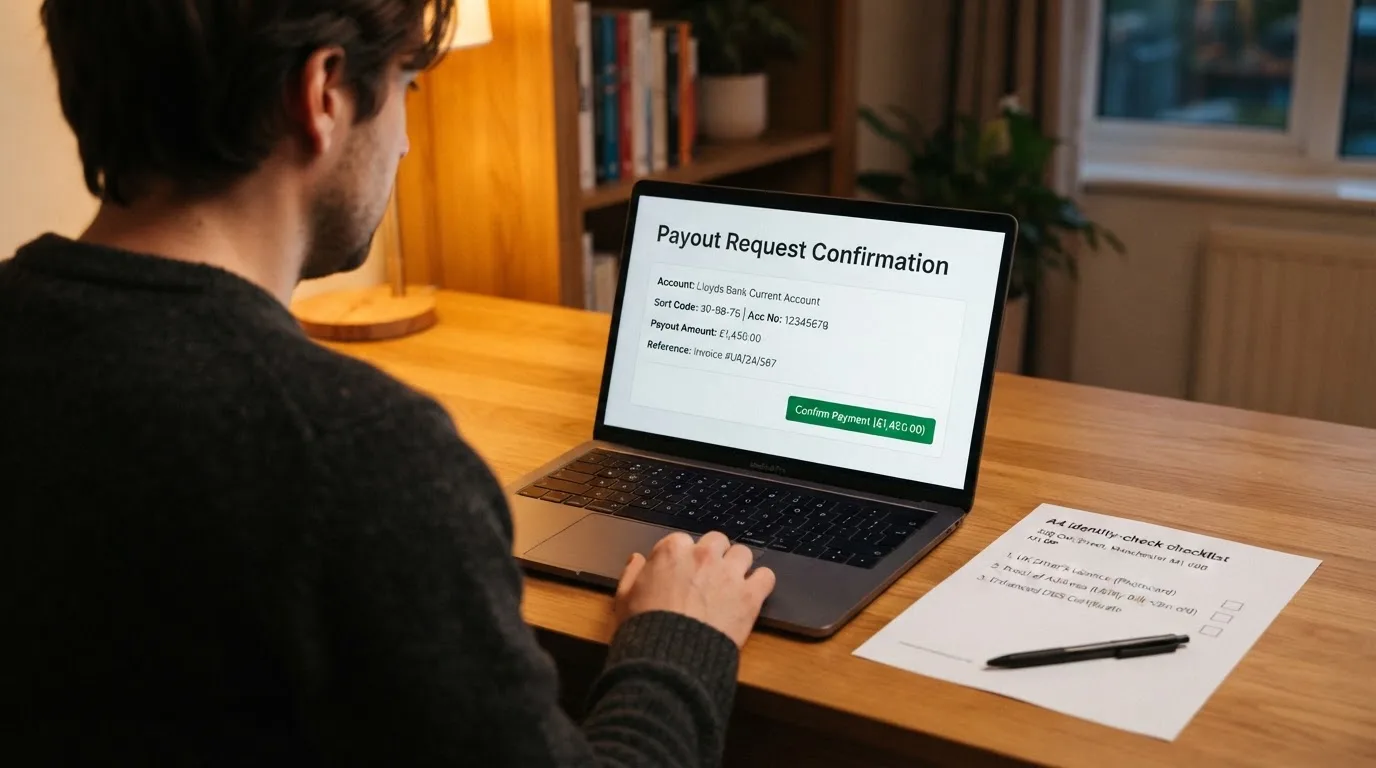
Operators must prompt a customer to set a financial limit before the first deposit, since 31 October 2025. Financial vulnerability checks fire when a customer crosses £150 in net deposits across a rolling 30 days, using public data only — a soft prompt to consider their play rather than a hard block. Auto-play has been banned on online slots since 31 October 2021; a slot spin may not be faster than 2.5 seconds; and “losses disguised as wins” — sounds and visuals that frame a net loss as a celebratory event — are banned under the Commission’s remote technical standards.
Online slots carry a per-cycle stake cap that arrived in two tranches: £5 for players aged 25 and over from 9 April 2025, and £2 for players aged 18 to 24 from 21 May 2025. A “game cycle” is the smallest unit the game treats as a single play — typically a spin — and the cap is per cycle rather than per session. None of this depends on whether the bankroll arrived by card, by bank transfer or as Ether: the cap is the cap, the cycle is the cycle.
Help is available through the National Gambling Helpline (GamCare) and through GambleAware’s signposting. A complaint that the operator cannot resolve goes to an approved ADR provider; if the operator is licensed, that route exists.
How Ethereum sits inside a licensed casino
Ethereum was conceived by Vitalik Buterin in 2013, with co-founders including Gavin Wood, Charles Hoskinson, Anthony Di Iorio and Joseph Lubin, and the network launched on 30 July 2015. The native currency, Ether, has no fixed maximum supply — unlike Bitcoin’s 21 million coin limit — and a portion of transaction fees has been burned under the London upgrade since August 2021, offsetting new issuance. The network switched its consensus mechanism from proof-of-work to proof-of-stake on 15 September 2022, in an upgrade known as “The Merge”, and an average block time sits at roughly 12 seconds.
Firms providing cryptoasset exchange or custodian wallet services in the UK — including those dealing in Ether — must register with the Financial Conduct Authority under regulations 8L, 9 and 14A of the Money Laundering Regulations before operating. The FCA’s financial promotions regime applies to all firms marketing cryptoassets such as Ethereum to UK consumers, regardless of where the firm is based. Gains from disposing of cryptoasset tokens such as Ether are potentially liable to Capital Gains Tax for individuals, with HMRC treating the tokens as property rather than currency, so the difference between acquisition and disposal value is what gets taxed. None of this is the casino’s job to enforce; it is the rail the money sits on before and after it reaches the gaming account.
The Gambling Commission itself has written that the anonymity associated with digital currencies such as Bitcoin and Ethereum may be attractive to individuals who want to conceal their identity, and has flagged their price volatility and a history of hacking and theft as risks that a gambling operator has to assess before accepting them. Great Britain-licensed gambling operators must notify the Commission of any change in payment methods, including the introduction of crypto-asset acceptance, and must review their anti-money-laundering risk assessment before doing so. That is the regulatory hook: a Commission-licensed casino accepting Ether still has to verify the customer’s identity, has to log the deposit in pounds equivalent, and has to treat the cryptoasset channel as a regulated payment rail, not a bypass.
Wagering requirements have been capped at 10x since 19 December 2025, and mixed-product bonuses — for example a sports bet that pays out as casino spins — are banned under the same rule. The cap applies to the bonus amount, not to deposit plus bonus. Anonymous play is not possible at a licensed site: credit cards have been banned for gambling since 14 April 2020, including credit-card-funded e-wallet routes, and the identity check that runs before a first deposit is required regardless of payment method.
Game selection, live tables and the deposit rail
Slots, blackjack, roulette and live-dealer tables all sit behind the same identity checks whether the account was funded through Ether or by card. Game selection does not change based on the payment rail used to deposit, and the same remote technical standards — the 2.5-second spin floor, the no-losses-disguised-as-wins rule, the £5 / £2 stake caps — apply across the lobby. A live-dealer table is no closer to an anonymous session than a slot is; the operator’s compliance posture is the same.
The studios that supply the games sit on their own licences. Their games are tested against the Commission’s Remote Technical Standards before they reach the lobby, and the studios carry their own remote game host or software licence on the register. A player switching between slots and a live blackjack table is not crossing into a different regulatory regime — they are staying in the same one, with the same deposit limit prompt, the same reality check interval, and the same GAMSTOP block running in the background.
What changes when the deposit rail is Ether is the time between the wallet sending the transaction and the funds landing at the operator. Ethereum’s roughly 12-second block time means a transaction typically confirms quickly in absolute terms, but the casino still has to receive, value and credit the deposit in its own ledger — usually in pounds — and that part is operator-side rather than blockchain-side.
The licensed landscape: how the ten brands on this page stack up
The table below summarizes the licensed operators on this page, their licence holders, domain status, and whether Ether support is confirmed.
| Brand | Licence Holder | Domain Status | Support |
|---|---|---|---|
| Betfair | PPB Games Limited | Active | — |
| bet365 | Hillside (UK Gaming) ENC | Active | — |
| Betfred | Petfre (Gibraltar) Limited | Active | — |
| BetVictor | BV Gaming Limited | Active | — |
| Coral | LC International Limited | Active | — |
| Gala Bingo | LC International Limited | Active | — |
| kwiff | Eaton Gate Gaming Limited | Active | — |
| Ladbrokes | LC International Limited | Active | — |
| Midnite | Dribble Media Limited | Active | — |
| PokerStars | Stars Interactive Limited | Active | — |
The table below lists ten operators taken from the Commission’s public register. The brands are not ranked by the value of any offer — research carries no terms for any of them on this subject, so a bonus column would be empty — and they are presented in alphabetical order, which is the order research lists them. Several share one licence holder; Ladbrokes, Coral and Gala Bingo all sit under LC International Limited, and a player who knows one of them knows the corporate envelope of the others.
Licence Holder Summary
| Licence Holder | Account Number | Remote Casino Licence |
|---|---|---|
| PPB Games Limited | 39411 | 039411-R-319335-010 |
| Hillside (UK Gaming) ENC | 55149 | 055149-R-331499-004 |
| Petfre (Gibraltar) Limited | 39544 | 039544-R-319290-010 |
| BV Gaming Limited | 39576 | 039576-R-319370-028 |
| LC International Limited | 54743 | 054743-R-330863-014 |
| Eaton Gate Gaming Limited | 44448 | 044448-R-323408-017 |
| Dribble Media Limited | 42647 | 042647-R-321653-022 |
| Stars Interactive Limited | 39108 | 039108-R-319334-026 |
Every row in the table above is a licence verified on the Commission’s public register, not a recommendation. Research carries no evidence that any of these ten accepts Ether as a deposit method on its customer-facing cashier, so the “Subject support” column shows a dash rather than a confirmation; the licence frame is what each brand brings to a player in Great Britain, and the rail itself is a separate question the player has to put to the operator. The fact that the licence is in place tells the player what is covered if the rail works; it does not tell the player the rail is wired up.
Three brands — Coral, Gala Bingo and Ladbrokes — sit under the same corporate envelope and on the same licence number, which is a useful pattern to recognise when comparing offers: identical corporate back-office, different product wrappers. The rest sit under different licence holders, and a player using two of them has used two distinct regulated entities.
What each operator actually brings
The operator write-ups below take each of the ten brands in alphabetical order, working from the licence entry to the practical shape of an account there. None of these reviews is a recommendation. Each closes on what the licence line and the operator’s own profile actually establish — what kind of player the brand fits, and where it loses to the next one in the list.
Betfair — PPB Games Limited
Betfair is one of the active domains of account 39411, PPB Games Limited, which holds the active remote casino operating licence 039411-R-319335-010. The group has long managed high transaction volumes, which is the primary draw; as with all brands here, research does not verify Ether support, so check the cashier directly.
bet365 — Hillside (UK Gaming) ENC
bet365 is an active domain of account 55149, Hillside (UK Gaming) ENC, operating under the licence 055149-R-331499-004. Being a large-scale operator, it integrates casino and sportsbook under one identity-check system, streamlining the setup. Whether or not it enables crypto-asset transactions is entirely at the discretion of the operator.
Betfred — Petfre (Gibraltar) Limited
Betfred operates under the licence 039544-R-319290-010, held by Petfre (Gibraltar) Limited (account 39544). The brand leverages its bookmaker heritage, with the casino product functioning as an extension of the main account. Like other sites listed, it provides no confirmation of Ether deposit rails.
BetVictor — BV Gaming Limited
BetVictor is operated by BV Gaming Limited (account 39576) under the licence 039576-R-319370-028. It maintains a traditional bookmaker identity, ensuring the same regulatory protections apply here as they would elsewhere. Deposit methods remain subject to the operator’s own cashier policy.
Coral — LC International Limited
Coral (coral.co.uk) sits under the LC International Limited licence 054743-R-330863-014 (account 54743), which also covers Ladbrokes and Gala Bingo. This shared corporate envelope means the regulatory experience is consistent across all three. The brand features a high-street-inspired casino environment, though crypto-asset banking is not verified.
Gala Bingo — LC International Limited
Gala Bingo also utilizes the LC International Limited licence 054743-R-330863-014 (account 54743). Despite the bingo-focused interface, the site adheres to the same safety standards and stake limits as the broader group. It has not explicitly confirmed crypto-asset support.
kwiff — Eaton Gate Gaming Limited
kwiff is powered by the Eaton Gate Gaming Limited licence 044448-R-323408-017 (account 44448). While the platform is smaller, it follows standard licensing protocols for customer protection. Support for Ethereum deposits is not currently verified in research.
Ladbrokes — LC International Limited
Ladbrokes shares the LC International Limited licence 054743-R-330863-014 (account 54743) used by Coral and Gala Bingo. The brand offers a familiar interface for players who have frequented their physical locations, yet its cashier terms regarding crypto-assets remain distinct from its licensing status.
Midnite — Dribble Media Limited
Midnite operates via Dribble Media Limited (account 42647) under licence 042647-R-321653-022. It targets a niche audience interested in esports, though the licensing obligations regarding deposit limits and safety remain identical to broader operators. Ether rail support is not explicitly confirmed.
PokerStars — Stars Interactive Limited
PokerStars runs under the licence 039108-R-319334-026, held by Stars Interactive Limited (account 39108). The brand’s poker legacy influences its product mix, yet the underlying regulatory framework for its casino lobby is standard. Users should confirm cashier options directly with the site.
How the wagering cap bites, in plain arithmetic
The 10x wagering cap that took effect on 19 December 2025 is the rule that decides how heavy a bonus offer can be at any Commission-licensed casino — at any of the ten brands on this page alike, because the cap is a licence condition, not a brand choice. The arithmetic belongs to the writer and runs as follows.
Take a notional bonus of, say, £100. The required turnover under the 10x cap is £100 × 10 = £1,000 — one thousand pounds of wagering that the bonus amount has to clear before it converts to withdrawable cash. At a slot stake of £1 per spin, that is £1,000 ÷ £1 = 1,000 spins. The Commission’s remote technical standards set a minimum spin interval of 2.5 seconds, so the time to clear the bonus, if a player is spinning as fast as the rules allow, is 1,000 spins × 2.5 seconds = 2,500 seconds, or roughly 42 minutes of continuous play. At £5 per spin — the highest stake a player aged 25 or over can place on a slot — the same £1,000 of turnover clears in 200 spins, or 500 seconds, around eight minutes of continuous play.
The figure that varies is the stake per spin, because the bonus amount and the wagering multiple are fixed by the rule. A player choosing to spin at £0.10 will see the turnover take 10,000 spins — roughly seven hours at the 2.5-second floor — to clear, and a player choosing £5 will see it clear in minutes. The bonus amount, the wagering multiple and the slot stake floor are the three inputs; the output is a band, not a single figure, because the stake sits in the player’s hands. The conclusion is the time and the spin count it takes to clear a given bonus — nothing more: no estimate of a payout, no suggestion of how likely a win is, no commentary on whether the bonus is worth claiming. That is the calculation’s ceiling.
Offshore and “not on GAMSTOP” — what the absence of a Commission line costs
A casino that markets itself as “not on GAMSTOP” or as accepting customers without a Commission licence is, by definition, offering to take British customers without holding a GB remote operating licence. Providing gambling to people in Great Britain without a licence is an offence under section 33 of the Gambling Act 2005. The Commission disrupts illegal sites — cease-and-desist notices, search-engine delisting, referrals to payment providers and hosting services — but has no statutory power to order ISP-level blocking, and the absence of a block is not a sign of legitimacy.
The cost is not on the operator’s side; the cost is on the player’s side. A player who plays at an unlicensed site loses the protections a Commission licence buys: no GAMSTOP block, no Commission complaints route, no approved ADR provider to escalate a dispute, no deposit limit prompt, no £150 financial vulnerability check, no £5 / £2 slot stake cap, no ban on losses disguised as wins, no 2.5-second spin floor. The Commission has no power to refund a player who has been treated unfairly at an unlicensed site; the player has no recourse other than a civil action against an offshore company, and that is a poor substitute.
Penalty is also asymmetric: the operator, not the player, is the one the regulator pursues. A player is not prosecuted for having wagered at an unlicensed site, but the player has also not been protected by the licence conditions the licensed route provides. For a player who has registered with GAMSTOP, an unlicensed site is the only kind that will still accept them, and that is precisely the unregulated environment in which a self-excluded player is least protected.
The FCA’s position on cryptoasset firms adds a second layer. Any firm marketing cryptoassets such as Ether to UK consumers falls under the FCA’s financial promotions regime, and any firm providing exchange or custodian wallet services must register with the FCA under the Money Laundering Regulations. A casino that sends British customers through an unregistered exchange or wallet to deposit Ether is layering a second unregulated step on top of an unlicensed gambling site, and the player has no recourse on either side if a deposit goes missing or if a value calculation is disputed.
Verdict — choosing the rail, not the operator
The ten brands on this page are licensed, and the licence is the only thing on the page that is settled fact for every one of them. None has been confirmed in research as accepting Ether at the cashier, and that gap is the page’s own finding rather than a defect to apologise for. The choice for a British player is two-layered: first, a licensed brand, and second, a cashier that accepts the rail the player wants to use. The first layer is what this page lists and what the public register verifies; the second layer is what the player puts to each brand’s own cashier.
The 10x wagering cap that took effect on 19 December 2025 is uniform across all ten brands and uniform across any other Commission-licensed casino the player might consider. The £5 / £2 slot stake caps are uniform, the GAMSTOP registration is uniform, the deposit limit prompt is uniform, the financial vulnerability check at £150 net deposits in 30 days is uniform, the 2.5-second spin floor is uniform. The cryptoasset side is the variable, and the variable sits at the operator’s discretion — declared on the cashier and disclosed in the terms — rather than at the regulator’s.
For a player whose bankroll is in Ether, the practical sequence is: confirm the operator holds a Commission remote casino licence (the register will say so), confirm the cashier accepts Ether at the deposit screen, fund the wallet with enough to clear the operator’s stated minimum, complete the identity check before the first deposit, and set the deposit limit the operator prompts for. The cryptoasset side of that sequence is one part of it; the licence side, the identity check, the deposit limit and the GAMSTOP registration are the other parts, and they are the parts a Commission-licensed operator has no discretion to skip.
Frequently asked questions
Is it legal for a licensed UK casino to accept Ethereum?
Yes, with conditions. A casino accepting British customers must hold a Gambling Commission remote casino operating licence, and it must notify the Commission before adding a crypto-asset deposit method and update its anti-money-laundering risk assessment. The currency the customer sends does not change the licence requirement; a Curaçao, Malta or Gibraltar licence on its own does not cover players in Great Britain.
Is there a minimum deposit when paying with Ethereum?
The Commission does not set a minimum; each operator sets its own. The minimum will typically be higher than the equivalent in pounds because the operator has to value the deposit on the blockchain and credit it in sterling, and small Ether amounts do not always survive the network fee. The cashier page states the minimum for the rail the player chooses.
How long does an Ethereum deposit take to show up in my account?
The blockchain side typically confirms in around twelve seconds per block, but the operator still has to receive, value and credit the deposit on its own ledger. End-to-end, an Ether deposit usually shows in the gaming balance within minutes once the network has confirmed, with the operator’s processing window on top of that. Withdrawals run the other way and are operator-paced rather than network-paced.
Do I need to verify my identity before depositing with Ethereum?
Yes. A Commission-licensed casino must verify name, address and date of birth before the first deposit or any play, and the rule applies regardless of how the account is funded. The check runs against public data and against the documents the operator asks for; funding an account through Ether does not waive it.
Does GAMSTOP self-exclusion cover an account funded with Ethereum?
Yes, at any Commission-licensed operator. GAMSTOP registration has been a condition of every online operating licence since 31 March 2020, and a self-exclusion of six months, one year or five years blocks new account opening across all licensed operators — including any that accept Ether. A casino accepting British customers without a Commission licence does not participate in GAMSTOP, and that is the principal cost of going off-licence.
Are there any fees for depositing with Ethereum?
The Commission does not cap network fees, but the operator’s own cashier terms state whether it charges a handling fee on the deposit or on the withdrawal. The Ethereum network itself charges a gas fee per transaction, which is set by the protocol and varies with congestion; the operator has no control over that. A player should read the cashier terms for any operator-side fee before depositing.